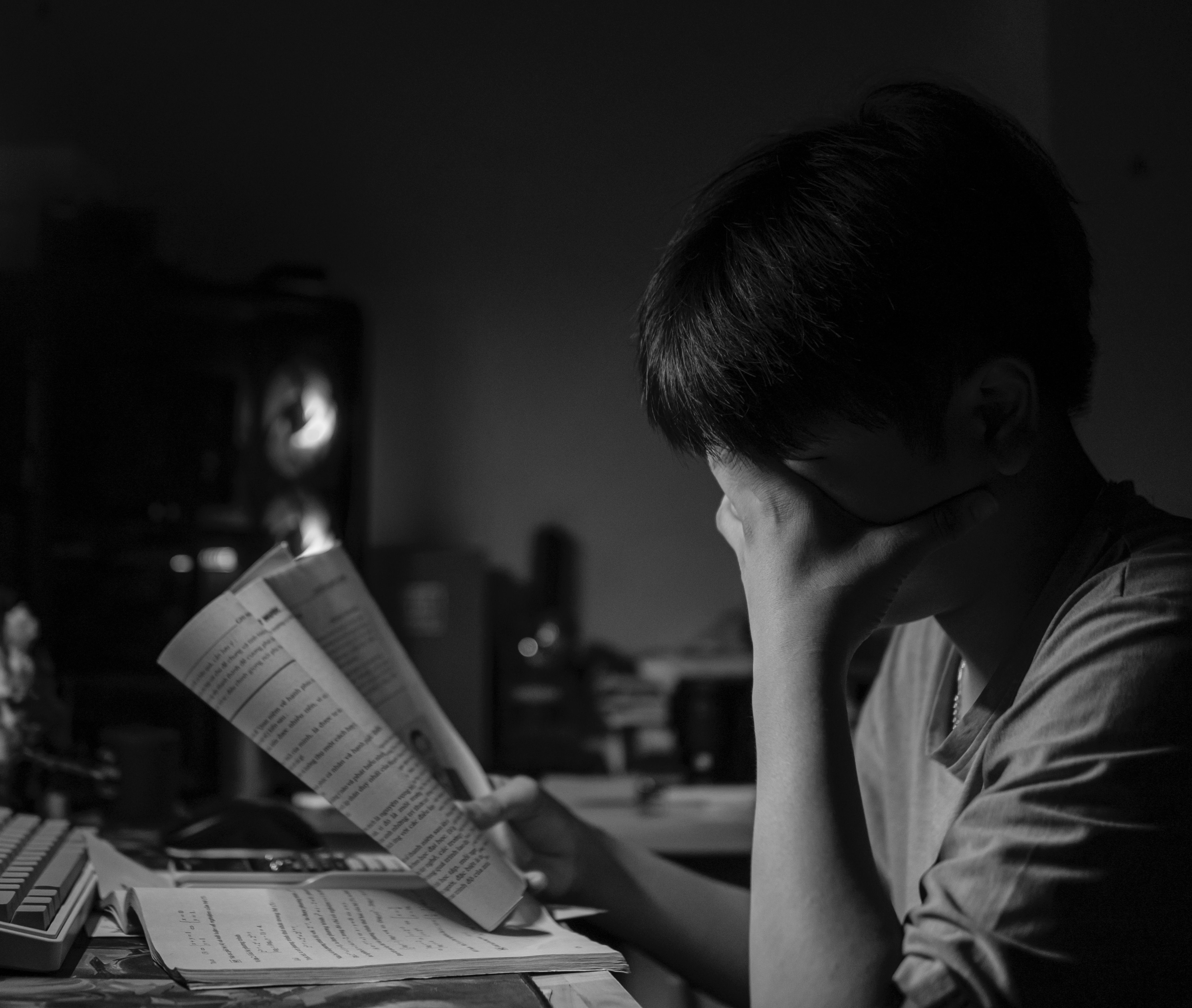
Everyone who has sat exams knows the specific cruelty of this one: you revised the topic, you could do it last night, and in the hall there is simply nothing there. Then you hand the paper in, walk down the corridor, and the answer strolls casually back into your head.
That last part is the important clue. The knowledge was in there the whole time. Blanking is not a storage problem — it is a retrieval problem, and retrieval is a skill you can train.
What blanking actually is
Two things happen at once when you blank. First, anxiety is expensive: the "what if I fail this" loop runs in working memory — the same limited mental workspace you need for holding a question's details and assembling an answer. A worried brain is quite literally running your exam on fewer resources.
Second, stress degrades retrieval selectively. Strong, well-practised memories survive it; weak ones — things you have only ever recognised rather than produced — fail first. Which is why the fix is only partly about calming down. It is mostly about how you revised in the first place.
The revision cause
If your revision was mostly re-reading and highlighting, you built recognition: the ability to know something when the page shows it to you. Recognition depends on cues — the page, the layout, the diagram next to it. The exam hall removes every one of those cues and asks you to produce the knowledge from nothing. Under pressure, recognition-only memories are exactly the ones that vanish.
Memories built through active recall — closed book, from a blank page, repeatedly — are different. Each successful retrieval builds a route to the memory that does not depend on the notes being in front of you. Practising retrieval is not just better learning; it is a rehearsal of the precise act the exam will demand under pressure.
A memory you have only ever recognised on a page is not yet a memory you can use in an exam hall.
Pressure-proof your knowledge before the day
The goal is to make exam conditions feel unremarkable, because your first timed paper should not be the real one:
- Do past papers timed, in one sitting, with no notes in the room. Uncomfortable is the point — every rep makes the real thing more familiar.
- Practise starting cold. Sit down and attempt a question with no warm-up browsing of notes first, because that is how the exam starts.
- Occasionally work somewhere unfamiliar — a library, a different room. Knowledge that only shows up at your own desk is too fragile.
In the exam: the four-step unblock
When it happens anyway — and it happens to strong students too — do not sit there staring at the void. Staring rehearses the panic. Work the protocol:
- Write what you do know. Anything genuinely related: the formula that might be relevant, a definition, a diagram, the values from the question. Retrieval is associative — each thing you produce is a hook that can pull the missing piece out.
- If nothing bites in a minute, flag the question and move on. This is not giving up; it is using incubation. The answer very often surfaces of its own accord while you are mid-way through a different question, which is the corridor effect working for you instead of after the exam.
- Reset physically before returning. Pen down, one slow breath out, shoulders down, then re-read the question word by word. Under stress people answer the question they expected rather than the one printed.
- Use the paper as a cue sheet. The formula booklet, the structure of the question, and earlier parts of it are legitimate prompts — part (a) usually feeds part (b), and examiners design it that way.
Triage the whole paper
Blanking spreads through confidence, so do not let one question poison the rest. First pass: answer everything you are sure of, flagging anything that stalls. Second pass: return to the flags with the confidence of a half-finished paper behind you. A blank on question 3 costs you question 3. Sitting in it for ten minutes costs you questions 8, 9 and 10.
After the exam
Skip the corridor post-mortem. Comparing answers changes nothing about the paper you just sat and reliably raises anxiety for the next one — which, as we have covered, is not a mood problem but a working-memory problem. Go eat something. The next paper starts now.
Kepler Revise is built around retrieval — quizzes and questions that make you produce answers, not recognise them. Try it free.
Frequently asked questions
Why do I remember the answer as soon as I leave the exam?
Because the knowledge was stored but not retrievable under pressure. Exam stress occupies working memory and suppresses weakly-practised retrieval routes, and once the pressure lifts, access returns — the corridor effect. It is evidence the problem is retrieval, not memory, and retrieval strength is built by practising recall under exam-like conditions.
How do I stop panicking mid-exam when my mind goes blank?
Stop staring at the gap and act: write down anything related to the question (formulas, definitions, given values) to give your memory hooks; if nothing surfaces within a minute, flag it and move to a question you can do — the answer often returns on its own while you work elsewhere. Then come back, take one slow breath, and re-read the question word by word.
Does exam anxiety mean I will underperform?
Not by itself. Some nerves are normal and even useful. Anxiety costs marks mainly when it occupies working memory or when knowledge was only ever revised passively, so it collapses under pressure. Training with timed, closed-book past papers builds memories that survive stress and makes exam conditions familiar enough that the anxiety itself shrinks.