Modelling with Statics
Statics begins with a choice of body and a force diagram. A good model explains which forces act, what the simplifying assumptions allow and which equilibrium equations are needed. Work through an unequal-angle suspension and a rough incline, then check the physical meaning of the answers instead of stopping at the algebra.
Before you start
- Resolve a force into horizontal and vertical components using sine and cosine.
- Distinguish mass in kilograms from weight in newtons, and know that static friction opposes a tendency to slip.
What you'll be able to do
- Isolate the body and draw only forces acting on it.
- Translate light strings, smooth contact and particle assumptions into a model.
- Solve two-direction equilibrium for unequal tensions.
- Check whether friction can supply the value required for equilibrium.
Choose the body before drawing forces
Decide whether the model is for a knot, a suspended load, an individual beam or the whole connected system. Include only forces acting on that selected body. If the system contains both a string and a load, their mutual forces are internal to the system; they are not an extra pair of external forces to add on top of the weight.
Weight acts vertically downwards. A taut string pulls along its own direction, away from the particle or object to which it is attached. A normal contact force acts perpendicular to a surface. Friction acts parallel to the contact and opposes the tendency to slip; its direction must be reasoned from the situation.
For a particle, the concurrent force model has no independent rotational condition. For a rigid body such as a beam, zero resultant force must be combined with zero resultant moment. State which model you are using rather than choosing equations by habit.
Turn assumptions into useful statements
A light string has negligible weight, so you do not include the weight of each string segment. An inextensible string does not stretch. A smooth contact has no friction. A light string passing over a smooth pulley supports the usual equal-tension idealisation along that single string; it does not make the tensions in two different strings equal.
A particle model neglects size and rotation. A rigid-body model retains geometry and turning effects. Treat these as purposeful approximations, then explain a limitation if the question asks how the real arrangement might differ. For example, an actual rough pulley can make the tensions on its two sides different.
Resolve an unequal-angle suspension
At the knot below, two strings pull upwards at different angles to the horizontal. A 120 N load pulls downwards. The steeper right-hand string does not generally have the same tension as the left-hand string. Horizontal components must cancel, while the two upward components together support the load.
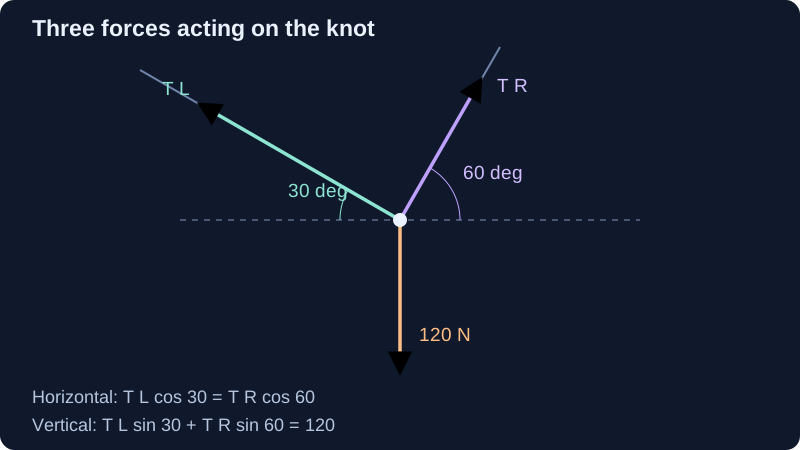
Example 1Find both tensions for the knot in the diagram.
Find required friction before testing the limit
For a body at rest on a rough plane, static friction adjusts up to a maximum magnitude . You may use , with equality only when the contact is in limiting equilibrium. Setting friction equal to in every stationary problem adds a condition that may be false.
Resolve along and perpendicular to the plane. First establish the tendency to move, then obtain the friction required for equilibrium. Compare that required value with the available limiting friction. If the required magnitude exceeds the limit, the proposed static model cannot hold.
Example 1A particle rests on a rough incline. A force of acts up the plane. Take and . Is equilibrium possible?
Example 2For the same 5 kg particle and 30 N applied force, find the smallest coefficient of friction that could maintain equilibrium.
Finish with checks and a limitation
Check units, directions and the assumptions that made each equation valid. If a calculated tension is negative, the assumed taut-string direction is inconsistent with that model: a string cannot push. Recheck the diagram and consider whether the string would become slack.
For a beam, check both force and moment balance. For a rough contact, check the friction inequality. A force diagram and a correct set of equations are valuable even if the numerical answer looks plausible; they make missing forces and unjustified assumptions visible.
When evaluating a model, connect the limitation to the result. Saying a pulley is not perfectly smooth is useful if you then explain why equal tensions may no longer follow. Saying a particle has a finite size matters when rotation or contact geometry affects the prediction.
Formula recap
Common mistakes to avoid
Key takeaways
- Name the body or system before listing its external forces.
- Translate modelling assumptions into physical statements, not just labels.
- Resolve in two independent directions and check the result.
- Test the friction limit and use moments as well as forces for rigid bodies.
Explore further
- Pearson Edexcel A-Level Mathematics (9MA0) (opens in a new tab)
Use the current official specification and assessment materials to check course scope.
- OpenStax: conditions for static equilibrium (opens in a new tab)
Further force-diagram and equilibrium reasoning. Use the assumptions and notation required by your own course.
Test yourself
Answer a few questions, then review anything you missed.
Prefer paper? Open the written self-check
Answer each question before opening its answer. This self-check does not record a quiz score.
A string pulls a knot at 40 degrees above the horizontal. Which component contributes vertically?
- T
Show answer and explanation
Answer:
The vertical component is opposite the angle measured from the horizontal. A diagram is safer than memorising which function is always vertical.
A stationary body requires 4 N of friction, while mu R is 7 N. What is the friction magnitude?
- 4 N
- 7 N
- 11 N
- 0 N
Show answer and explanation
Answer: 4 N
Static friction adjusts to the 4 N needed for balance. The 7 N value is the maximum available, so the body need not be at the limit.
Two different strings support a knot at unequal angles. May their tensions be assumed equal?
- No: resolve the forces to determine them
- Yes: both strings are light
- Yes: the knot is stationary
- Yes: all tensions are equal
Show answer and explanation
Answer: No: resolve the forces to determine them
Light strings have negligible weight, but that does not impose equal tension in different strings. Horizontal and vertical balance determine the relationship.
A string calculation gives a negative tension for an assumed taut string. What should you do?
- Recheck the model and whether the string is slack
- Treat the string as pushing
- Discard the negative sign automatically
- Replace tension by weight
Show answer and explanation
Answer: Recheck the model and whether the string is slack
A string can pull but cannot push. A negative result can signal an inconsistent assumed arrangement or a mistake in the force equations.
For a rigid beam in static equilibrium, which conditions are required?
- Zero resultant force and zero resultant moment
- Zero resultant force only
- Zero resultant moment only
- Equal masses on each side
Show answer and explanation
Answer: Zero resultant force and zero resultant moment
A beam can have no net force yet still have a turning effect. Both translational and rotational balance must be satisfied.
A required friction magnitude is 12 N but the maximum available is 9 N. What follows?
- The proposed static equilibrium is impossible
- The actual friction becomes 12 N
- The coefficient automatically increases
- The reaction must vanish
Show answer and explanation
Answer: The proposed static equilibrium is impossible
The contact cannot supply the friction needed for balance under the stated model. You must reconsider equilibrium and, if asked, model the subsequent motion.
Keep practising
Start with the quiz above to check the key ideas. You can also choose another topic from the practice library.
Related lessons
All 6 lessons- Same chapterStatic ParticlesEquilibrium of a particle by resolving forces.
- Same chapterFriction and Static ParticlesLimiting equilibrium with friction on slopes.
- Same chapterStatic Rigid BodiesLadders and beams using forces and moments.
Put the methods into practice: see how A-Level maths duels work. An account is required to play; the overview and sample are public.