Resultant Moments
A resultant moment describes the combined turning effect about one chosen point. This lesson builds from signed moments to forces acting on a beam, an oblique force and an unknown load. Keep the pivot, perpendicular distances and positive direction explicit: a zero resultant moment alone does not prove that the body is in equilibrium.
Before you start
- Calculate the moment of a force using force multiplied by perpendicular distance.
- Resolve a force into components and distinguish a force in newtons from a moment in newton metres.
What you'll be able to do
- Choose and keep a consistent positive direction for rotation.
- Calculate a signed moment from the position and direction of a force.
- Combine several moments and solve for an unknown force.
- Distinguish rotational balance from complete static equilibrium.
Start with the pivot and a sign convention
Choose the point about which you are taking moments before doing any arithmetic. A moment depends on both the force and the position of its line of action relative to that point. Imagine the direction in which each force would turn the beam if it acted alone; that direction determines the sign.
Anticlockwise positive is convenient, but clockwise positive is equally valid if used consistently. Add the signed values. A negative total means the combined turning effect acts opposite to your chosen positive direction. It does not mean that a force has a negative magnitude.
Tip — Do not decide clockwise or anticlockwise from whether an arrow points up or down. Its position relative to the pivot matters too.
Build the moments from a force diagram
The horizontal beam below has a pivot at O. Distances are measured along the beam because each applied force is vertical, so those distances are perpendicular to the forces. The downward force on the left and the upward force on the right both tend to turn the beam anticlockwise.
A pivot reaction acts through O, so its perpendicular distance from O is zero. It contributes no moment about O, even though it can be essential when balancing the vertical forces. Ignore the beam weight only when the model says the beam is light.
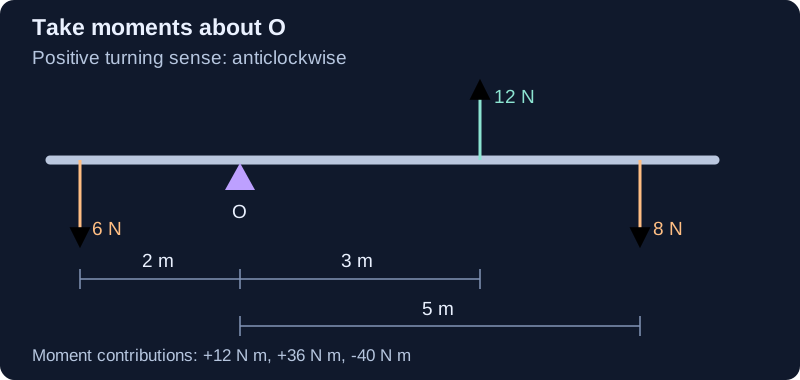
Example 1Find the resultant moment about O for the three forces in the diagram.
Use a perpendicular distance for an oblique force
When a force makes an angle with the beam, the distance along the beam is not generally the moment arm. You can either find the perpendicular distance to the line of action or multiply the position length by the perpendicular component of the force. These are two descriptions of the same calculation.
For a force applied at distance r along a horizontal beam and directed at angle theta to that beam, the perpendicular force component has magnitude F sin(theta). The parallel component acts along a line through the pivot and contributes no moment about it.
Example 1A force acts to the right of O, directed above the horizontal. Find its moment.
Solve for an unknown and check what has balanced
Set the signed sum to zero when the question requires rotational balance. Write each term as a force multiplied by its own perpendicular distance; do not add forces first when they act at different positions. After solving, check the direction and whether the value is physically possible.
Complete static equilibrium of a rigid body also requires zero resultant force. Taking moments about a support can eliminate its unknown reaction from one equation, but that reaction must still be found from force balance.
Example 1Replace the 8 N downward force in the diagram by a downward force F at the same position. Find F for rotational balance, then the upward pivot reaction required for complete equilibrium.
Formula recap
Common mistakes to avoid
Key takeaways
- Draw the pivot, forces and perpendicular distances before adding signed moments.
- Choose one positive turning sense and retain it throughout.
- An oblique force needs a perpendicular component or a perpendicular moment arm.
- Use both force and moment balance when the whole rigid body must be in equilibrium.
Explore further
- Pearson Edexcel A-Level Mathematics (9MA0) (opens in a new tab)
Use the current official specification and assessment materials to check course scope.
- OpenStax: the second condition for equilibrium (opens in a new tab)
Compare torque and force balance. This reference uses torque terminology; match its notation to the moments used here.
Test yourself
Answer a few questions, then review anything you missed.
Prefer paper? Open the written self-check
Answer each question before opening its answer. This self-check does not record a quiz score.
A 7 N downward force acts 2 m to the left of O. With anticlockwise positive, what is its moment?
- +14 N m
- -14 N m
- +3.5 N m
- 0 N m
Show answer and explanation
Answer: +14 N m
The force turns the left side downward, which is anticlockwise about O. Its moment magnitude is 7 times 2 = 14 N m.
About O, two forces produce +18 N m and -25 N m. State the resultant moment.
- 7 N m clockwise
- 7 N m anticlockwise
- 43 N m clockwise
- 43 N m anticlockwise
Show answer and explanation
Answer: 7 N m clockwise
The signed sum is 18 - 25 = -7 N m. With anticlockwise positive, the negative sign means clockwise.
A force acts from O at to the beam. What is the moment magnitude?
- 4 N m
- 8 N m
- 16 N m
- 0.4 N m
Show answer and explanation
Answer: 4 N m
Use . The full distance along the beam is not the perpendicular moment arm.
A force line passes directly through O. What is its moment about O?
- 0 N m
- Equal to the force
- Always clockwise
- It cannot be determined
Show answer and explanation
Answer: 0 N m
The perpendicular distance from O to that line is zero. The force can still contribute to the resultant force.
A beam has zero resultant moment but a nonzero resultant force. Is it in static equilibrium?
- No: force balance is also required
- Yes: moments are sufficient
- Only if clockwise is positive
- Only if the beam is light
Show answer and explanation
Answer: No: force balance is also required
Zero resultant moment supplies rotational balance about the chosen point. Static equilibrium also requires zero net force, so the given condition is insufficient.
A +30 N m moment is balanced by a downward force 6 m right of O. Find the force magnitude.
- 5 N
- 180 N
- 0.2 N
- 36 N
Show answer and explanation
Answer: 5 N
The downward force on the right produces a clockwise moment: 30 - 6F = 0. Therefore F = 5 N; a separate force equation may still be needed for the support reaction.
Keep practising
Start with the quiz above to check the key ideas. You can also choose another topic from the practice library.
Related lessons
All 5 lessons- Same chapterMomentsThe turning effect of a force: F × perpendicular distance.
- Same chapterEquilibriumΣF = 0 and ΣM = 0 for rigid bodies.
- Same chapterCentres of MassLocating the centre of mass of a non-uniform rod.
- Data CollectionPopulations and SamplesUnderstanding the difference between populations and samples.
Put the methods into practice: see how A-Level maths duels work. An account is required to play; the overview and sample are public.