Loading...
3.3.4.1Exchange and TransportCore
Haemoglobin and Oxygen Dissociation
Haemoglobin loads oxygen where oxygen partial pressure is high and releases it where tissues need it. Interpret a curve by comparing saturation at the same partial pressure.
What you'll be able to do
- Explain cooperative oxygen binding
- Use dissociation curves to compare loading and unloading
- Explain the Bohr effect and haemoglobin adaptations
1
Connect red-cell structure with oxygen transport
Haemoglobin is a globular protein with quaternary structure. Its subunits contain haem groups with iron ions involved in reversible oxygen binding. Red blood cells provide a high concentration of haemoglobin; their biconcave shape gives a large surface relative to volume and a short diffusion path.
Reversible binding allows loading at high oxygen partial pressure and unloading at lower partial pressure. Oxygenated haemoglobin is not permanently bonded to oxygen as an irreversible end product. The first oxygen bindings alter haemoglobin’s conformation in ways that facilitate further binding, producing cooperative behaviour and a sigmoid dissociation curve.
2
Read the sigmoid curve carefully
The steep region allows a relatively small fall in tissue oxygen partial pressure to produce a substantial fall in saturation and release of oxygen. At higher pressures the plateau helps maintain substantial loading even if lung oxygen pressure varies moderately.
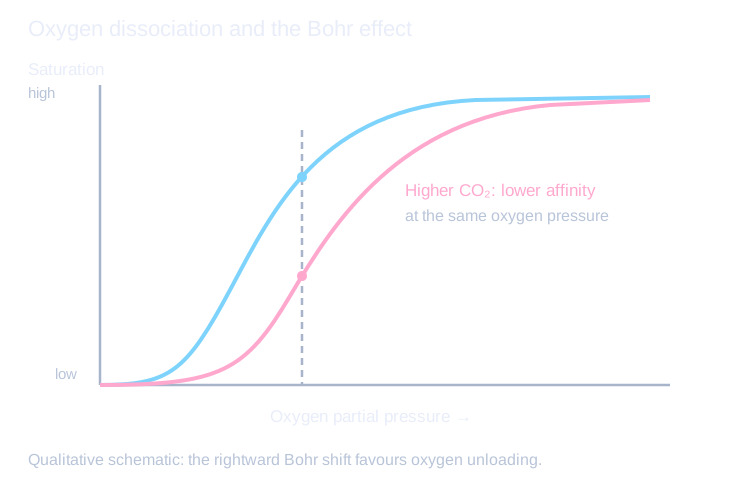
To compare affinity, choose the same oxygen partial pressure on both curves. A higher saturation at that pressure indicates greater affinity under the stated conditions. A left-shifted curve generally indicates higher affinity; it can help loading in low-oxygen conditions but may make unloading less easy. Do not compare unrelated points at different pressures and call the difference affinity.
3
Explain carbon dioxide and environmental adaptation
Higher carbon dioxide concentration can reduce haemoglobin’s oxygen affinity, shifting the curve to the right: the Bohr effect. Metabolically active tissues produce more carbon dioxide and use oxygen, so this shift promotes oxygen unloading where demand is high. Link the changed environment to the changed binding behaviour.
Different organisms can possess haemoglobins with different affinities suited to their environments and demands. An adaptation should be evaluated through both loading and unloading. “More affinity is always better” ignores the requirement to deliver oxygen to tissues after it has been loaded.
4
Apply the biology
Try each question before opening the worked response. Use precise biological terms, connect each cause to its effect, and check units and assumptions when interpreting data.
Example 1Blood is 97% saturated leaving lungs and 67% saturated after a tissue bed. What fraction of its full haemoglobin oxygen capacity was unloaded?
1Subtract the two saturations: 97−67=30 percentage points.
2This is 30% of full oxygen-binding capacity, not a 30% relative decrease from the initial 97%.
Answer30% of full capacity; the relative decrease from the loaded amount is about 31%.
Example 2Two haemoglobins are 80% and 55% saturated at the same oxygen partial pressure. Which has higher affinity under those conditions?
1Compare saturation at the same pressure.
2The 80%-saturated haemoglobin retains more oxygen and has the higher affinity.
3This alone does not establish which delivers more oxygen in every environment.
AnswerThe first has higher affinity at the stated conditions.
Common mistakes to avoid
Calling a 30-point saturation fall a 30% relative fall without checking.
Distinguish percentage points from percentage change.
Assuming all higher-affinity haemoglobins are better in every context.
Evaluate loading and delivery together.
Key takeaways
- Cooperativity produces a useful sigmoid response.
- Curve shifts change affinity and oxygen delivery.
- Carbon dioxide helps match unloading to tissue metabolism.
Test yourself
Answer a few questions, then review anything you missed.
Next step
Browse practice topicsKeep practising
Start with the quiz above to check the key ideas. You can also choose another topic from the practice library.