Loading...
3.1.1, 3.1.2Biological MoleculesCore
Monomers, Bonds and Carbohydrates
The same small molecules build many different biological structures. Explain a carbohydrate by connecting its monomers and bonds to its shape, solubility and role.
What you'll be able to do
- Distinguish condensation from hydrolysis
- Compare starch, glycogen and cellulose
- Interpret reducing-sugar and starch tests
1
Build and break biological molecules
A monomer is a small molecular unit that can join with others to form a polymer. A condensation reaction forms a covalent bond while releasing a water molecule; hydrolysis uses water to break a bond. These describe chemical reactions, not simply molecules moving closer together or dissolving.
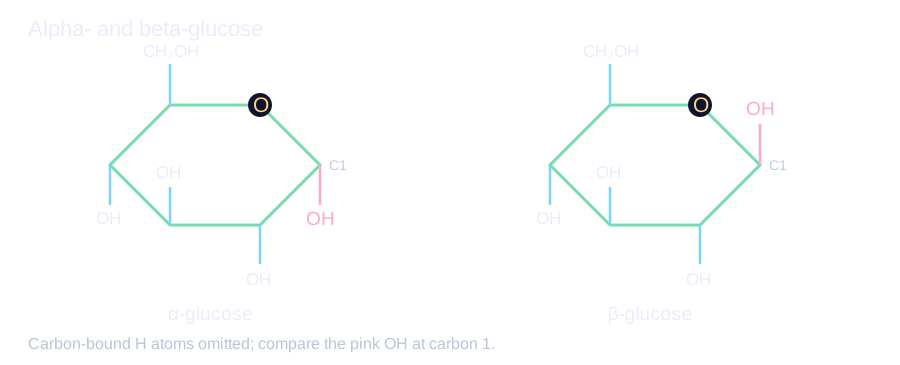
Glucose, galactose and fructose are monosaccharides. Maltose contains two glucose units, sucrose contains glucose and fructose, and lactose contains glucose and galactose. A glycosidic bond links monosaccharide residues. Alpha- and beta-glucose differ in the orientation of the hydroxyl group on carbon 1; the different bonding patterns produce very different polymers.
2
Connect polymer structure to function
Starch contains amylose, a largely unbranched alpha-glucose polymer that coils, and branched amylopectin. Glycogen is more highly branched and provides many accessible ends for rapid enzyme-controlled release of glucose in animals. These storage molecules are relatively compact and insoluble, so do not diffuse out readily or strongly lower cell water potential as the equivalent number of separate glucose molecules would.
Cellulose consists of beta-glucose chains with alternating units inverted. Straight parallel chains form many hydrogen bonds between chains, producing strong microfibrils in plant cell walls. Glycosidic bonds hold each chain together; hydrogen bonds between chains provide additional collective strength. Do not describe cellulose as a store of alpha-glucose.
3
Use chemical tests as evidence
Heat a sample with Benedict’s reagent in a suitable hot-water bath. A reducing sugar can change the blue mixture through green, yellow or orange to a brick-red precipitate, depending on concentration and the controlled method. A colour comparison is only semi-quantitative unless supported by calibration and consistent treatment.
To test for a non-reducing sugar after an initial negative result, hydrolyse a fresh portion with dilute acid, cool and neutralise before repeating Benedict’s test. Hydrolysis can release reducing monosaccharides. Iodine in potassium iodide changes from orange-brown to blue-black with starch. Use positive and negative controls and follow the laboratory reagent and heating procedures.
4
Apply the biology
Try each question before opening the worked response. Use precise biological terms, connect each cause to its effect, and check units and assumptions when interpreting data.
Example 1A straight carbohydrate chain contains 200 glucose units. How many condensation bonds join it, and how many water molecules are released?
1Joining the first two units forms one bond. Each of the next 198 units adds one further bond.
2A linear chain of n units has n−1 joining bonds, so there are 199. Each condensation releases one water molecule.
Answer199 glycosidic bonds and 199 water molecules for this unbranched chain.
Example 2Explain why storing glucose as glycogen limits its osmotic effect.
1Many small soluble glucose molecules would contribute many independently dissolved particles.
2Joining them into a large, relatively insoluble polymer reduces the number of dissolved particles.
3The water-potential decrease is therefore much smaller than for the equivalent glucose stored as separate molecules.
AnswerLink polymerisation and low solubility to fewer dissolved particles, rather than claiming glycogen prevents every movement of water.
Common mistakes to avoid
Calling the bonds within a cellulose chain hydrogen bonds.
The chain uses glycosidic bonds; hydrogen bonds link neighbouring chains.
Treating every Benedict’s colour as an exact concentration.
Use controlled conditions and a suitable calibration for quantitative claims.
Key takeaways
- Condensation and hydrolysis have opposite roles in bond formation and breakage.
- Carbohydrate structure explains storage and structural functions.
- Biochemical tests need controls and careful interpretation.
Test yourself
Answer a few questions, then review anything you missed.
Next step
Browse practice topicsKeep practising
Start with the quiz above to check the key ideas. You can also choose another topic from the practice library.