Loading...
3.6.2.1Responses and HomeostasisCore
Nerve Impulses and Conduction
An action potential is regenerated as a wave of membrane change. Explain ion permeability, gradients and refractory behaviour instead of picturing a packet of electricity travelling unchanged down a tube.
What you'll be able to do
- Explain resting potential and action-potential stages
- Distinguish myelinated and non-myelinated conduction
- Predict effects of refractory period, diameter and temperature
1
Maintain a resting membrane potential
A neurone has unequal ion distributions across its membrane and selective permeability. Sodium–potassium pumps help maintain gradients by moving sodium out and potassium in using ATP. Potassium tends to diffuse out through leak pathways, leaving the inside relatively negative. Selective permeability and opposing electrical forces contribute to a stable resting potential.
The pump maintains conditions for signalling, but a rapid action potential is not simply the pump suddenly running backwards. A motor neurone has a cell body, dendritic input regions and an axon ending in terminals; myelin can insulate sections of the axon, leaving nodes of Ranvier.
2
Change permeability and regenerate a spike
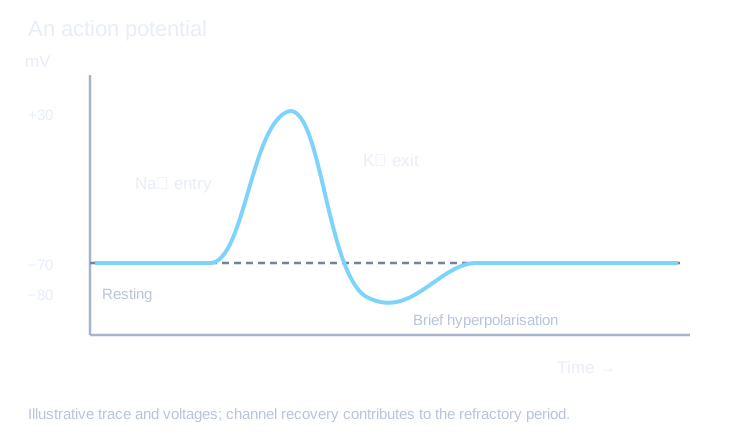
If depolarisation reaches threshold, voltage-gated sodium channels open and sodium enters down its electrochemical gradient, causing rapid depolarisation. Sodium-channel inactivation and increased potassium permeability then contribute to repolarisation as potassium leaves. Continued potassium movement can briefly produce hyperpolarisation.
Action potentials are all-or-nothing once threshold is reached. Local currents depolarise the next suitable region to threshold, regenerating the signal. Channel states during the refractory period limit immediate re-excitation, helping produce separate impulses and limiting maximum firing frequency.
3
Explain speed and frequency separately
In a non-myelinated axon, successive nearby membrane regions regenerate action potentials. In a myelinated axon, current spreads beneath insulated regions and action potentials are regenerated mainly at nodes: saltatory conduction. Ions do not literally leap through empty space from one node to another.
Greater axon diameter can reduce internal resistance and increase conduction speed. Temperature affects channel and enzyme kinetics within a viable range, while extreme conditions can impair function. Conduction speed in m s⁻¹ is different from impulse frequency in s⁻¹; a shorter refractory period can raise a theoretical frequency limit without itself specifying the speed along an axon.
4
Apply the biology
Try each question before opening the worked response. Use precise biological terms, connect each cause to its effect, and check units and assumptions when interpreting data.
Example 1A neurone has an absolute refractory period of 2.0 ms. Estimate the simplified upper frequency bound based on this period alone.
1Convert 2.0 ms to 0.0020 s.
2 s⁻¹.
Answer500 Hz as a simplified upper bound, not a guarantee of sustained firing at that rate.
Example 2A signal travels 0.90 m in 0.015 s. Calculate conduction speed and distinguish it from firing frequency.
1Speed =distance/time =0.90/0.015=60 m s⁻¹.
2Frequency would require the interval between successive impulses, not the travel time of one impulse.
Answer60 m s⁻¹; the data alone do not give impulse frequency.
Common mistakes to avoid
Saying action-potential amplitude gradually fades along a healthy axon.
Regeneration maintains the all-or-nothing signal.
Using m s⁻¹ as the unit of firing frequency.
Distinguish propagation speed from impulses per second.
Key takeaways
- Selective permeability and maintained gradients support membrane potentials.
- Voltage-gated channel changes generate action potentials.
- Myelin, diameter and refractory properties affect different aspects of signalling.
Test yourself
Answer a few questions, then review anything you missed.
Next step
Browse practice topicsKeep practising
Start with the quiz above to check the key ideas. You can also choose another topic from the practice library.
Related lessons
All 4 lessons- Same chapterMyogenic Rhythm and Control of Heart RateTrace SAN, AVN and ventricular conduction
- Same chapterSynapses and Neuromuscular JunctionsTrace cholinergic synaptic transmission
- Same chapterSkeletal Muscle and Sliding FilamentsExplain sarcomere changes during contraction
- Cell Division and MembranesThe Cell Cycle, Mitosis and Binary FissionRecognise stages of mitosis