Loading...
RP7; 3.5.1Practical, Data and Essay SkillsCore
Required Practical 7: Leaf-Pigment Chromatography
Chromatography separates components through their different interactions with a moving solvent and stationary material. Compare pigment evidence under the same conditions.
What you'll be able to do
- Explain pigment separation
- Calculate and interpret Rf values
- Evaluate comparisons between leaf types
1
Prepare a controlled comparison
Use the centre’s approved leaf-extraction and chromatography procedure, with the specified solvent and handling arrangements. Compare suitable leaves and apply comparable extracts to a marked origin, allowing appropriately concentrated small applications rather than a large spreading patch.
The origin must begin above the solvent level so the applied extract is not simply washed into the reservoir. Use a suitable pencil mark rather than soluble ink. Keep the same stationary material, solvent system and development conditions across samples; these affect separation and the resulting pattern.
2
Explain separation and calculate Rf
As solvent moves, pigment molecules partition differently between the stationary phase and moving phase. Differences in solubility and attraction lead components to travel different distances. A separated colour band is evidence of a component under those conditions, not automatically proof of its identity.
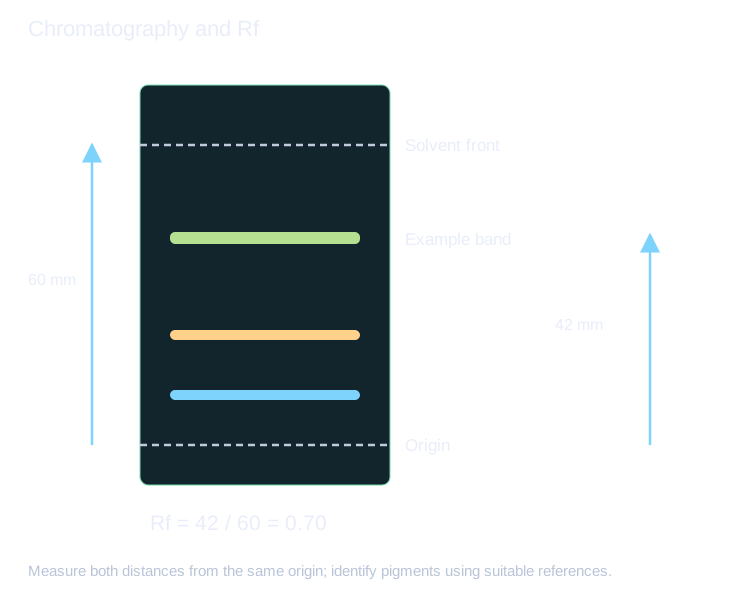
Mark the solvent front promptly and measure from the origin to the centre of the pigment band and from the origin to the solvent front. Rf is the first distance divided by the second, so it has no unit. A valid band cannot have travelled farther than the recorded solvent front in the same run.
3
Interpret leaf differences and method limits
Compare band position and colour with suitable known references under matching conditions. Similar Rf values alone do not prove that two compounds are identical. Diffuse or overlapping bands make centres and component counts uncertain, while different extract concentrations can alter band intensity.
Differences between shade-tolerant and other leaves may suggest different pigment complements or relative amounts, but chromatography alone does not directly measure photosynthetic rate. Control leaf source, extraction efficiency and loading before attributing a darker band only to greater biological pigment abundance. Use independent samples and record limitations.
4
Apply the biology
Try each question before opening the worked response. Use precise biological terms, connect each cause to its effect, and check units and assumptions when interpreting data.
Example 1A pigment travels 42 mm and the solvent front 60 mm from the origin. Find Rf.
1Rf=42/60=0.70.
2Both distances use the same origin and units.
Answer0.70, with no unit.
Example 2Two leaves produce bands with the same colour and similar Rf. Is identity proven?
1The pattern is consistent with a similar pigment under the run conditions.
2Different compounds can sometimes have similar migration.
3A reference and further evidence strengthen identification.
AnswerSimilarity supports but does not uniquely establish identity.
Equation recap
Relationship recap
Common mistakes to avoid
Measuring pigment and solvent distances from different baselines.
Use the same origin.
Calling an Rf match definitive chemical identification.
Use references and recognise method limits.
Key takeaways
- Controlled conditions make patterns comparable.
- Rf is a dimensionless migration ratio.
- Pigment patterns need cautious biological interpretation.
Test yourself
Answer a few questions, then review anything you missed.
Next step
Browse practice topicsKeep practising
Start with the quiz above to check the key ideas. You can also choose another topic from the practice library.
Related lessons
All 6 lessons- Same chapterRequired Practical 8: Chloroplast Dehydrogenase ActivityDesign a named-factor investigation
- Same chapterRequired Practical 9: Single-Celled Organism RespirationDesign a controlled culture comparison
- Same chapterRequired Practical 10: Animal MovementDesign a controlled animal-response investigation