Loading...
3.4.3Genetic Information and DiversityCore
Meiosis, Mutation and Genetic Variation
Meiosis reduces chromosome number and reshuffles inherited alleles. New alleles arise through mutation; the two processes contribute to diversity in different ways.
What you'll be able to do
- Track homologues and chromatids through two divisions
- Explain crossing over and independent segregation
- Calculate combinations and interpret non-disjunction
1
Track two nuclear divisions
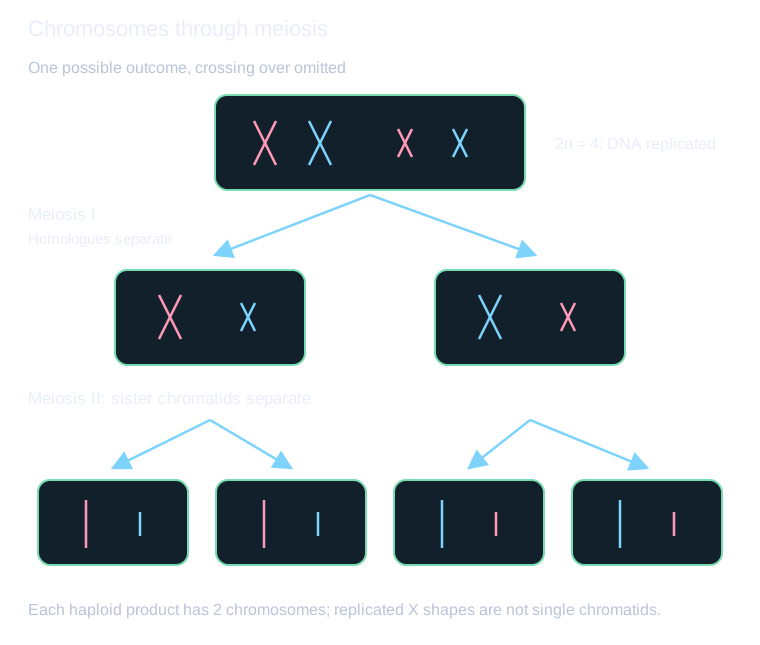
Before meiosis, DNA replicates so each chromosome has two sister chromatids. Homologous chromosomes carry the same gene loci but may have different alleles. In the first meiotic division, homologous chromosomes separate; in the second, sister chromatids separate. The usual outcome is four haploid products from one diploid cell.
Chromosome number is reduced when homologues separate, not because each DNA molecule is cut in half. A haploid cell has one chromosome from each homologous pair. Diagrams must distinguish a replicated chromosome from two separate homologous chromosomes.
2
Explain sources of new combinations
Crossing over exchanges corresponding DNA regions between non-sister chromatids of homologous chromosomes, creating new combinations of alleles along a chromosome. Independent orientation and segregation of homologous pairs create further combinations of maternal and paternal chromosomes.
Ignoring crossing over, a diploid organism with n homologous pairs can produce 2ⁿ combinations from independent segregation. Random fertilisation combines independently formed gametes and adds further variation. These processes reshuffle existing alleles; mutation is the source of new allele sequences. Not every meiotic product is guaranteed unique in every possible genotype.
3
Distinguish gene mutation from chromosome errors
A gene mutation changes DNA base sequence, for example by substitution or deletion. The effect may depend on the altered codon, reading frame and role of the gene. Mutations can arise spontaneously, and mutagenic agents can increase their frequency; mutation is not directed towards what an organism needs.
Non-disjunction is failure of homologues or sister chromatids to separate correctly during meiosis. It can produce gametes with an extra or missing chromosome and therefore zygotes with altered chromosome numbers after fertilisation. This is different from changing a single DNA base while leaving chromosome number unchanged.
4
Apply the biology
Try each question before opening the worked response. Use precise biological terms, connect each cause to its effect, and check units and assumptions when interpreting data.
Example 1An organism has three homologous chromosome pairs. Ignoring crossing over, find gamete chromosome combinations and possible combinations after random fertilisation between two such individuals.
1Each individual can produce chromosome combinations.
2Combining two independent gametes gives possible chromosome-origin combinations.
Answer8 and 64 under the stated model.
Example 2A species normally has 2n=8. An abnormal gamete has five chromosomes and fuses with a normal gamete. Find the zygote’s chromosome number.
1Normal haploid number is 4.
2The abnormal gamete contributes 5, giving 5+4=9.
Answer9 chromosomes, one above the normal diploid number.
Common mistakes to avoid
Calling crossing over exchange between identical sister chromatids as the main source of new allelic combinations.
Use non-sister chromatids of homologues.
Treating meiosis as making new alleles whenever chromosomes move.
Distinguish reshuffling from mutation.
Key takeaways
- Two divisions reduce ploidy and distribute chromosomes.
- Crossing over, segregation and fertilisation create combinations.
- Mutation and non-disjunction change different aspects of genetic information.
Test yourself
Answer a few questions, then review anything you missed.
Next step
Browse practice topicsKeep practising
Start with the quiz above to check the key ideas. You can also choose another topic from the practice library.