Loading...
H420 · 5.1.2Communication, homeostasis and energyCore
Kidneys, Nephrons and Osmoregulation
A nephron filters small components from blood and selectively reabsorbs useful material. Hormonal control changes the final water loss while preserving the distinction between filtration and reabsorption.
Before you start
- Recall the relevant cell structures and biological molecules before explaining the mechanism.
- Read graph axes, units and any assumptions supplied with data.
Watch, pause, try
Video by Cognito. Foundation recap: the written lesson develops the A-level detail.
Viewing focus: Explain ultrafiltration and proximal reabsorption
After watching, attempt these questions before opening the answers. You can also use the written lesson below.
After watching 1: Ultrafiltration is driven mainly by:
Show answer and reasoning
Glomerular hydrostatic pressure. The barrier and pressure determine initial filtrate formation.
After watching 2: Glucose is normally reabsorbed principally in the:
Show answer and reasoning
Proximal convoluted tubule. Selective epithelial transport returns it towards blood.
What you'll be able to do
- Explain ultrafiltration and proximal reabsorption
- Describe the medullary gradient and loop of Henle
- Trace ADH synthesis, release and collecting-duct action
1
Form filtrate and recover useful solutes
Blood enters the glomerulus, where hydrostatic pressure supports ultrafiltration into Bowman’s capsule. The filtration barrier normally retains blood cells and most large plasma proteins while allowing water and many small solutes into the filtrate. Filtration is pressure driven, not active pumping of every glucose molecule into the capsule.
In the proximal convoluted tubule, selective transport reabsorbs substances including glucose and ions. Sodium gradients and co-transport are important, linking reabsorption to ATP-dependent processes in the epithelium. Water follows suitable water-potential gradients. Reabsorption means return from tubule towards blood, the opposite direction from the initial filtration step.
2
Establish an osmotic gradient in the medulla
The descending limb of the loop of Henle is relatively permeable to water, while the ascending limb has low water permeability and transfers sodium and chloride out, including active transport in its thick region. Opposite flows and different permeabilities help maintain a concentrated medullary environment.
This gradient allows water to leave suitable later tubule regions by osmosis when their permeability permits it. The loop does not simply pump water up both limbs, and active salt transport should not be placed indiscriminately in every descending segment. The final urine concentration depends on both the medullary gradient and regulated permeability.
3
Control water permeability using ADH
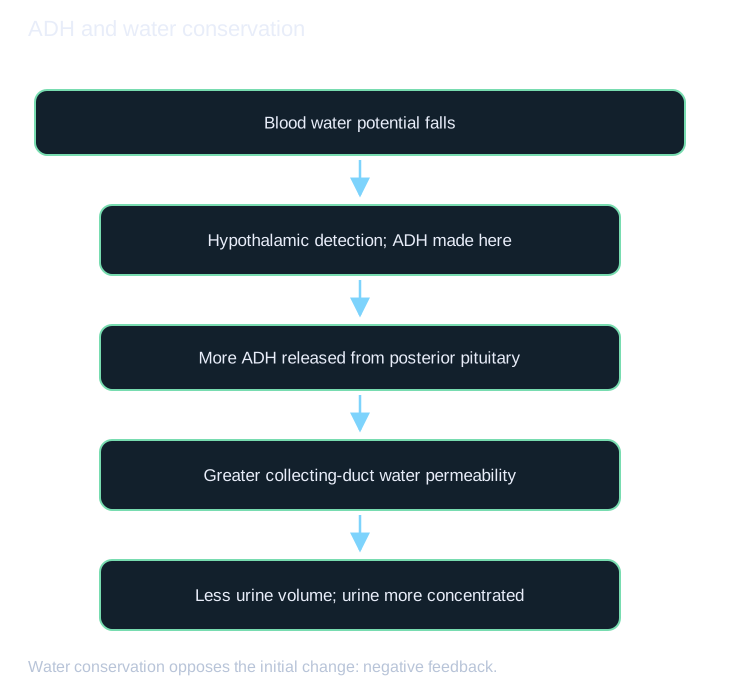
Osmoreceptors in the hypothalamus detect changes associated with blood water potential. ADH is synthesised in hypothalamic neurones and released from the posterior pituitary. When blood water potential falls, increased ADH release can increase water permeability of the distal tubule and collecting duct through changes involving aquaporin availability.
More water is reabsorbed into the surrounding tissue and blood, producing a smaller volume of more concentrated urine under the stated conditions. As water potential returns towards its regulated range, negative feedback reduces the stimulus for ADH release. ADH does not supply the water or create the medullary gradient single-handedly.
4
Apply the biology
Try each question before opening the worked response. Use precise biological terms, connect each cause to its effect, and check units and assumptions when interpreting data.
Example 1A person loses water without replacing it. Predict the direction of ADH response and the likely urine change in a functioning control system.
1Blood water potential tends to fall.
2ADH release increases, increasing water permeability in target nephron regions.
3More water is conserved, so urine volume falls and concentration rises.
AnswerExplain the complete feedback sequence.
Example 2Why can glucose occur in normal glomerular filtrate but normally be absent or very low in final urine?
1Glucose is small enough to enter the filtrate.
2It is normally selectively reabsorbed in the proximal tubule within transport capacity.
3Initial filtration and final excretion therefore have different compositions.
AnswerAbsence from final urine does not mean glucose never entered the nephron.
Common mistakes to avoid
Saying the posterior pituitary manufactures ADH.
Distinguish synthesis in the hypothalamus from release at the posterior pituitary.
Calling reabsorption movement from blood into filtrate.
Track tubule-to-blood return.
Key takeaways
- Pressure-driven filtration differs from selective reabsorption.
- Loop structure supports a medullary gradient.
- ADH regulates permeability to adjust water conservation.
Explore further
- OCR H420 official specification (opens in a new tab)
Check the assessed scope and practical or mathematical requirements.
- Read or explore this topic (opens in a new tab)
An external explanation or interactive activity to use alongside the lesson. It may include extension material.
Return to this tomorrow
Close the notes and answer from memory. Revisit any explanation you cannot yet reconstruct.
- ADH is synthesised in the:
- Increased ADH usually promotes:
Test yourself
Answer a few questions, then review anything you missed.
Next step
Browse practice topicsKeep practising
Start with the quiz above to check the key ideas. You can also choose another topic from the practice library.