Loading...
H420 · 2.1.2Foundations in biologyCore
Protein Structure and Function
A protein’s sequence helps determine its folding, and folding determines what it can bind or do. Explain effects of a sequence change through the relevant level of structure.
Before you start
- Recall the relevant cell structures and biological molecules before explaining the mechanism.
- Read graph axes, units and any assumptions supplied with data.
Watch, pause, try
Video by Cognito. The video’s own board label is retained; follow the specification reference and scope notes on this lesson for assessed content.
Viewing focus: Describe amino acids and peptide-bond formation
After watching, attempt these questions before opening the answers. You can also use the written lesson below.
After watching 1: Primary structure means:
Show answer and reasoning
The amino-acid sequence. It specifies the residue order.
After watching 2: Quaternary structure requires:
Show answer and reasoning
More than one polypeptide subunit. It concerns the arrangement of multiple chains.
What you'll be able to do
- Describe amino acids and peptide-bond formation
- Connect four levels of protein structure
- Explain denaturation and the biuret test
1
From amino acid to polypeptide
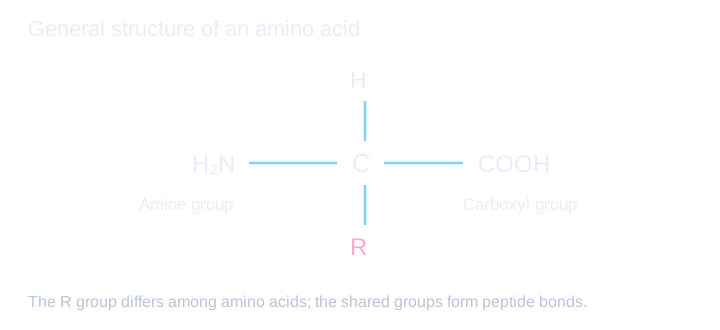
An amino acid has a central carbon bonded to an amine group, a carboxyl group, a hydrogen atom and a variable R group. The R group distinguishes the twenty common amino acids. Condensation between the amine and carboxyl groups of neighbouring amino acids forms a peptide bond and releases water.
A dipeptide contains two amino-acid residues. Many residues form a polypeptide; one functional protein may contain one chain or several. The primary structure is the sequence, not the folded outline seen in a diagram. Different R-group interactions mean that changing even one residue can sometimes alter folding or binding, although not every substitution has a large effect.
2
Relate the levels of structure
Secondary structure includes alpha helices and beta-pleated sheets stabilised by hydrogen bonds between parts of the polypeptide backbone. Tertiary structure is the overall three-dimensional folding of one polypeptide, maintained by interactions including hydrogen bonds, ionic interactions and disulfide bridges between suitable side chains.
Quaternary structure describes the association of multiple polypeptide subunits. Haemoglobin is an example of a multi-subunit protein; an enzyme with one polypeptide can have tertiary structure without quaternary structure. Fibrous proteins such as collagen and globular proteins have structures suited to different mechanical or metabolic roles. Name the feature and explain its contribution rather than writing “shape suits function”.
3
Distinguish folding changes from peptide hydrolysis
Heat or extreme pH can disrupt interactions maintaining protein conformation. This may change a binding site so a protein loses activity: denaturation. A typical denaturation explanation does not require peptide bonds to break or the primary sequence to change. Different proteins vary in stability, so avoid claiming every protein denatures at one temperature.
The biuret test detects peptide bonds: add the reagents providing alkaline copper(II) ions according to the laboratory method; a lilac or purple result supports protein/polypeptide being present. Free amino acids do not give the same positive response. Use controls and distinguish a positive chemical test from proof that a sample’s enzyme remains functional.
4
Apply the biology
Try each question before opening the worked response. Use precise biological terms, connect each cause to its effect, and check units and assumptions when interpreting data.
Example 1A polypeptide contains 80 amino-acid residues. How many peptide bonds does the unbranched chain contain?
1Each additional residue joins to the chain through one peptide bond.
2There are 80−1=79 joins.
Answer79 peptide bonds.
Example 2An enzyme loses activity after heating, but its amino-acid sequence is unchanged. Explain a mechanism.
1Heating disrupts interactions maintaining the tertiary structure.
2The active-site conformation changes, reducing complementary binding or catalysis.
3Peptide-bond hydrolysis is not needed to explain this result.
AnswerLink altered folding to loss of function while preserving primary structure.
Common mistakes to avoid
Saying secondary structure is formed by peptide-bond hydrolysis.
Hydrogen bonding stabilises local folded patterns.
Equating denaturation with destruction of the amino-acid sequence.
Explain the relevant changes to folding and binding.
Key takeaways
- Peptide bonds build the primary chain.
- Several interactions stabilise higher levels of structure.
- Protein activity depends on specific structural features.
Explore further
- OCR H420 official specification (opens in a new tab)
Check the assessed scope and practical or mathematical requirements.
- Read or explore this topic (opens in a new tab)
An external explanation or interactive activity to use alongside the lesson. It may include extension material.
Return to this tomorrow
Close the notes and answer from memory. Revisit any explanation you cannot yet reconstruct.
- Typical heat denaturation initially disrupts:
- The biuret test detects:
Test yourself
Answer a few questions, then review anything you missed.
Next step
Browse practice topicsKeep practising
Start with the quiz above to check the key ideas. You can also choose another topic from the practice library.