Loading...
H420 · 6.1.3Genetics, evolution and ecosystemsCore
Genetic Fingerprinting and Electrophoresis
Variable DNA regions provide patterns that can help compare individuals and relationships. Read fragment positions carefully and distinguish exclusion from a claim of absolute identity.
Before you start
- Recall the relevant cell structures and biological molecules before explaining the mechanism.
- Read graph axes, units and any assumptions supplied with data.
Watch, pause, try
Video by Cognito. Foundation recap: the written lesson develops the A-level detail.
Viewing focus: Explain tandem-repeat variation and DNA profiles
After watching, attempt these questions before opening the answers. You can also use the written lesson below.
After watching 1: DNA moves towards the positive electrode because it is:
Show answer and reasoning
Negatively charged. Its phosphate-containing backbone contributes negative charge.
After watching 2: In a comparable gel, smaller fragments generally:
Show answer and reasoning
Travel farther. The gel separates fragments partly by size.
What you'll be able to do
- Explain tandem-repeat variation and DNA profiles
- Interpret electrophoresis and PCR-amplified fragments
- Evaluate relationship and identification evidence
1
Use variable regions to make informative comparisons
Some genome regions contain variable numbers of tandem repeats, VNTRs. Different repeat counts can produce fragments of different lengths. Comparing several informative loci gives a much more discriminating profile than comparing one short region alone.
A typical diploid individual can have two alleles at a locus, inherited from the two parents. The profile concerns selected regions rather than every base in the genome. Identical twins and close relatives illustrate why relatedness and marker choice matter when interpreting a match.
2
Separate DNA fragments by size
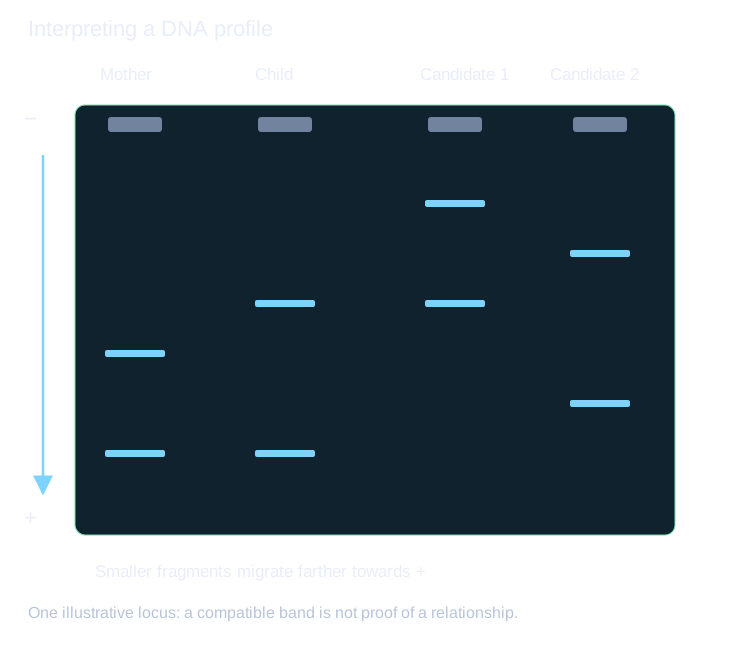
PCR can amplify the selected regions before analysis. In gel electrophoresis, DNA’s negative charge causes movement towards the positive electrode under an electric field. For comparable fragments under the same conditions, smaller fragments generally travel farther through the gel.
A size ladder and consistent run conditions allow fragment lengths to be estimated. A band position corresponds to migration, not directly to the amount of a person’s total genome. Detection depends on the method used; the absence of a clear band could reflect sample quality or assay failure rather than a genuine absence of every allele.
3
Interpret relationship and identification evidence
In a simple inheritance comparison, each child allele should be explainable by inheritance from one parent at a locus, subject to mutation and assay limitations. An incompatible pattern can provide exclusion evidence. A compatible profile supports a relationship but does not prove it with absolute certainty using only a small panel.
Forensic, breeding, conservation and medical contexts may use DNA patterns for different aims. Consider sample contamination, mixed samples, marker independence, relatives and the size of the comparison population. A small random-match probability is not identical to the probability that a particular accusation or biological explanation is true; contextual evidence still matters.
4
Apply the biology
Try each question before opening the worked response. Use precise biological terms, connect each cause to its effect, and check units and assumptions when interpreting data.
Example 1A child has marker alleles 120 and 150, and the mother 120 and 140. Which child allele needs a paternal source in the simple model?
1The maternal 120 allele can explain one child allele.
2The child’s 150 allele must be explained by the father under the stated inheritance model.
Answer150; evaluate several loci rather than one alone.
Example 2Two DNA fragments of 150 and 500 base pairs are run in the same suitable gel. Which normally travels farther?
1Both carry negative charge and move towards the positive electrode.
2The smaller 150-base-pair fragment passes more readily through the gel matrix.
AnswerThe 150-base-pair fragment usually migrates farther under comparable conditions.
Common mistakes to avoid
Reversing the electrode direction of DNA migration.
Negative DNA moves towards the positive electrode.
Calling a limited profile a full-genome comparison or an absolute identity proof.
State the loci, assumptions and evidential limits.
Key takeaways
- Variable repeats generate informative differences in fragment lengths.
- Electrophoresis separates DNA under controlled conditions.
- Profile comparisons require inheritance and evidence-aware interpretation.
Explore further
- OCR H420 official specification (opens in a new tab)
Check the assessed scope and practical or mathematical requirements.
- Read or explore this topic (opens in a new tab)
An external explanation or interactive activity to use alongside the lesson. It may include extension material.
Return to this tomorrow
Close the notes and answer from memory. Revisit any explanation you cannot yet reconstruct.
- A match at one variable locus:
- A compatible parentage pattern means:
Test yourself
Answer a few questions, then review anything you missed.
Next step
Browse practice topicsKeep practising
Start with the quiz above to check the key ideas. You can also choose another topic from the practice library.