Loading...
4.6.4.1Computer SystemsCore
Logic Gates and Truth Tables
A logic circuit transforms Boolean inputs into outputs. Evaluate every intermediate signal in dependency order and enumerate all input combinations when constructing its truth table.
What you'll be able to do
- Use NOT, AND, OR, XOR, NAND and NOR
- Trace multi-gate circuits
- Relate a circuit to its Boolean expression
1
Define each gate’s behaviour
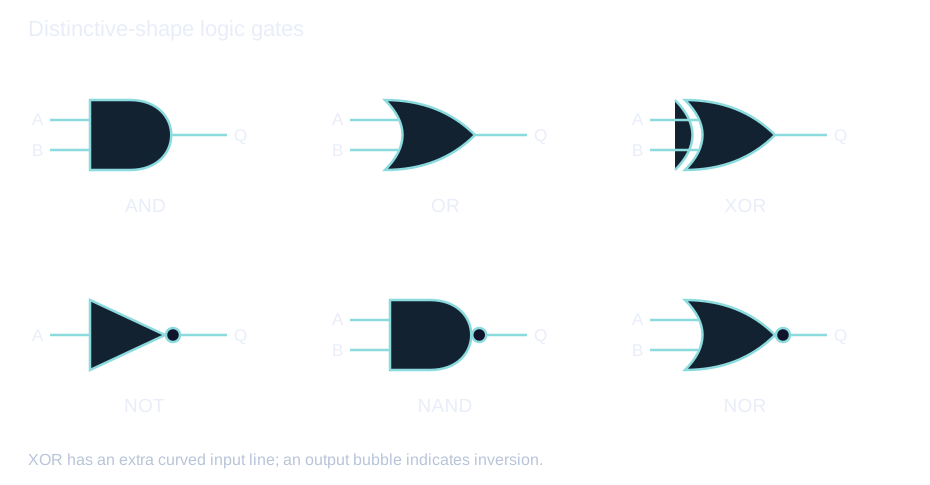
NOT inverts one input. AND is true only when both inputs are true. OR is true when at least one input is true. XOR is true when exactly one of two inputs is true. NAND and NOR invert the outputs of AND and OR respectively.
AQA uses distinctive-shape logic-gate symbols, including output bubbles for inversion. The additional curved input line distinguishes XOR from OR. A symbol or expression should be interpreted through its truth function rather than guessed from how many lines enter the diagram.
2
Enumerate inputs systematically
For n independent Boolean inputs, a complete truth table has 2ⁿ rows. List combinations consistently, for example 00,01,10,11 for two inputs. Add a column for each useful intermediate signal before calculating the final output.
This prevents a common error: applying a final NOT to just one input instead of to the whole gate result. A circuit implementing NOT(A AND B) differs from (NOT A) AND B. Explicit intermediate columns make the inversion’s scope visible.
3
Translate between representations
To obtain an expression from a circuit, name intermediate wires or recursively substitute gate operations. To draw a circuit from an expression, first identify grouped subexpressions and their dependencies. A shared intermediate result can feed more than one later gate.
Truth-table agreement over every permitted input combination proves equivalence for the described combinational Boolean function. Matching one or two sample rows is insufficient. This method concerns current inputs; a sequential circuit with stored state requires an additional state and timing model.
| A | B | AND | OR | XOR | NAND | NOR |
|---|---|---|---|---|---|---|
| 0 | 0 | 0 | 0 | 0 | 1 | 1 |
| 0 | 1 | 0 | 1 | 1 | 1 | 0 |
| 1 | 0 | 0 | 1 | 1 | 1 | 0 |
| 1 | 1 | 1 | 1 | 0 | 0 | 0 |
4
Work through the problem
Attempt the task before opening its worked response. Record each change of state, explain the rule used, and check the result against the original requirements. Code examples labelled Python 3 use that language’s conventions; pseudocode states its own assumptions.
Example 1Evaluate (A XOR B) AND C for A=1,B=1,C=1.
11 XOR 1 is 0.
20 AND 1 is 0.
Answer0.
Example 2How many input rows are required for a circuit with four independent Boolean inputs?
1Each input has two possible values.
22⁴=16 combinations.
Answer16.
Common mistakes to avoid
Confusing OR with exclusive OR.
Check the both-true row.
Moving a NOT across a compound expression without a valid law.
Track its scope explicitly.
Key takeaways
- Gate functions determine outputs.
- Intermediate columns support reliable traces.
- Complete tables establish combinational equivalence.
Test yourself
Answer a few questions, then review anything you missed.
Next step
Browse practice topicsKeep practising
Start with the quiz above to check the key ideas. You can also choose another topic from the practice library.