Loading...
4.1.2.3Fundamentals of ProgrammingCore
Inheritance, Composition and Polymorphism
An object-oriented relationship should describe the problem rather than merely reuse code. Distinguish “is a kind of” inheritance from relationships in which one object contains or uses another.
What you'll be able to do
- Compare inheritance, aggregation and composition
- Trace overriding and dynamic method selection
- Interpret abstract, virtual and static methods and class diagrams
1
Choose the relationship deliberately
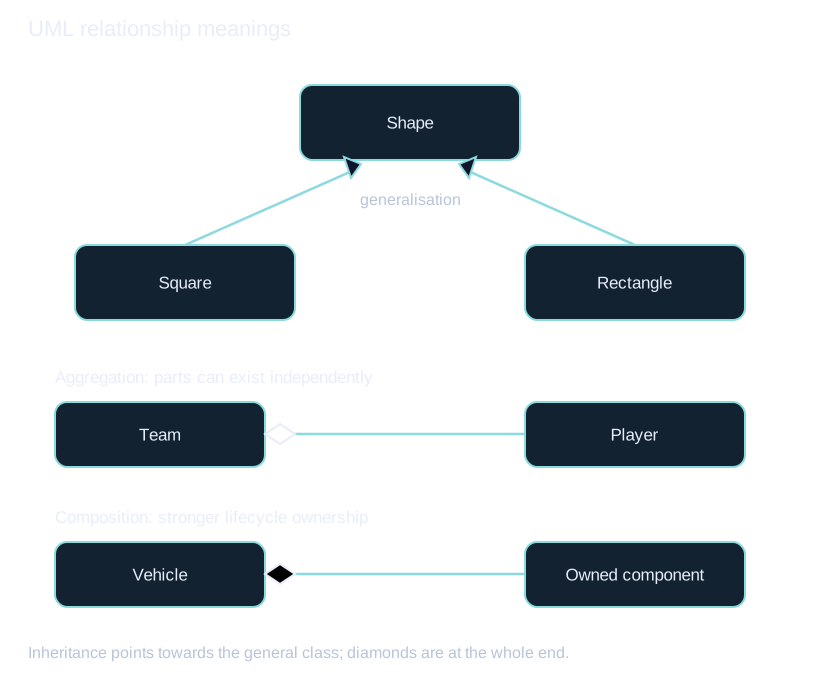
Inheritance specialises a base class, representing an appropriate is-a relationship. Aggregation relates objects that can exist independently, such as a team and a player. Composition expresses stronger ownership: a component’s conceptual lifecycle belongs to its whole. UML uses a hollow diamond for aggregation and a filled diamond for composition, both at the whole end.
A design can favour composition when behaviour should be assembled from replaceable collaborators rather than forced into a deep inheritance hierarchy. Encapsulating what varies reduces changes spreading through unrelated classes. Reuse alone is insufficient evidence that an is-a relationship is sensible.
2
Override behaviour through a shared interface
Polymorphism allows code using a shared interface to work with different concrete implementations. A subclass can override an inherited method so that the method selected at runtime reflects the actual object. The caller should depend on the promised behaviour rather than inspect every implementation’s internal fields.
An abstract method specifies an operation that a concrete subclass must provide. A virtual method permits runtime overriding in languages using that term. Python normally dispatches instance methods dynamically; C# and Java have their own rules. A static method belongs to the class interface without requiring an instance receiver.
3
Read diagrams and evaluate consequences
A class diagram lists attributes, operations and relationships, including visibility markers and single-inheritance links. Draw the generalisation arrow towards the more general class. For composition, the diamond marks the owning whole, not the contained part.
Programming to an interface makes replacement easier when implementations obey the same contract. AQA includes awareness of this design principle but does not require explicit interface programming in the practical examination. Keep language-independent design ideas distinct from the specific syntax used in a classroom language.
Python 3
class Shape:
    def area(self):
        raise NotImplementedError

class Square(Shape):
    def __init__(self, side):
        self.side = side

    def area(self):
        return self.side * self.side

class Rectangle(Shape):
    def __init__(self, width, height):
        self.width, self.height = width, height

    def area(self):
        return self.width * self.height

print([shape.area() for shape in [Square(3), Rectangle(2, 4)]])Python 3
from abc import ABC, abstractmethod

class Converter(ABC):
    @abstractmethod
    def convert(self, value):
        pass

    @staticmethod
    def unit_label():
        return "m"

class Double(Converter):
    def convert(self, value):
        return value * 2

print(Double().convert(3), Converter.unit_label())4
Work through the problem
Attempt the task before opening its worked response. Record each change of state, explain the rule used, and check the result against the original requirements. Code examples labelled Python 3 use that language’s conventions; pseudocode states its own assumptions.
Example 1A rendering routine calls area() on the two example objects. What results are produced?
1Square overrides area with side×side, giving 9.
2Rectangle overrides area with width×height, giving 8.
Answer[9, 8], selected through the actual object types.
Example 2A playlist references songs that also exist outside it. Which relationship is more suitable than strict lifecycle-owning composition?
1The songs can outlive or belong outside the playlist.
2Aggregation represents this independent existence in the conceptual model.
AnswerAggregation; justify it from lifecycle and ownership assumptions.
Common mistakes to avoid
Using inheritance merely because two classes share a few lines.
Check that the specialised object satisfies an is-a relationship.
Reversing the ownership diamond.
Place it at the conceptual whole.
Key takeaways
- Relationships encode meaning and lifecycle.
- Polymorphism separates a shared contract from implementations.
- Language syntax and design principles should be distinguished.
Test yourself
Answer a few questions, then review anything you missed.
Next step
Browse practice topicsKeep practising
Start with the quiz above to check the key ideas. You can also choose another topic from the practice library.