Loading...
4.3.2.1AlgorithmsCore
Pre-order, In-order and Post-order Traversal
Tree traversals differ in when they process a node relative to its subtrees. Keep that rule consistent at every level rather than trying to read the diagram row by row.
What you'll be able to do
- Trace the three binary-tree traversals
- Relate in-order to a search-tree invariant
- Use post-order for expressions and child-before-parent work
1
Place the node visit in the rule
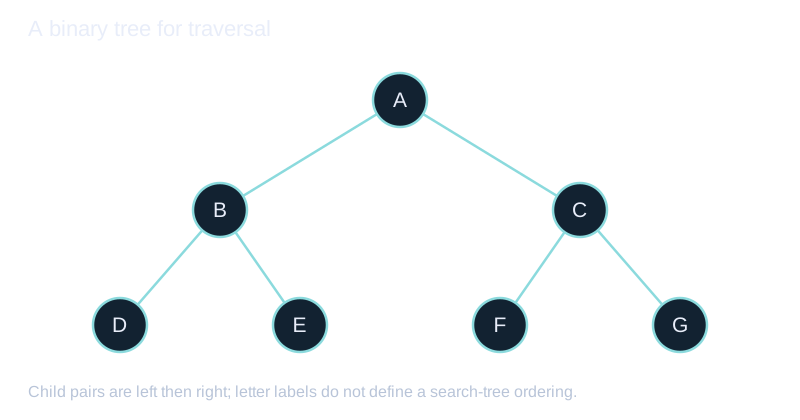
For a binary tree, pre-order processes the node, then the left subtree, then the right subtree. In-order processes left subtree, node, right subtree. Post-order processes left subtree, right subtree, node. An absent subtree contributes no visit.
These are recursive rules: “left subtree” means apply the whole same traversal there, not just visit its immediate root. A small tree with one node gives the same result for all three orders, so it is insufficient to distinguish whether a rule has been applied correctly.
2
Connect order with purpose
In-order traversal outputs keys in ascending order when the tree is a binary search tree under the stated ordering policy. An arbitrary binary tree does not become sorted simply because in-order traversal is used. The result follows from the combination of structure and algorithm.
Pre-order can record a parent before the structure below it, useful for some copying or serialisation tasks with sufficient structural information. Post-order handles children before their parent, useful for evaluating an expression tree or releasing child structures before a containing node.
3
Trace a complete subtree before returning
Mark each recursive return point or write a small expansion for each subtree. This reduces the common error of switching from a depth-based rule to a breadth-based reading halfway through. For a proper tree, each node is processed once, giving O(V) total visits.
The call-stack depth follows the tree height, which can be logarithmic for a balanced tree or linear for a chain. A recursive implementation is concise but does not remove the need to consider an empty tree and resource limits. Distinguish the number of visits from the maximum simultaneous calls.
| Tree description | Rule result |
|---|---|
| A has children B,C; B has D,E; C has F,G | |
| Pre-order | A B D E C F G |
| In-order | D B E A F C G |
| Post-order | D E B F G C A |
4
Work through the problem
Attempt the task before opening its worked response. Record each change of state, explain the rule used, and check the result against the original requirements. Code examples labelled Python 3 use that language’s conventions; pseudocode states its own assumptions.
Example 1For root 8 with left child 3 and right child 11, give all three traversal orders.
1Pre-order visits 8 before both children: 8,3,11.
2In-order gives 3,8,11; post-order gives 3,11,8.
AnswerPre: 8,3,11; in: 3,8,11; post: 3,11,8.
Example 2Why is post-order useful when an expression node multiplies two subtree results?
1Both operand subtrees must be evaluated before their product can be computed.
2Post-order visits those children before processing the operator node.
AnswerIt respects the dependency of an operator on its operands.
Common mistakes to avoid
Visiting just an immediate child instead of its whole subtree.
Reapply the traversal rule recursively.
Assuming in-order sorts arbitrary trees.
Check the BST invariant.
Key takeaways
- The three orders differ in node timing.
- A subtree must be completed under the same rule.
- Traversal applications follow dependency and ordering needs.
Test yourself
Answer a few questions, then review anything you missed.
Next step
Browse practice topicsKeep practising
Start with the quiz above to check the key ideas. You can also choose another topic from the practice library.