Network Components and Transmission Media
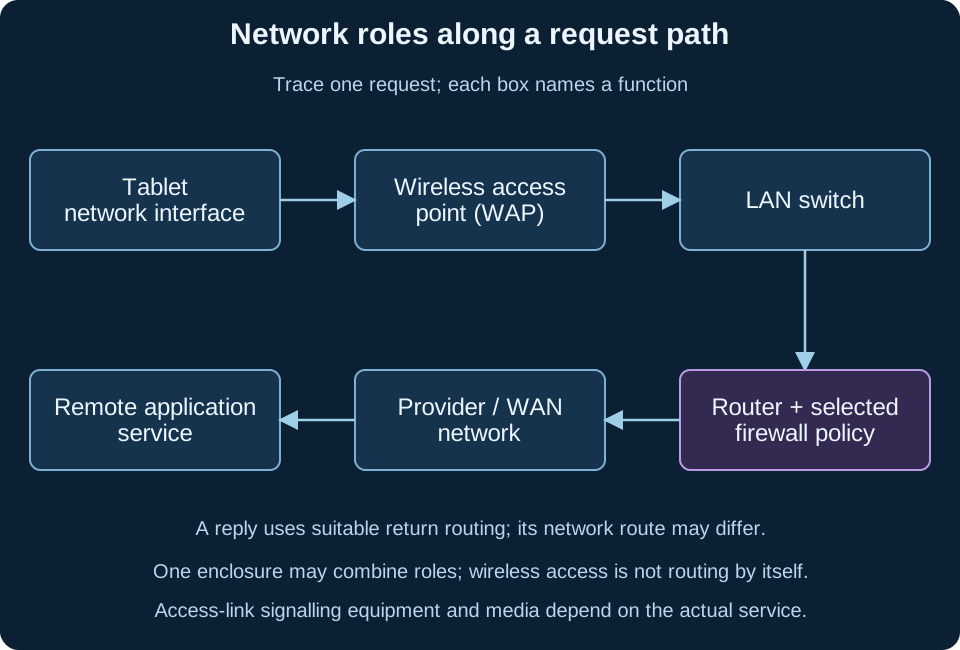
Build a path from a device to another network and explain each function along it. A combined home gateway can perform several roles without making those roles identical.
Before you start
- Distinguish a LAN link, an inter-network route and a user account.
- Identify the distance, interference and mobility requirements before choosing a medium.
Watch, pause, try
Video by Craig'n'Dave. The shared OCR hardware explanation provides the main foundation; optional AQA companions develop Wi-Fi and firewall roles. Apply Pearson’s diagram requirements, distinguishing a logical function from a physical product that combines functions. A modem/access-link device depends on the actual provider technology, and a firewall is one policy boundary rather than complete endpoint protection.
Viewing focus: Explain NIC, switch, router, modem, WAP and firewall roles
After watching, attempt these questions before opening the answers. You can also use the written lesson below.
After watching 1: A tablet reaches a remote learning service through a wireless access point, a local Ethernet switch and a gateway router. Explain each function in order. Could one gateway enclosure combine some of them, and does adding a separate box labelled modem automatically create an Internet subscription?
Show answer and reasoning
The WAP connects the tablet’s wireless link to the local network, the switch forwards suitable LAN frames towards the gateway, and routing forwards packets between network paths. One enclosure can implement several of these functions. Access-link signalling equipment is chosen for the actual service; merely adding a labelled box supplies neither a provider agreement nor every required link/addressing configuration.
After watching 2: A warehouse has moving handheld scanners and a link to another building beside electrically noisy machinery. Suggest relevant wireless and fibre roles, then explain why blocking unsolicited inbound traffic does not prove a permitted learning application or an internal account is safe.
Show answer and reasoning
Wireless can serve moving clients subject to coverage, interference and shared-capacity checks; suitable fibre equipment can serve the inter-building path without electrical signalling in the fibre. Check installation and endpoints rather than promise universal rates. A firewall rule limits specified communication, while permitted application content, compromised endpoints and account permissions still require their own controls.
What you'll be able to do
- Explain NIC, switch, router, modem, WAP and firewall roles
- Compare copper, fibre and wireless media
- Complete a network diagram from a scenario’s requirements
Connect the device and the local network
A network interface card or controller (NIC) gives a device the interface needed to communicate on a network. In a basic Ethernet LAN, a switch forwards frames towards suitable ports using learned link-layer information. A wireless access point (WAP) provides wireless clients with access to a local network, commonly bridging their communication to a wired infrastructure.
A switch does not automatically supply Internet service, and a WAP is not necessarily a router. A home gateway may combine switching, wireless access and routing in one enclosure. Identify the logical function in a diagram rather than assuming every drawn physical box has only one role or every product name describes all its functions.
Cross network and security boundaries
A router forwards network-layer packets between networks using routing information. A modem adapts information to the signalling used by the relevant access link; modern access technologies use different physical arrangements, so a separate old-style telephone modem is not universal. An Internet-facing connection still needs suitable provider service and addressing, not just a box labelled router.
A firewall applies traffic policy. It can run on dedicated hardware or as software on a host or gateway. Filtering can restrict unwanted communication, but a permitted connection can still carry malicious content or misuse. State which traffic direction and rule protect which resource. A firewall does not guarantee that every internal account, endpoint and application is safe.
Match the medium to the environment
Copper electrical links can be convenient within their permitted distance and installation constraints, but are affected by electrical signalling limits and interference conditions. Fibre carries optical signals, can support suitable long-distance/high-capacity designs and is resistant to electromagnetic interference in the fibre path. Transceivers, installation and physical handling still have requirements.
Wireless supports mobility and avoids a cable to every client, but range and useful throughput depend on obstacles, interference, shared airtime and system design. A school diagram might connect desktop NICs to a switch by copper, another building through suitable fibre equipment, and mobile devices through WAPs. These are justified scenario choices, not universal speed rankings or current product purchasing advice.
| Component | Principal role |
|---|---|
| NIC | Device network interface |
| Switch | Forward suitable LAN frames between ports |
| Router | Forward packets between networks |
| Modem/access-link equipment | Adapt to the access link’s signalling |
| WAP | Connect wireless clients to a local network |
| Firewall | Apply traffic-access policy |
Work through the problem
Attempt the task before opening its worked response. Record each change of state, explain the rule used, and check the result against the original requirements. Code examples labelled Python 3 use that language’s conventions; pseudocode states its own assumptions.
Example 1A home gateway has Ethernet sockets, Wi-Fi and an Internet uplink. Name three functions it may combine.
Example 2Two buildings need a suitable link beside equipment producing electromagnetic interference. Why consider fibre?
Common mistakes to avoid
Key takeaways
- Network functions remain distinct even when combined in one box.
- Media have physical and service trade-offs.
- Explain how the complete path meets the scenario.
Explore further
- Pearson YCP01 official specification (opens in a new tab)
Check the International A-level requirements and relevant numbered points; this course remains in progress.
- Pearson International Computer Science subject guide (opens in a new tab)
Official introduction to the four examined units and their theory/practical purposes.
- 62. OCR A Level (H446) SLR11 - 1.3 Network hardware — Craig'n'Dave (opens in a new tab)
Original publisher or creator source for the embedded explanation; apply the stated viewing scope.
- 137. AQA A Level (7516-7517) SLR21 - 4.9.2 Introduction to Wi-Fi — Craig'n'Dave (opens in a new tab)
Companion explanation: connect its topic to the written Pearson scope and follow-up activities.
- 142. AQA A Level (7517) SLR21 - 4.9.3 How firewalls work — Craig'n'Dave (opens in a new tab)
Companion explanation: connect its topic to the written Pearson scope and follow-up activities.
Return to this tomorrow
Close the notes and answer from memory. Revisit any explanation you cannot yet reconstruct.
- A firewall may be implemented:
- A medium recommendation should consider:
Test yourself
Answer a few questions, then review anything you missed.
Keep practising
Start with the quiz above to check the key ideas. You can also choose another topic from the practice library.