Loading...
1.3.3(a), 1.3.3(b)Networks and SecurityCore
TCP/IP Layers, Sockets and Protocols
Layering separates application meaning from transport and delivery mechanisms. Follow data through the four-layer model without treating every protocol as if it performed the same job.
What you'll be able to do
- Describe the four TCP/IP layers
- Explain endpoints, ports and MAC addresses
- Compare required application protocols and client/server roles
1
Follow the four-layer model
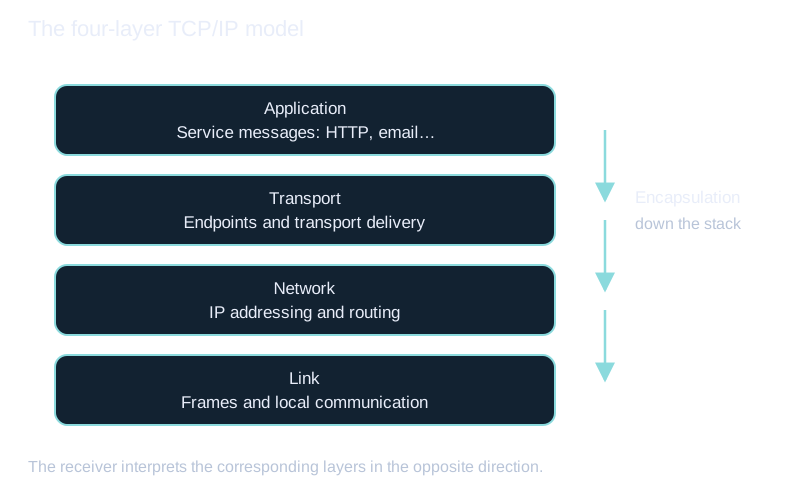
The application layer defines service-level exchanges, such as web requests. The transport layer supports communication between application endpoints; TCP supplies an ordered reliable byte stream through mechanisms such as sequencing, acknowledgements and retransmission. The network layer handles IP addressing and routing, while the link layer handles local-link delivery.
Encapsulation adds the information needed by each layer, and the receiver interprets it in reverse. An Internet transfer can cross several local links, so link-level addresses change along the route while transport endpoints describe the end-to-end exchange. The four-layer model should not be mixed halfway through with a seven-layer labelling scheme.
2
Identify communication endpoints
A socket endpoint involves an address and port under a transport protocol. A server often listens on a well-known service port; a client commonly uses an allocated temporary port so responses return to the right communication endpoint. Several connections can be distinguished by their endpoint combinations.
A MAC address identifies an interface for local-link communication under the relevant protocol. It is not a substitute for an IP route across networks and should not be treated as an unchangeable person identifier. Devices can have several interfaces and address assignments.
3
Explain application responsibilities
HTTP requests and responses support web resources; HTTPS protects HTTP using TLS. FTP transfers files under its own protocol. SMTP sends/transfers email and POP3 retrieves it, with retention depending on the client/server configuration. SSH supports authenticated encrypted remote access and can also tunnel suitable connections.
A web browser requests HTML and associated resources and renders or executes them as appropriate; a web server supplies responses. Application commands such as an HTTP GET still belong to their application protocol even when carried through a configured tunnel. SFTP over SSH and conventional FTP are different protocols, not alternative spellings.
| Layer | Typical responsibility |
|---|---|
| Application | HTTP, SMTP and other service messages |
| Transport | TCP endpoints and reliable stream |
| Network | IP delivery and routing |
| Link | Local frames and interface addressing |
4
Work through the problem
Attempt the task before opening its worked response. Record each change of state, explain the rule used, and check the result against the original requirements. Code examples labelled Python 3 use that language’s conventions; pseudocode states its own assumptions.
Example 1Why can many clients use one server’s HTTPS port without all responses being confused?
1Each connection has identifiable local and remote endpoints.
2Client addresses and temporary ports distinguish different exchanges.
AnswerThe server port alone is not the whole connection identity.
Example 2Which protocol role fits sending an email onward, and which fits retrieving messages using the required syllabus examples?
1SMTP handles sending/transfer.
2POP3 handles retrieval; server retention depends on configuration.
AnswerSMTP and POP3 respectively.
Common mistakes to avoid
Mixing layer models without explaining the mapping.
Use the stated four-layer TCP/IP model consistently.
Treating a port number as a complete connection identity.
Consider both endpoints and the protocol.
Key takeaways
- Layers separate responsibilities.
- Ports identify service/application endpoints.
- Application protocols define different exchanges.
Test yourself
Answer a few questions, then review anything you missed.
Next step
Browse practice topicsKeep practising
Start with the quiz above to check the key ideas. You can also choose another topic from the practice library.