Loading...
2.2.2(f), 2.3.1(f)Algorithms and EfficiencyCore
A*: Costs, Heuristics and Paths
A* combines the known cost of reaching a vertex with an estimate of the remaining cost. Keep g, h and f separate and do not stop merely because a route to the goal has first appeared.
What you'll be able to do
- Trace g, h and f with explicit tie-breaking
- Use and interpret an original A* implementation
- Explain admissibility, consistency and the relation to Dijkstra
1
Combine cost so far and estimated cost ahead
g(v) is the best currently known cost from the start to v. h(v) estimates the cost from v to the goal. A* prioritises the smallest f(v)=g(v)+h(v). When examining an edge, calculate a candidate new g and retain a better value and predecessor when one is found. The heuristic alone is not the complete priority.
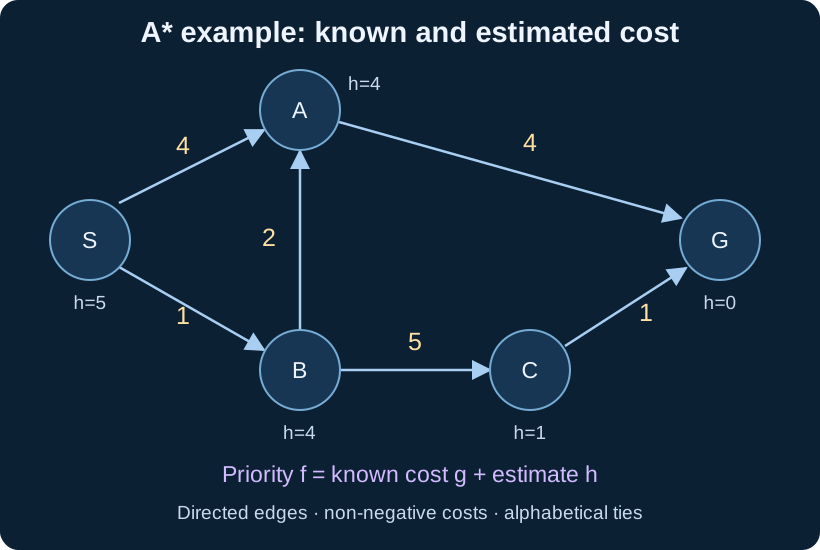
In this lesson’s directed graph, S→A costs 4, S→B 1, B→A 2, B→C 5, A→G 4 and C→G 1. Use h(S)=5,h(A)=4,h(B)=4,h(C)=1,h(G)=0. Ties in f use alphabetical vertex order. These edge and heuristic conventions make the example’s trace reproducible.
2
Follow the frontier accurately
After expanding S, B has g=1,f=5 and A has g=4,f=8, so select B. B improves A to g=3,f=7 and discovers C with g=6,f=7. Select A alphabetically, discovering G at g=7,f=7. C is then selected before G under the tie rule; its route to G also costs 7, so no strict improvement is made.
When G is removed as the lowest-priority frontier item under the stated assumptions, its predecessor chain gives S→B→A→G, cost 7. The first discovery of G is not generally a sufficient termination condition. Old priority-queue entries can remain after a g update; the code skips entries whose priority no longer matches the best known value.
3
State the guarantee conditions
An admissible heuristic never overestimates the true remaining minimum cost. Consistency additionally requires h(u)≤cost(u,v)+h(v) for each edge and h(goal)=0. The displayed heuristic satisfies these conditions. A graph search that permanently closes vertices needs care with inconsistent heuristics; the example allows improved vertices to be queued again rather than assuming every heuristic is safe.
Costs are non-negative, and the function rejects negative edges. If h is zero everywhere, prioritising g reduces to Dijkstra-style search. A better informative heuristic can reduce explored work, but heuristic computation also has a cost. OCR requires understanding and tracing A*; this small implementation makes the state updates visible without making memorisation of its Python syntax a requirement.
Python 3
from heapq import heappop, heappush

def a_star(graph, heuristic, start, goal):
    if any(cost < 0 for edges in graph.values() for cost in edges.values()):
        raise ValueError("non-negative edge costs required")
    best = {start: 0}
    previous = {}
    frontier = [(heuristic[start], start)]
    while frontier:
        priority, vertex = heappop(frontier)
        if priority != best[vertex] + heuristic[vertex]:
            continue
        if vertex == goal:
            path = [goal]
            while path[-1] != start:
                path.append(previous[path[-1]])
            return list(reversed(path)), best[goal]
        for neighbour, cost in graph.get(vertex, {}).items():
            candidate = best[vertex] + cost
            if candidate < best.get(neighbour, float("inf")):
                best[neighbour] = candidate
                previous[neighbour] = vertex
                heappush(frontier, (candidate + heuristic[neighbour], neighbour))
    return None

graph = {"S": {"A": 4, "B": 1}, "B": {"A": 2, "C": 5},
         "A": {"G": 4}, "C": {"G": 1}, "G": {}}
heuristic = {"S": 5, "A": 4, "B": 4, "C": 1, "G": 0}
print(a_star(graph, heuristic, "S", "G"))4
Work through the problem
Attempt the task before opening its worked response. Record each change of state, explain the rule used, and check the result against the original requirements. Code examples labelled Python 3 use that language’s conventions; pseudocode states its own assumptions.
Example 1After B is expanded, calculate A’s updated g and f.
1The route S→B→A costs 1+2=3, improving the direct route’s cost 4.
2Add h(A)=4 to get f(A)=3+4.
Answerg=3, h=4, f=7.
Example 2Explain what setting every heuristic value to zero changes.
1f(v)=g(v)+0, so the frontier is ordered only by known cost.
2The search becomes Dijkstra-style under the same non-negative-cost conditions.
AnswerThe estimate supplies no extra direction towards the goal.
Common mistakes to avoid
Comparing h alone and calling it A*.
Calculate f from both g and h.
Claiming optimality for any arbitrary heuristic.
State the cost, heuristic and graph-search assumptions.
Key takeaways
- A* keeps known, estimated and combined costs distinct.
- Frontier updates and predecessor links determine the path.
- Heuristic conditions control the optimality argument.
Test yourself
Answer a few questions, then review anything you missed.
Next step
Browse practice topicsKeep practising
Start with the quiz above to check the key ideas. You can also choose another topic from the practice library.
Related lessons
All 4 lessons- Same chapterDijkstra’s Shortest-Path AlgorithmTrace tentative distances and permanent choices
- Same chapterBig-O, Growth Rates and Resource CostsCompare constant, logarithmic, polynomial and exponential growth
- Same chapterAlgorithm Cases, Time, Space and SelectionCompare constant, logarithmic, linear, polynomial and exponential growth