Loading...
3.11.2.1, 3.11.2.2, 3.11.2.3Engineering PhysicsCore
The First Law and Gas Processes
Heating a gas can increase its internal energy, make it do work, or both. A consistent sign convention connects the first law to pressure–volume diagrams. This lesson is part of the Engineering Physics option; study it if this is your centre’s chosen Paper 3 Section B topic.
What you'll be able to do
- Use Q=ΔU+W with work done by the gas
- Compare four non-flow processes
- Estimate work from p–V graphs and cycles
1
Fix the signs first
Take Q as energy transferred into the system by heating, ΔU as the increase in internal energy, and W as work done by the system. Expansion normally gives positive W; compression gives negative W. For an ideal gas, internal energy depends only on temperature.
If a gas receives 100 J by heating and does 40 J of work, its internal energy rises by 60 J. If it is compressed without heat transfer, the negative W gives a positive ΔU. A sign convention explained once is more reliable than memorising a separate rule for every process.
Use kelvin and absolute pressure in the ideal-gas equation.
2
Four processes and their physical meanings
At constant volume, the gas does no boundary work, so Q=ΔU. At constant pressure, work is and heating generally changes both volume and temperature. An isothermal ideal-gas process keeps temperature and internal energy constant, so Q=W; it requires heat exchange during expansion or compression.
An adiabatic process transfers no energy by heating, so ΔU=−W. For a fixed amount of ideal gas the adiabatic relation is constant. During expansion its temperature falls and its p–V curve drops more steeply than an isotherm through the same starting point. “Fast” can help make a real process approximately adiabatic, but the defining condition is negligible heat transfer.
Do not apply the constant-pressure work expression to a curved p–V path.
3
Areas represent work
The area under a p–V curve is the work done by the gas during expansion. For a varying pressure estimate the area with rectangles or trapezia if numerical data are provided. On compression the signed work is negative.
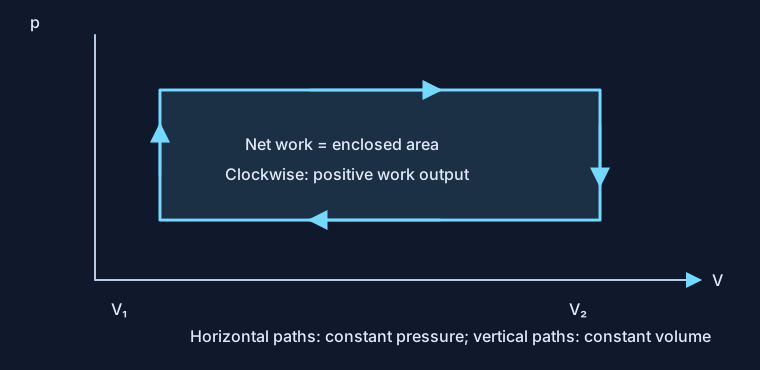
The area enclosed by a clockwise cycle is net work output; an anticlockwise cycle needs net work input. Since the system returns to its initial state after a full cycle, total ΔU=0 and net heat input equals net work output. The route matters for Q and W even though ΔU depends only on the endpoints.
4
Work through the reasoning
Try each problem before opening the worked solution. State the physical model, show substitutions with consistent units, and explain what your answer means.
Example 1A gas is compressed adiabatically with 150 J of work done on it. Find Q, W and ΔU.
1 because the process is adiabatic.
2 J because the gas has work done on it.
3 J.
AnswerQ=0, W=−150 J, ΔU=+150 J.
Example 2A gas expands at 200 kPa from 1.0 to 3.0 litres while receiving 600 J. Find work and internal-energy change.
1 m³.
2 J.
3 J.
Answer400 J of work; internal energy increases by 200 J.
Equation recap
Use kelvin and absolute pressure in the ideal-gas equation.
Do not apply the constant-pressure work expression to a curved p–V path.
Common mistakes to avoid
Using litres as cubic metres.
One litre is 10⁻³ m³.
Calling every constant-temperature change adiabatic.
Isothermal and adiabatic impose different conditions.
Key takeaways
- A consistent work sign fixes first-law calculations.
- Gas processes impose different constraints on Q, W and ΔU.
- p–V areas represent work; cycle area gives net work.
Test yourself
Answer a few questions, then review anything you missed.
Next step
Browse practice topicsKeep practising
Start with the quiz above to check the key ideas. You can also choose another topic from the practice library.