Loading...
3.10.3.1Medical PhysicsCore
Electrocardiograms
An ECG records changing potential differences at the body surface as electrical activity spreads through the heart. Interpret the normal waveform without mistaking it for a direct graph of force or blood pressure. This lesson is part of the Medical Physics option; study it if this is your centre’s chosen Paper 3 Section B topic.
What you'll be able to do
- Explain electrodes, amplification and noise reduction
- Identify P, QRS and T features
- Calculate heart rate from a calibrated trace
1
Obtaining a small electrical signal
Electrodes placed on the skin pick up potential differences associated with the heart’s electrical activity. Conductive gel reduces poor electrical contact. A high-input-resistance differential amplifier measures the difference between two electrode signals while drawing very little current from the source.
Because the useful signal is small, interference from mains electricity, movement and electrode contact can be significant. Differential measurement helps reject interference common to both inputs; filtering can reduce unwanted frequencies but must preserve the features of interest. The trace is voltage against time, and its calibration must be read before using intervals.
2
The normal waveform
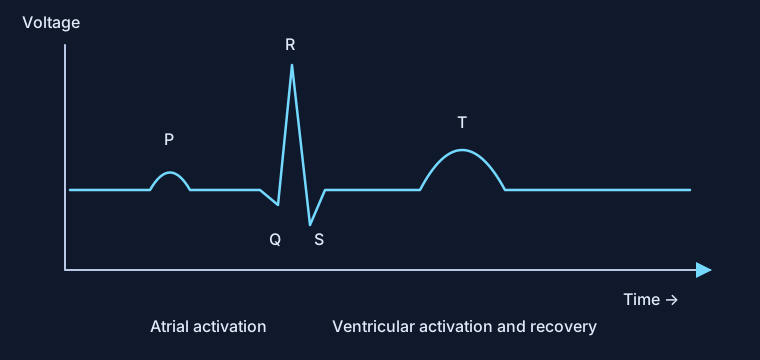
The P wave corresponds to atrial depolarisation. The QRS complex corresponds to ventricular depolarisation; atrial repolarisation is usually hidden within it. The T wave corresponds to ventricular repolarisation. Depolarisation triggers the subsequent muscle contraction, but an ECG measures electrical activity rather than contraction itself.
The larger QRS signal reflects the substantial ventricular muscle mass and the electrical sequence seen by the chosen leads. A flat segment does not mean that the heart is empty or completely inactive: the measured potential difference depends on the changing distribution of electrical activity.
3
Extracting reliable measurements
Measure the separation between equivalent points in successive cycles, commonly successive R peaks. Taking the time for several cycles and dividing reduces the percentage uncertainty in a single interval. Convert a cycle frequency in s⁻¹ to beats per minute by multiplying by 60.
A changing baseline may arise from movement rather than a changed heartbeat. Distinguish an interval calculation from clinical interpretation; the physics task is to use voltage and time information with an appropriate measurement method.
4
Work through the reasoning
Try each problem before opening the worked solution. State the physical model, show substitutions with consistent units, and explain what your answer means.
Example 1Successive R peaks are separated by 0.80 s. Calculate heart rate.
1 s⁻¹.
2Rate beats per minute.
Answer75 beats per minute.
Example 2A trace moves at 25 mm s⁻¹. Five complete cycles span 100 mm. Calculate the mean rate.
1Elapsed time s.
2Mean period s.
3Rate beats per minute.
Answer75 beats per minute; count five intervals, not merely five peaks.
Common mistakes to avoid
Counting five peaks as five full periods.
Five consecutive peaks span four periods.
Calling the ECG a graph of ventricular force.
It is a potential-difference recording of electrical activity.
Key takeaways
- ECG electrodes detect small changing potential differences.
- P, QRS and T mark different phases of electrical activity.
- A calibrated R–R interval gives cycle frequency and heart rate.
Test yourself
Answer a few questions, then review anything you missed.
Next step
Browse practice topicsKeep practising
Start with the quiz above to check the key ideas. You can also choose another topic from the practice library.