RP9: Reflection and Refraction
Use an approved ray source to produce a narrow visible ray. Outline the reflecting surface or transparent block on paper, mark several points along each visible ray and keep the apparatus in the same position. After removing the apparatus, join marked points with a ruler. A single broad mark gives poor direction evidence; two separated points define a path more clearly.
Before you start
- Use your teacher’s tier checklist: this overview can include Higher-only material, and is not a tier-specific revision list.
- This required activity is labelled Physics-only in AQA 8463; it is part of the separate GCSE Physics course.
- AQA separate GCSE Physics 8463. Use the specified required-practical reference and the centre’s approved apparatus and supervised procedure.
- Draw a perpendicular normal and measure an angle with a protractor.
- Use the centre’s approved supervised method and equipment limits. These notes prepare you to explain and evaluate practical work; they do not replace carrying it out and recording the evidence.
Watch, pause, try
Video by ATPhysics1. This AQA-focused demonstration develops reflection and refraction. Compare its apparatus and substances with the particular board reference; Pearson specifies rectangular glass-block work.
Viewing focus: Trace incident, reflected and refracted rays
After watching, attempt these questions before opening the answers. You can also use the written lesson below.
After watching 1: If a ray makes 30° with the surface, what is its incident angle and why?
Show answer and reasoning
The incident angle is 60°, measured from the normal perpendicular to the surface.
After watching 2: Explain why a rough surface can scatter reflected rays while each ray still obeys the reflection law.
Show answer and reasoning
The small surface regions have differently directed normals. Equal local incident/reflected angles therefore produce different outgoing directions.
What you'll be able to do
- Trace incident, reflected and refracted rays
- Measure angles from the local normal
- Distinguish regular/diffuse reflection and material-dependent refraction
Trace paths that can be reconstructed accurately
Use an approved ray source to produce a narrow visible ray. Outline the reflecting surface or transparent block on paper, mark several points along each visible ray and keep the apparatus in the same position. After removing the apparatus, join marked points with a ruler. A single broad mark gives poor direction evidence; two separated points define a path more clearly.
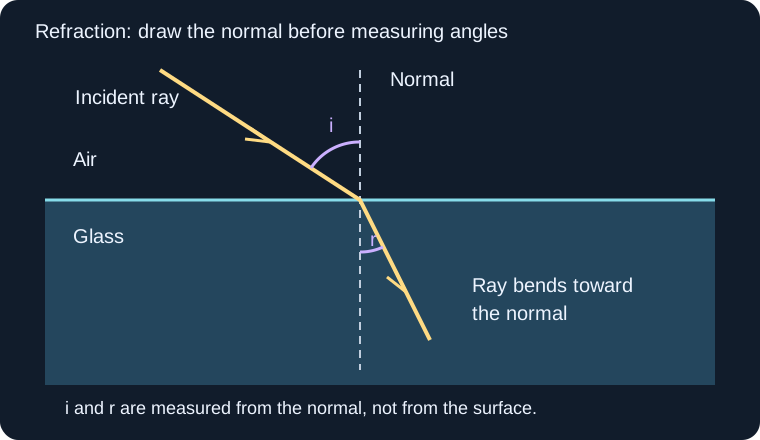
At each boundary point, draw a normal perpendicular to the surface. The angle of incidence and the reflected or refracted angle are measured from that normal, not from the surface. Use different incident angles and retain the raw measurements. Avoid looking into the source or using an unapproved laser arrangement.
Compare reflecting surfaces and materials
For a plane reflecting surface, the reflected and incident rays make equal angles with the local normal. A rough surface produces diffuse reflection because its small surface regions have different normals; the local law is not abolished. Compare a smooth surface with an appropriate rougher surface under similar illumination, distinguishing a spread of reflected directions from an absence of reflection.
For oblique incidence from air into common transparent glass or plastic, light slows and the ray bends toward the normal. On emerging into air it bends away from the local normal. A parallel-sided block in the same outside medium gives an emerging ray parallel to the incident ray but laterally displaced in the ideal geometry. At normal incidence there is no directional bending even though speed changes.
AQA RP9 requires reflection from different surface types and refraction by different substances. A single ray through one glass block illustrates the technique but does not complete every comparison; plan suitable surface and material choices with controlled incident-angle measurements.
Identify the inference supported by the measurements
Compare repeated angle readings and the quality of the ray marks. A block moved after its outline was drawn gives a systematic path error. A thick ray, uncertain normal or protractor resolution affects angular precision. Improve a named limitation, such as using longer marked ray segments or securing the block, rather than saying only “use more accurate equipment”.
Comparing substances requires controlled geometry and the same incident-angle convention. Do not compare one refracted angle at 20° incidence with another at 60° and attribute the difference only to material. Wave reflection/refraction can also be observed at suitable water-depth boundaries; the medium conditions change wave speed and wavelength while the source frequency stays the same. The centre selects additional wave/matter contexts where required.
Worked applications
Attempt these problems on paper before opening the worked reasoning. Explain your steps as well as giving a final answer.
Example 1An incident ray is 35° from a plane mirror surface. Find its angle of incidence and angle of reflection.
Example 2A ray enters a parallel-sided glass block from air at 40° to the normal and travels inside at 25°. Describe the entry bend and ideal emerging direction.
Example 3A water wave crosses into shallower water, where its speed falls from 0.40 to 0.30 m s⁻¹. The source remains at 10 Hz. Compare wavelengths.
Common mistakes to avoid
Key takeaways
- You can trace incident, reflected and refracted rays.
- You can measure angles from the local normal.
- You can distinguish regular/diffuse reflection and material-dependent refraction.
Apply it in an exam
Question 1: A water wave crosses into shallower water, where its speed falls from 0.40 to 0.30 m s⁻¹. The source remains at 10 Hz. Compare wavelengths.
Show answer and reasoning
Wavelength falls from 4.0 to 3.0 cm; frequency stays 10 Hz.
- Initial λ = 0.40/10 = 0.040 m.
- Final λ = 0.30/10 = 0.030 m.
- The frequency remains fixed by the unchanged source.
Explore further
- AQA 8463 official specification (opens in a new tab)
Check the assessed scope and practical or mathematical requirements.
- Read or explore this topic (opens in a new tab)
An external explanation or interactive activity to use alongside the lesson. It may include extension material.
Return to this tomorrow
Close the notes and answer from memory. Revisit any explanation you cannot yet reconstruct.
- Does diffuse reflection mean the local reflection law fails?
- At normal incidence into glass, which statement is correct?
Test yourself
Answer a few questions, then review anything you missed.
Keep practising
Start with the quiz above to check the key ideas. You can also choose another topic from the practice library.
Related lessons
All 10 lessons- Same chapterRP1: Measuring Specific Heat CapacityRelate measured energy input to mass and temperature change
- Same chapterRP2: Comparing Thermal InsulatorsDesign a fair comparison of insulating materials or thicknesses
- Same chapterRP3: Wire Resistance and Resistor CombinationsMeasure resistance for a controlled wire-length comparison