PAG2: Forces and Spring Extension
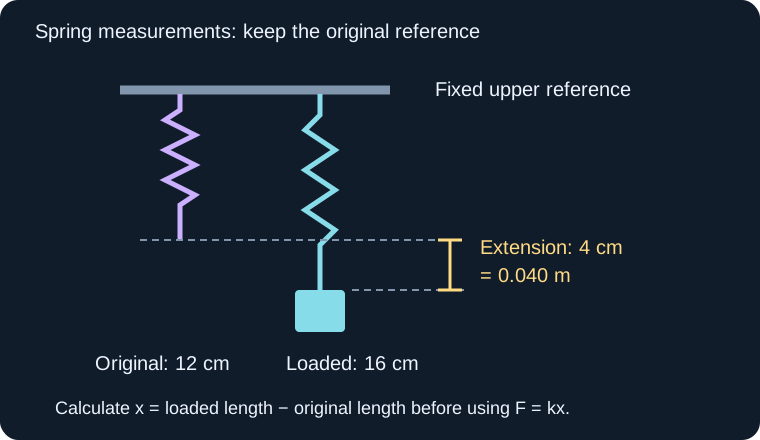
Secure the spring and place a ruler alongside it using an approved stable arrangement. Record its original length or the initial position of a fixed pointer. Add suitable loads in steps, let oscillations settle and record the corresponding positions. Extension is the increase from the original reference, not the spring’s total loaded length. Read the scale at eye level and use the same pointer each time.
Before you start
- Use your teacher’s tier checklist: this overview can include Higher-only material, and is not a tier-specific revision list.
- OCR Gateway A separate GCSE Physics J249. P9 groups the practical techniques into PAG1–8; the activities here are suitable examples, and centres can choose alternatives covering the required apparatus and techniques.
- Distinguish mass and weight, convert centimetres to metres and find a graph gradient.
- Use the centre’s approved supervised method and equipment limits. These notes prepare you to explain and evaluate practical work; they do not replace carrying it out and recording the evidence.
Watch, pause, try
Video by Malmesbury Education. The demonstration develops force and extension. Pearson’s written guide additionally requires work done, which is developed through graph area and the original examples.
Viewing focus: Calculate extension from loaded and original lengths
After watching, attempt these questions before opening the answers. You can also use the written lesson below.
After watching 1: A spring length changes from 11 cm to 15 cm. Which value is x, and what is it in metres?
Show answer and reasoning
The extension is 4 cm = 0.040 m, not the total 15 cm loaded length.
After watching 2: How would the meaning of a straight-line gradient change if the force and extension axes were exchanged?
Show answer and reasoning
Force against extension gives k in N m⁻¹. Extension against force gives its reciprocal, 1/k in m N⁻¹.
What you'll be able to do
- Calculate extension from loaded and original lengths
- Identify a proportional force–extension region
- Calculate spring constant and work with stated elastic assumptions
Measure extension from one reference
Secure the spring and place a ruler alongside it using an approved stable arrangement. Record its original length or the initial position of a fixed pointer. Add suitable loads in steps, let oscillations settle and record the corresponding positions. Extension is the increase from the original reference, not the spring’s total loaded length. Read the scale at eye level and use the same pointer each time.
Convert each added mass to its weight using the supplied gravitational field strength. In a static hanging arrangement, the spring’s upward force balances the load’s downward weight. A 100 g mass is not a 100 N force. Keep within approved limits, secure the stand and use the centre’s arrangements to contain falling loads. A loading and unloading comparison can reveal whether the spring returns to its initial length.
Read proportionality from the chosen axes
Within a proportional region, F = kx: force increases in proportion to extension and a force-against-extension graph is straight through the appropriate zero reference. Its gradient is k in N m⁻¹. An extension-against-force graph instead has gradient 1/k. State the axes before interpreting a slope. A straight line with a substantial unexplained intercept needs its zero reference or model checked.
Beyond the limit of proportionality, force and extension no longer have a constant ratio. That limit is not defined as identical to the elastic limit: a non-proportional deformation may still be recoverable. Inspect the data rather than extending an early straight line through every later point. Record unloading evidence before making a claim about permanent deformation.
| Extension / m | Spring A: force / N | Spring B: force / N |
|---|---|---|
| 0.000 | 0.0 | 0.0 |
| 0.010 | 0.5 | 1.0 |
| 0.020 | 1.0 | 2.0 |
| 0.030 | 1.5 | 3.0 |
| 0.040 | 2.0 | 4.0 |
| 0.050 | 2.5 | 5.0 |
| 0.060 | 3.0 | 6.0 |
Compare spring stiffness from force and extension
Calculate the force–extension gradient for each spring. Which needs more force for the same extension, and why is total spring length not the horizontal quantity?
Blue: data with straight joining guides. Gold: selected interval. Scroll the plot horizontally on a small screen.
Try Δy ÷ Δx on paper first. Keep the sign and use the units on the axes.
Connect the area to transferred energy
Work done in slowly stretching a spring is represented by the area beneath a force-against-extension graph. In the proportional region the area is a triangle, so E = ½Fx = ½kx². The final force multiplied by the entire extension would be too large because the force increased during the stretch. Use metres for x to obtain joules.
Interpreting the work as recoverable elastic energy assumes the stated elastic model. If the spring is permanently deformed or shows substantial hysteresis, not all loading work is recovered. For a non-linear curve, the triangular shortcut is not generally valid. Estimate the actual area only when the question supplies a suitable method or enough information.
Worked applications
Attempt these problems on paper before opening the worked reasoning. Explain your steps as well as giving a final answer.
Example 1A spring’s original length is 12.0 cm and its loaded length is 16.0 cm under a 2.00 N force. Find extension and k within the proportional region.
Example 2A proportional spring with k = 50 N m⁻¹ is extended by 0.060 m. Calculate the work done.
Example 3An extension-against-force graph rises by 0.040 m when force rises by 2.00 N. Find its gradient and spring constant.
Common mistakes to avoid
Key takeaways
- You can calculate extension from loaded and original lengths.
- You can identify a proportional force–extension region.
- You can calculate spring constant and work with stated elastic assumptions.
Apply it in an exam
Question 1: An extension-against-force graph rises by 0.040 m when force rises by 2.00 N. Find its gradient and spring constant.
Show answer and reasoning
Gradient 0.020 m N⁻¹; k = 50 N m⁻¹.
- Graph gradient = Δx/ΔF = 0.040/2.00 = 0.020 m N⁻¹.
- This slope is 1/k, so k = 1/0.020.
Explore further
- OCR J249 official specification (opens in a new tab)
Check the assessed scope and practical or mathematical requirements.
- Read or explore this topic (opens in a new tab)
An external explanation or interactive activity to use alongside the lesson. It may include extension material.
Return to this tomorrow
Close the notes and answer from memory. Revisit any explanation you cannot yet reconstruct.
- Which slope gives k directly?
- Why is proportional-region work ½Fx?
Test yourself
Answer a few questions, then review anything you missed.
Keep practising
Start with the quiz above to check the key ideas. You can also choose another topic from the practice library.