Loading...
3.2.3CellsCore
Active Transport and Sodium–Glucose Co-transport
A cell can move a substance against its gradient by coupling transport to an energy source. In the ileum, one ATP-powered pump supports a second transport process through an ion gradient.
What you'll be able to do
- Explain ATP-driven carrier transport
- Follow sodium and glucose across an epithelial cell
- Distinguish direct and indirect energy dependence
1
Explain the carrier cycle
Active transport moves a substance against its concentration gradient, using a carrier mechanism coupled to an energy source. In a common ATP-driven mechanism, ATP hydrolysis and phosphorylation change a transport protein’s conformation, moving bound ions across the membrane before the carrier resets.
This allows a cell to maintain concentration differences that diffusion alone would dissipate. More carriers can increase transport capacity, but only if the required energy source and substrates remain available. Saying “the membrane needs energy” is less precise than identifying the ATP-dependent protein process.
2
Create the sodium gradient at the correct membrane
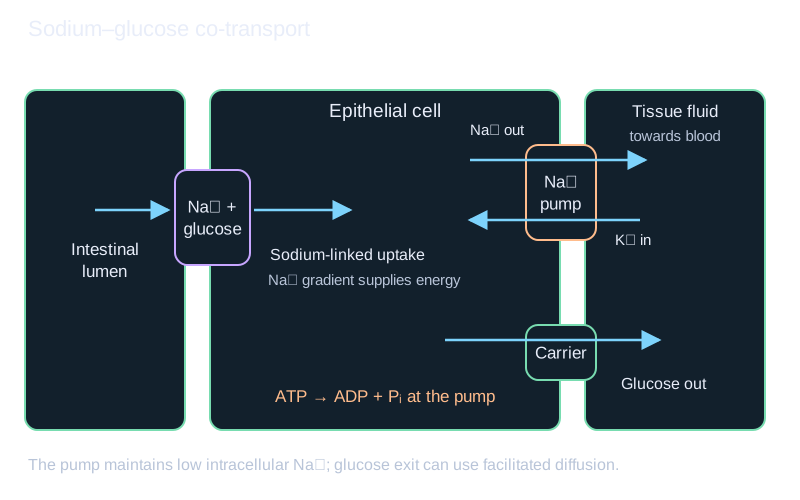
In an epithelial cell lining the ileum, the sodium–potassium pump in the membrane facing tissue fluid uses ATP to move sodium ions out of the cell, helping maintain a low intracellular sodium concentration. Sodium therefore has a tendency to enter from the intestinal lumen through suitable transport proteins.
A sodium–glucose co-transporter in the lumen-facing membrane binds sodium and glucose. Sodium movement down its electrochemical gradient is coupled to glucose uptake, which can occur against the glucose concentration gradient. The co-transporter is not simply hydrolysing one ATP directly each time it binds glucose; its energy dependence is indirect through the maintained sodium gradient.
3
Complete the absorption pathway
Glucose can leave the epithelial cell into tissue fluid through a different transporter by facilitated diffusion when the concentration gradient favours that direction. It can then enter the circulation. Microvilli increase the membrane area available for transport proteins, while mitochondria support the ATP demand of maintaining ion gradients.
Blocking ATP production can eventually reduce glucose uptake by allowing the sodium gradient to weaken. It need not stop every glucose molecule instantly because an existing gradient can persist briefly. Locate each membrane and transport direction clearly in a diagram; mixing the lumen-facing co-transporter with the tissue-facing pump loses the causal sequence.
4
Apply the biology
Try each question before opening the worked response. Use precise biological terms, connect each cause to its effect, and check units and assumptions when interpreting data.
Example 1A sodium-pump inhibitor reduces glucose absorption, although the glucose co-transporter does not directly hydrolyse ATP. Explain.
1The pump normally maintains a low sodium concentration inside the epithelial cell.
2Inhibition reduces the sodium gradient over time.
3Less energy is then available from sodium entry to drive co-transported glucose uptake.
AnswerAn indirectly ATP-dependent process can be inhibited by disrupting the gradient-maintaining pump.
Example 2Why does a large microvillus surface area support rapid absorption without proving that every absorbed substance uses active transport?
1More area permits more relevant channels or carriers and a greater exchange surface.
2Some solutes still move passively when their gradients favour entry.
3The structural adaptation increases capacity; the mechanism depends on the substance and gradient.
AnswerSeparate the effect of surface area from the classification of transport.
Common mistakes to avoid
Putting the sodium pump only in the lumen-facing membrane in this explanation.
Distinguish the two epithelial surfaces.
Saying the co-transporter must directly split ATP.
Explain indirect coupling through the sodium gradient.
Key takeaways
- ATP-driven transport establishes useful gradients.
- Sodium entry can drive glucose uptake against its gradient.
- Epithelial polarity and protein location make the pathway work.
Test yourself
Answer a few questions, then review anything you missed.
Next step
Browse practice topicsKeep practising
Start with the quiz above to check the key ideas. You can also choose another topic from the practice library.