Loading...
3.2.1.1CellsCore
Eukaryotic Cells and Specialisation
Identify organelles through their structures and explain why a particular cell needs them. A useful answer connects an adaptation to the cell’s actual work.
What you'll be able to do
- Relate organelle structures to their functions
- Follow a secreted protein through a cell
- Connect specialised cells, tissues, organs and systems
1
Organise information and energy transfer
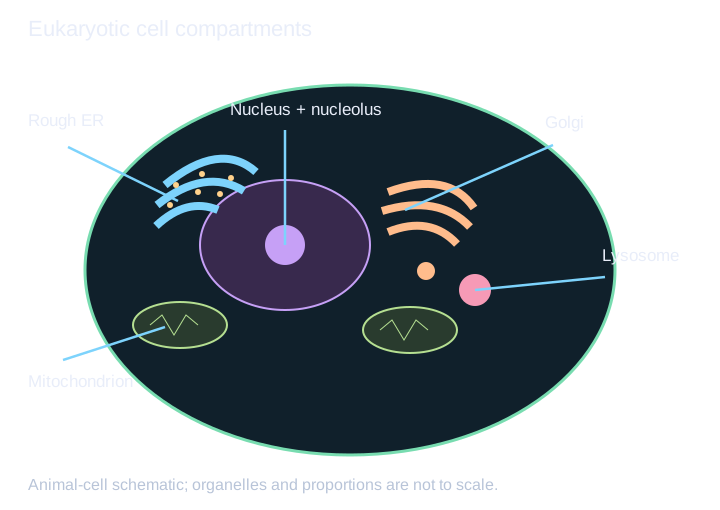
A eukaryotic nucleus is surrounded by an envelope and contains chromosomes made from linear DNA associated with proteins. Nuclear pores permit regulated exchange, including export of RNA. The nucleolus is involved in producing components of ribosomes. Ribosomes translate mRNA into polypeptides; they are not membrane-bound organelles.
Mitochondria have an outer membrane and a folded inner membrane forming cristae, with a matrix inside. These compartments support stages of aerobic respiration. Chloroplasts in plants and algae have thylakoid membranes and a surrounding stroma that support different photosynthetic reactions. Folded or stacked membranes increase the area available for particular reaction systems, rather than simply giving a cell more space.
2
Trace proteins and other cellular products
Rough endoplasmic reticulum has associated ribosomes and is involved in synthesis and processing of proteins destined for secretion or membranes. Transport vesicles carry material to the Golgi apparatus, which modifies, sorts and packages products. Secretory vesicles can fuse with the cell-surface membrane to release their contents.
Smooth endoplasmic reticulum lacks attached ribosomes and participates in lipid synthesis and other metabolic functions. Lysosomes contain hydrolytic enzymes in a membrane-bound compartment, allowing controlled digestion of material. The cell-surface membrane regulates exchange and communication; it is a dynamic phospholipid-and-protein structure, not a rigid wall.
3
Explain plant structures and specialised cells
Plant cells commonly have a cellulose wall and a large permanent vacuole bounded by a membrane. Vacuolar cell sap and water entry contribute to turgor; the wall resists expansion and provides support. Fungi also have cell walls, but their walls are not simply plant cellulose walls. Not every plant cell contains chloroplasts: many root cells are not photosynthetic.
Specialised cells combine organelles in proportions appropriate to function. A protein-secreting cell may have extensive rough ER, Golgi apparatus and mitochondria. Similar specialised cells form tissues; tissues work together in organs; organs cooperate in systems. Apply this hierarchy to a named example and avoid assuming every eukaryotic cell has the same visible structures.
4
Apply the biology
Try each question before opening the worked response. Use precise biological terms, connect each cause to its effect, and check units and assumptions when interpreting data.
Example 1A gland cell exports large quantities of a protein enzyme. Explain three likely adaptations.
1Many ribosomes and extensive rough ER support polypeptide synthesis and processing.
2A developed Golgi apparatus and many vesicles support modification, packaging and secretion.
3Numerous mitochondria support ATP-dependent processes involved in synthesis and transport.
AnswerRelate each named structure to a different stage of the secretory pathway.
Example 2A non-photosynthetic root cell has a wall, vacuole and nucleus but no chloroplasts. Is it necessarily abnormal?
1It has structures consistent with a eukaryotic plant cell.
2Root cells may not receive light or carry out photosynthesis, so chloroplasts are not required in every cell.
AnswerNo: organelle complement is linked to cell function and development.
Common mistakes to avoid
Saying every plant cell must contain chloroplasts.
Use the cell’s function and location.
Listing mitochondria without explaining the energy demand.
Name the ATP-dependent processes the cell performs.
Key takeaways
- Cell compartments support different biochemical activities.
- Protein secretion follows an organised membrane pathway.
- Specialisation links structure to a specific function.
Test yourself
Answer a few questions, then review anything you missed.
Next step
Browse practice topicsKeep practising
Start with the quiz above to check the key ideas. You can also choose another topic from the practice library.