Loading...
3.8.2.2Control of Gene ExpressionCore
Transcription Factors and RNA Interference
Gene expression can be controlled before RNA is made and after it is made. Identify the controlled stage before predicting a change in protein production.
What you'll be able to do
- Explain transcription-factor control
- Describe oestrogen-linked transcription
- Explain RNA interference and interpret expression data
1
Regulate access to transcription
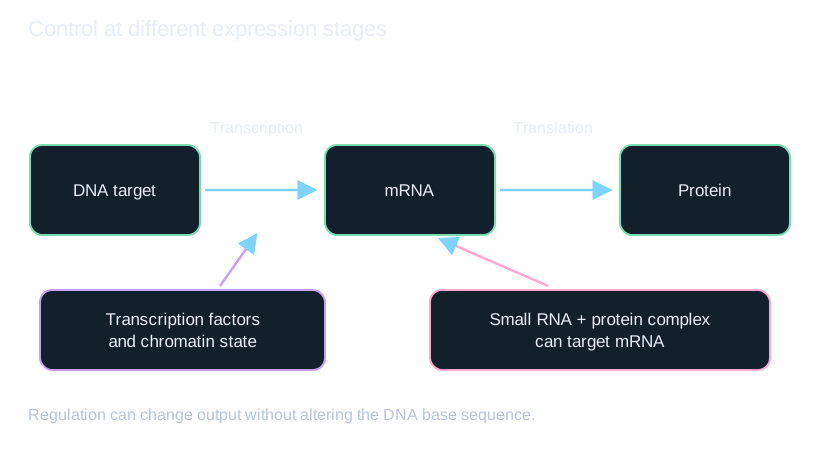
A transcription factor is a protein that influences transcription of target genes through interactions with regulatory DNA and other components. Some promote recruitment or activity of transcription machinery; others inhibit it. A gene’s presence does not imply continuous production of its RNA.
A signal can change a factor’s activity or location, including movement from cytoplasm to nucleus. Specific DNA-binding interactions help determine which genes respond. Saying a factor “turns on all DNA” loses both the target specificity and the possibility of inhibitory control.
2
Use oestrogen as a signalling example
Oestrogen is a steroid hormone that can cross the cell membrane and bind an intracellular receptor. In the relevant model, the activated hormone–receptor complex influences transcription by acting at suitable regulatory sequences in the nucleus and interacting with the transcription system.
Only cells with appropriate receptors and regulatory machinery show that particular response. Increased mRNA can later increase production of a protein, but a measurable protein change may be delayed by translation and turnover. Hormone concentration, receptor availability and other regulation can all affect the outcome.
3
Control the message through RNA interference
RNA interference uses small RNA molecules that guide a protein complex to complementary target mRNA. Depending on the system, this can promote mRNA cleavage or inhibit its translation. The DNA sequence need not change for protein output to fall.
To interpret an experiment, distinguish measurements of DNA copy number, mRNA abundance and protein amount. Reduced protein with similar mRNA could support translational control or increased protein breakdown; reduced mRNA could support altered transcription or message stability. A single measurement rarely identifies one unique regulatory mechanism without controls and further evidence.
4
Apply the biology
Try each question before opening the worked response. Use precise biological terms, connect each cause to its effect, and check units and assumptions when interpreting data.
Example 1A treatment leaves a gene’s DNA sequence unchanged but lowers its mRNA and protein amounts. Is mutation the only explanation?
1No: transcriptional inhibition or increased mRNA degradation can reduce the message.
2Less available mRNA can reduce translation and protein abundance.
3Further experiments are needed to distinguish the regulatory steps.
AnswerExpression can change without a base-sequence mutation.
Example 2Why can a small RNA be relatively specific for one target mRNA?
1Its sequence can be complementary to a region of the target.
2Base pairing guides the regulatory complex towards that message.
3Specificity still depends on sequence matching and experimental conditions.
AnswerUse complementarity rather than saying every RNA molecule inhibits every gene.
Common mistakes to avoid
Treating all gene regulation as mutation.
Distinguish expression from sequence.
Assuming an mRNA measurement directly gives the amount of active protein.
Consider translation, processing and degradation.
Key takeaways
- Transcription factors affect selected genes.
- Hormonal signals can alter transcriptional activity.
- RNA-level and protein-level controls require distinct evidence.
Test yourself
Answer a few questions, then review anything you missed.
Next step
Browse practice topicsKeep practising
Start with the quiz above to check the key ideas. You can also choose another topic from the practice library.