Loading...
H432 · PAG6; 6.2.5, 6.3.1Practical Activity GroupsCore
PAG6: Organic Solids, Purity and Chromatography
A preparation first forms an organic product using the teacher-selected reaction, then separates and purifies it. The particular approved solid is an example of the required skill, rather than a universal requirement to use a single synthesis. Use the provided stoichiometry to identify the limiting reagent and theoretical product amount. Impurities may include starting material, by-products and solvent.
Before you start
- OCR PAGs group practical skills. These are worked contexts for the group; your centre may select suitable alternatives. Independent supervised competence across the required skills is assessed separately.
- Calculate a limiting-reagent yield and explain solubility changes with temperature.
- Use these notes to prepare for teacher-approved laboratory work. Follow the laboratory risk assessment, eye protection, handling and disposal instructions; a reading or quiz does not record Practical Endorsement evidence.
- This group includes filtration, recrystallisation, melting-point measurement and chromatography; reflux is mapped across PAG5/PAG6 as appropriate to the selected activities.
Watch, pause, try
Video by Royal Society of Chemistry. Use the demonstration alongside this lesson’s specification reference and written explanations.
Viewing focus: Explain synthesis, filtration and recrystallisation of an organic solid
After watching, attempt these questions before opening the answers. You can also use the written lesson below.
After watching 1: Why minimise the hot recrystallisation solvent volume?
Show answer and reasoning
To reduce product left dissolved after cooling. A larger cold solvent volume retains more dissolved product at its solubility limit.
After watching 2: Why wash crystals with a small amount of cold solvent?
Show answer and reasoning
To remove adhering solution while limiting product dissolution. Soluble surface impurities can be removed with limited loss of product.
What you'll be able to do
- Explain synthesis, filtration and recrystallisation of an organic solid
- Evaluate dry yield and melting-range evidence
- Use chromatography as an independent test of composition
1
Separate synthesis from purification
A preparation first forms an organic product using the teacher-selected reaction, then separates and purifies it. The particular approved solid is an example of the required skill, rather than a universal requirement to use a single synthesis. Use the provided stoichiometry to identify the limiting reagent and theoretical product amount. Impurities may include starting material, by-products and solvent.
Recrystallisation relies on the product being appreciably soluble in a suitable hot solvent and much less soluble when cold. A good solvent also has a useful behaviour for impurities and does not react with the product. Add the minimum sufficient hot solvent specified by the method. Excess solvent leaves more product dissolved at the final temperature, lowering recovery.
2
Explain the sequence and the trade-offs
If insoluble impurity is present, an appropriate hot filtration removes it before crystals form; the apparatus and method should limit premature crystallisation. Allow the filtrate to cool so the product crystallises, then use the specified further cooling. Collect crystals by suction filtration using sound apparatus designed for reduced pressure. Wash with a small amount of cold solvent to remove surface solution while limiting product dissolution.
Dry the product by the approved method before weighing or measuring a melting range. A wet crystal mass is not a valid isolated product yield. Handle hot solvent, flammable vapours and vacuum glassware according to the laboratory procedure. A higher crude mass can mean more retained impurity rather than better synthesis.
3
Use multiple pieces of purity evidence
Report a melting range, from first visible melting to complete melting, with a controlled heating rate near the expected value. An impure solid often melts over a broader range at a depressed temperature, but agreement with a literature value is supporting evidence rather than absolute proof. Sample packing, residual solvent, thermometer calibration and fast heating can distort the range.
Calculate percentage yield as dry recovered product divided by theoretical product, using matching units. Distinguish reaction yield from recrystallisation recovery: recovery compares purified mass with the crude mass processed, which itself may contain impurities. Evaluate whether a lower recovered mass reflects product left in solution or successful removal of unwanted material.
4
Control the conditions that create separation
TLC uses a thin stationary phase, commonly silica, on a plate and a moving solvent. Different components move different distances because their interactions with both phases differ. Mark a pencil baseline above the solvent level and apply small concentrated sample and reference spots with a capillary. Let applications dry; repeated small applications can concentrate a sample without making a broad initial spot.
Place the plate in the development chamber without submerging the baseline. A cover reduces solvent evaporation and helps provide more consistent chamber conditions. Avoid disturbing the plate. Follow the approved solvent and ventilation arrangements; many mobile phases are volatile and flammable. Handle a plate by its edges to avoid contaminating the stationary surface.
5
Make a measurement that remains interpretable
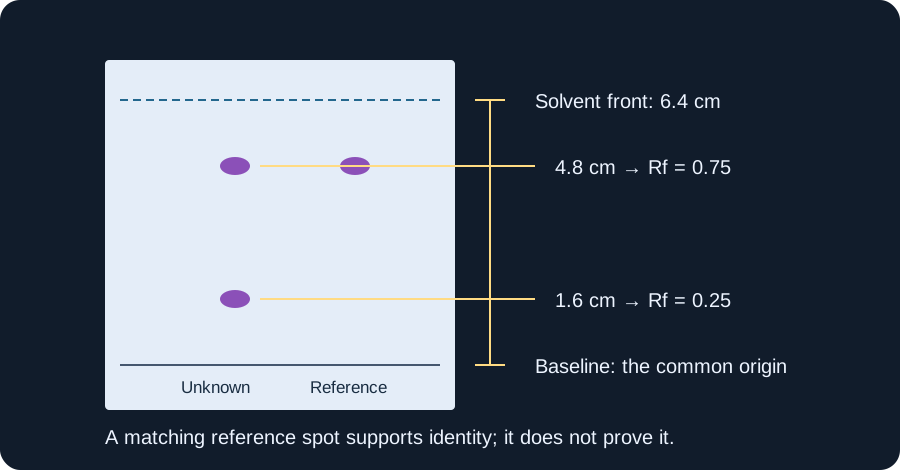
Remove the plate before the front reaches the top and mark the solvent front immediately in pencil, before it evaporates. Measure from the baseline to the centre of each spot and from that same baseline to the front. Rf = spot distance/front distance, so it has no unit. Using the plate edge for one distance and the baseline for the other gives an invalid ratio.
Colourless compounds need a suitable visualisation method. Use UV only with the specified shielded viewing equipment and protection; do not look directly into an unshielded source. Some approved visualising reagents alter the sample, so record the developed pattern as instructed. A streak rather than a discrete spot may indicate overloading or an unsuitable solvent system.
6
Distinguish useful evidence from proof
Run unknown and reference on the same plate with the same solvent. Rf depends on the mobile phase, stationary phase and conditions, so a tabulated number from a different system is not a reliable direct comparison. A matching spot supports a possible identity; different compounds can travel together. A second solvent system or independent spectral evidence provides a stronger test.
More than one spot supports a mixture if the spots arise from sample components. One spot does not prove complete purity: components may co-migrate or escape the visualisation method. Improve resolution with a suitable solvent composition, smaller starting spots and controlled development. Do not merely develop longer if the front is already near the plate edge.
7
Worked applications
Attempt these problems on paper before opening the worked reasoning. Explain your steps as well as giving a final answer.
Example 1A synthesis theoretically makes 3.60 g of product. The dry recrystallised mass is 2.52 g. Find isolated percentage yield.
1Use dry isolated product, not the wet filter cake.
2100 × 2.52/3.60 = 70.0.
Answer70.0%.
Example 2A crude product melts at 119–127 °C and a purified sample at 130–132 °C. The expected range is 131–133 °C. What can be concluded?
1The purified sample has a narrower, higher range closer to the expected value.
2This supports improved purity, but measurement conditions and independent identity evidence still matter.
AnswerPurification appears effective; the melting result alone does not prove complete purity.
Example 3The solvent front moves 6.4 cm from the baseline. A sample has spot centres at 1.6 and 4.8 cm. Calculate Rf values.
1First component: 1.6/6.4 = 0.25.
2Second component: 4.8/6.4 = 0.75.
Answer0.25 and 0.75, without units; two detected components are present.
Example 4An unknown gives one spot at Rf 0.60, matching a reference on the same plate. What further evidence would strengthen the identification?
1A match in one solvent system can result from co-migration.
2Compare in a different suitable solvent system or use independent spectroscopic evidence.
AnswerA second independent comparison strengthens identity; the single spot alone does not establish complete purity.
Common mistakes to avoid
Weighing wet crystals as pure product.
Dry before weighing and report the method.
Equating high recovery with high purity.
Use purity evidence separately from recovered mass.
Key takeaways
- You can explain synthesis, filtration and recrystallisation of an organic solid.
- You can evaluate dry yield and melting-range evidence.
- You can use chromatography as an independent test of composition.
Apply it in an exam
Question 1: A crude product melts at 119–127 °C and a purified sample at 130–132 °C. The expected range is 131–133 °C. What can be concluded?
Show answer and reasoning
Purification appears effective; the melting result alone does not prove complete purity.
- The purified sample has a narrower, higher range closer to the expected value.
- This supports improved purity, but measurement conditions and independent identity evidence still matter.
Explore further
- OCR H432 official specification (opens in a new tab)
Check the assessed scope and practical or mathematical requirements.
- Read or explore this topic (opens in a new tab)
An external explanation or interactive activity to use alongside the lesson. It may include extension material.
Return to this tomorrow
Close the notes and answer from memory. Revisit any explanation you cannot yet reconstruct.
- Why wash crystals with a small amount of cold solvent?
- What does a yield over 100% most strongly suggest?
Test yourself
Answer a few questions, then review anything you missed.
Next step
Browse practice topicsKeep practising
Start with the quiz above to check the key ideas. You can also choose another topic from the practice library.