Loading...
1.1.1(c), 1.1.1(d)Processors, Devices and StorageCore
Pipelines, Throughput and Hazards
A pipeline overlaps stages of different instructions. Use a timing diagram to distinguish how quickly one instruction finishes from how frequently completed instructions emerge.
What you'll be able to do
- Trace an ideal three-stage instruction pipeline
- Calculate throughput and explain the assumptions
- Explain data, control and resource hazards
1
Overlap different instructions
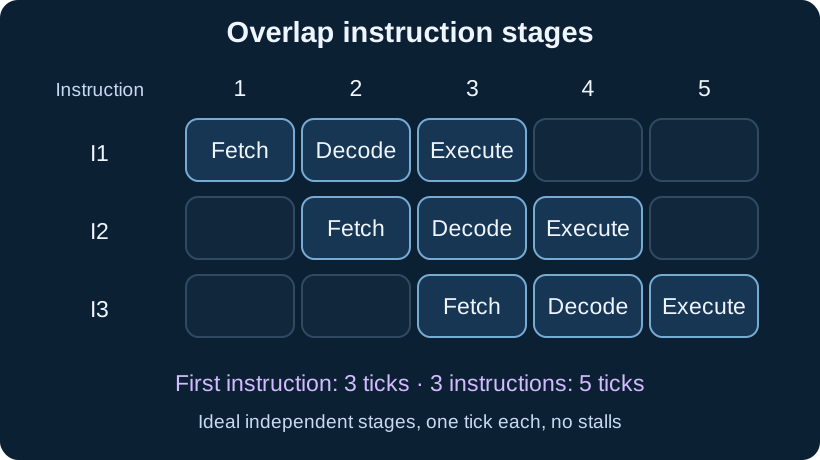
Consider a simplified processor with fetch, decode and execute stages, each taking one clock tick. Without overlap, one instruction occupies three ticks before the next starts. With separate stage resources, instruction 2 can be fetched while instruction 1 is decoded. The instructions remain distinct even though they are active together.
For n instructions and k equal-length stages, an ideal initially empty pipeline takes k+n−1 ticks. Six instructions in three stages therefore take eight ticks instead of eighteen. This formula assumes no stalls, no competing resource use and equal stage times; a question with different assumptions needs its own timeline.
2
Separate latency from throughput
Latency is the time taken by one instruction from entry to completion. In the simple example it remains three ticks. Once the pipeline is full, throughput is one completed instruction per tick. Saying that every instruction now takes one tick confuses these two measurements.
The slowest stage constrains the clock period in a basic synchronous pipeline. Dividing a processor into more stages can change the period, but adds overhead and can increase the cost of a branch misprediction. Clock frequency alone does not determine the time a whole program takes. Compare the same workload and include stalls and memory delays.
3
Explain why the ideal may fail
A data hazard occurs when an instruction needs a result not yet available from an earlier instruction. A stall or forwarding mechanism may be needed. A control hazard arises when a branch makes the next instruction address uncertain. Instructions fetched along an incorrect path may need to be discarded.
A structural hazard occurs when stages need the same limited resource at once. These issues can reduce useful throughput. Pipelining is also a broader software idea: processing one data item in a later stage while the next enters an earlier stage. Dependencies, buffering and stage balance still matter; overlap is not a guarantee of proportional speedup.
| Tick | Fetch | Decode | Execute |
|---|---|---|---|
| 1 | I1 | — | — |
| 2 | I2 | I1 | — |
| 3 | I3 | I2 | I1 |
| 4 | I4 | I3 | I2 |
| 5 | I5 | I4 | I3 |
| 6 | I6 | I5 | I4 |
| 7 | — | I6 | I5 |
| 8 | — | — | I6 |
4
Work through the problem
Attempt the task before opening its worked response. Record each change of state, explain the rule used, and check the result against the original requirements. Code examples labelled Python 3 use that language’s conventions; pseudocode states its own assumptions.
Example 1Calculate the ideal speedup for six instructions in the table.
1Sequential time is 6×3=18 ticks.
2Pipeline time is 3+6−1=8 ticks; divide 18 by 8.
Answer2.25 times, under the stated equal-stage, no-stall model.
Example 2Instruction I2 uses the result calculated by I1, but that result is not ready when I2 needs it. Explain the problem.
1The dependency creates a data hazard.
2The processor must preserve the required order, for example by stalling until the value is available or forwarding a result where supported.
AnswerUseful throughput can fall below one instruction per tick.
Common mistakes to avoid
Calling pipeline throughput the latency of one instruction.
Track entry and completion for one instruction separately.
Assuming three stages always triple performance.
Account for filling, draining, hazards and workload.
Key takeaways
- Pipelining overlaps stages of different instructions.
- Ideal throughput and individual latency differ.
- Hazards and resource limits reduce the ideal benefit.
Test yourself
Answer a few questions, then review anything you missed.
Next step
Browse practice topicsKeep practising
Start with the quiz above to check the key ideas. You can also choose another topic from the practice library.
Related lessons
All 4 lessons- Same chapterBuses, Memory and Computer ArchitecturesDescribe processor, memory, buses and I/O controllers
- Same chapterProcessor Registers and Fetch–ExecuteExplain the ALU, control unit, clock and registers
- Same chapterRISC, CISC, GPUs and Parallel SystemsCompare the RISC and CISC models with appropriate qualifications