Loading...
3.9.2.5AstrophysicsCore
HR Diagrams and Stellar Evolution
The Hertzsprung–Russell diagram connects temperature, luminosity and radius. Read its unusual axes, then trace a Sun-like star through its changing energy sources. This lesson is part of the Astrophysics option; study it if this is your centre’s chosen Paper 3 Section B topic.
What you'll be able to do
- Locate main-sequence stars, giants and white dwarfs
- Use position to compare stellar radii
- Trace the evolution of a Sun-like star on an HR diagram
1
Read the axes before interpreting the pattern
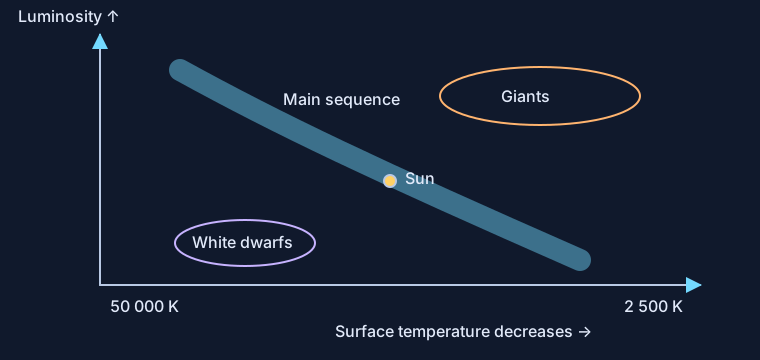
Temperature decreases from left to right, typically from 50000 K to 2500 K, or the axis uses spectral classes OBAFGKM. Luminosity increases upwards. If absolute magnitude is used instead, values become more negative upwards, often from +15 at the bottom to −10 at the top.
Main-sequence stars form a band from hot, luminous upper left to cool, faint lower right. Giants occupy the luminous cool region at upper right; white dwarfs are hot but faint at lower left. The Sun is a main-sequence G star at about 5800 K and absolute magnitude +4.8.
2
Use Stefan’s law to infer size
A cool star can still be very luminous if its emitting surface is enormous: that is the giant region. A hot star can be faint if its radius is small: that is the white-dwarf region. At fixed temperature the star higher on the diagram has the larger surface area. At fixed luminosity the hotter star must have the smaller radius.
The main sequence is a population of stars of different masses, rather than a path that one star travels from top left to bottom right as it ages. Position on it depends strongly on stellar mass.
3
A Sun-like star’s journey
A contracting cloud releases gravitational potential energy and forms a protostar. Once its core is hot enough for sustained hydrogen fusion, it joins the main sequence. Outward pressure supports the star against gravity while energy is transported outwards.
When core hydrogen runs out, the core contracts and hydrogen burning continues in a shell. The outer layers expand and cool while luminosity rises: the star moves towards the red-giant region. Later helium fusion occurs in the core. Eventually outer layers are expelled, leaving a hot compact white dwarf. With no sustained fusion, the remnant cools and fades. A Sun-like star does not normally become a core-collapse supernova.
4
Work through the reasoning
Try each problem before opening the worked solution. State the physical model, show substitutions with consistent units, and explain what your answer means.
Example 1Two stars have equal luminosity. Star A is twice as hot as B. Compare their radii.
1 is constant.
2.
AnswerA has one quarter the radius of B.
Example 2A star moves upwards and rightwards from the main sequence. Explain the changes.
1Rightwards means a lower surface temperature.
2Upwards means a greater luminosity, even if absolute magnitude becomes numerically smaller.
3Stefan’s law therefore requires a substantial increase in radius.
AnswerIt becomes cooler at the surface, more luminous and much larger, consistent with a red giant.
Common mistakes to avoid
Moving a star along the main sequence to represent every stage of its life.
Its post-main-sequence path leaves that band.
Reading a larger positive absolute magnitude as more luminous.
The magnitude scale is reversed.
Key takeaways
- HR axes need careful interpretation.
- Giants are large; white dwarfs are compact.
- A Sun-like star evolves off the main sequence and ends as a cooling white dwarf.
Test yourself
Answer a few questions, then review anything you missed.
Next step
Browse practice topicsKeep practising
Start with the quiz above to check the key ideas. You can also choose another topic from the practice library.