Loading...
3.9.1.1, 3.9.1.2AstrophysicsCore
Refracting and Reflecting Telescopes
A telescope increases the angle an object subtends at your eye. Follow the rays through a refractor and a Cassegrain reflector to see why magnification, image formation and aperture are different design choices. This lesson is part of the Astrophysics option; study it if this is your centre’s chosen Paper 3 Section B topic.
What you'll be able to do
- Draw a refractor in normal adjustment
- Calculate angular magnification and telescope length
- Explain Cassegrain ray paths and compare optical aberrations
1
Normal adjustment: a shared focal plane
Light from a very distant point reaches the objective as a parallel bundle. The long-focal-length converging objective forms a real, inverted image in its focal plane. The eyepiece is positioned so that this plane is also its first focal plane. Rays from each image point then emerge parallel, producing a final virtual image at infinity for a relaxed eye.
Draw two parallel oblique rays from one distant point, refract them through the objective to a point below the axis, then through the eyepiece as another parallel bundle. Label both focal lengths, the intermediate image and the angles to the axis. The lens separation is the sum of the focal lengths. The positive magnification formula gives the magnitude; the image is inverted.
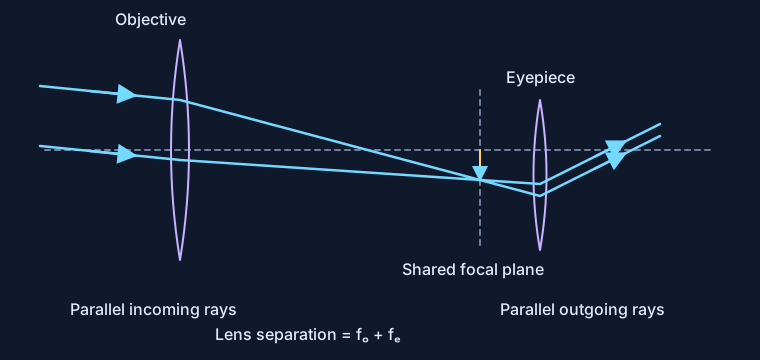
Normal adjustment for two thin converging lenses.
2
The Cassegrain reflector
Incoming rays reflect from a large concave parabolic primary towards its focus. A smaller convex secondary intercepts the converging beam and reflects it back through a hole in the primary to the eyepiece. This folds a long optical path into a short tube. Trace the beam in that order rather than drawing the secondary as a converging lens.
A lens refracts different wavelengths by different amounts, producing chromatic aberration and coloured edges. Reflection does not disperse colours this way. A spherical mirror also brings marginal and near-axis rays to different foci; a parabolic primary reduces this spherical aberration for on-axis rays.
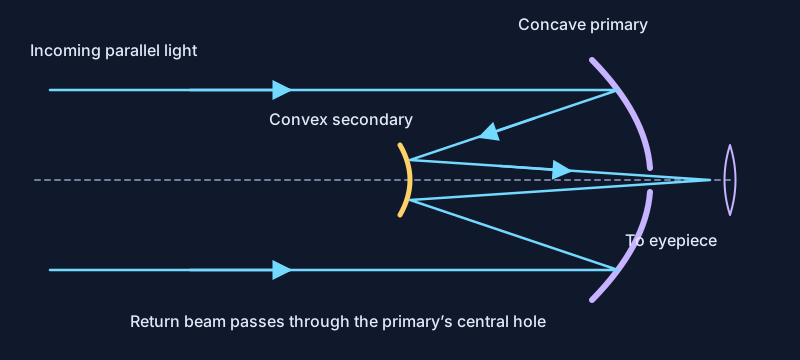
3
Choosing an instrument
Large mirrors can be supported from behind, making very large apertures practical. A large objective lens is heavy and supported at its edge; absorption in thick glass and chromatic aberration are disadvantages. Reflectors need alignment and their secondary obstructs some incoming light. A shorter eyepiece focal length increases magnification but cannot recover detail already lost through diffraction or atmospheric turbulence.
4
Work through the reasoning
Try each problem before opening the worked solution. State the physical model, show substitutions with consistent units, and explain what your answer means.
Example 1A refractor has an objective of focal length m and an eyepiece of focal length m. Find its magnification and length in normal adjustment.
1.
2 m.
AnswerAngular magnification 30; separation 1.24 m.
Example 2A student replaces the eyepiece above by a 20 mm lens. Explain two consequences.
1Convert mm to m.
2; m.
3The angular image doubles in size; the unchanged objective aperture does not improve diffraction-limited resolution.
AnswerTwice the magnification, with a slightly shorter tube; unchanged intrinsic resolving power.
Equation recap
Normal adjustment for two thin converging lenses.
Common mistakes to avoid
Drawing the final image on a screen at the eyepiece.
Normal adjustment places the final image at infinity; the intermediate image is real.
Calling a spherical mirror parabolic.
These shapes have different focusing properties; label the primary parabolic.
Key takeaways
- Normal adjustment uses a shared focal plane and parallel emerging rays.
- A Cassegrain uses a concave parabolic primary and convex secondary.
- Magnification depends on focal lengths; resolution also depends on aperture.
Test yourself
Answer a few questions, then review anything you missed.
Next step
Browse practice topicsKeep practising
Start with the quiz above to check the key ideas. You can also choose another topic from the practice library.