Loading...
3.13.3.2, 3.13.4.1, 3.13.4.2ElectronicsCore
Comparators and Amplifier Gain
An operational amplifier can compare two voltages or, with negative feedback, produce a controlled gain. The virtual-earth approximation belongs to linear feedback operation, not every op-amp circuit. This lesson is part of the Electronics option; study it if this is your centre’s chosen Paper 3 Section B topic.
What you'll be able to do
- Explain ideal op-amp input and gain properties
- Predict comparator output and clipping
- Derive the inverting gain and use non-inverting gain
1
Comparator operation
An ideal op-amp has infinite input resistance and infinite open-loop voltage gain. For a real device, only while output remains within its available supply limits. The supply connections provide output energy and must not be confused with the signal inputs.
Without negative feedback, even a small input difference can drive the output to a high or low saturation level. If the non-inverting input is above the inverting input, the output tends high; if below, it tends low. This makes a comparator useful for detecting a sensor crossing a reference voltage.
2
Derive the inverting amplifier
With negative feedback and an unsaturated output, the large gain makes the input difference very small. If the non-inverting input is at 0 V, the inverting node is approximately 0 V: a virtual earth. It is not physically connected to earth, and essentially no current enters the op-amp input.
The input resistor current is . It must flow through the feedback resistor, where the voltage difference is . Equating currents gives the negative gain. If the predicted output exceeds the supply range, this linear analysis fails and the output clips.
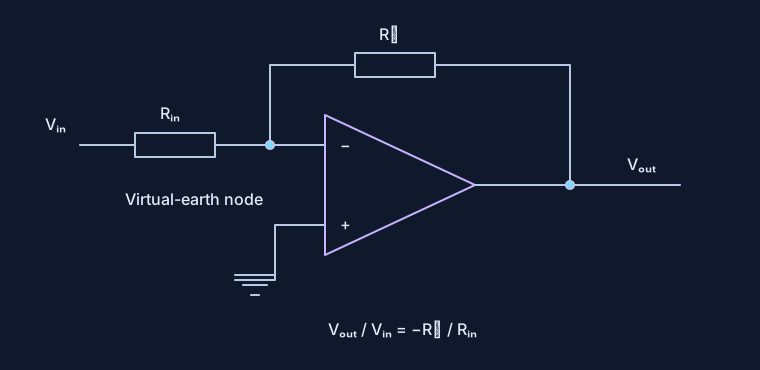
Derivation required: state negligible input current and the virtual-earth approximation.
3
Non-inverting amplification
A non-inverting amplifier applies the signal to the + input and feeds a fraction of the output to the − input through a resistor divider. Negative feedback makes the divider voltage approximately equal to the input, giving a positive closed-loop gain.
The input source sees a high input resistance. Its output has the same polarity as the input for slow signals within the operating range. Use the supplied resistor positions consistently: Rf joins output to the inverting input and R1 joins that input to 0 V.
The non-inverting closed-loop gain is at least one for positive resistances.
4
Work through the reasoning
Try each problem before opening the worked solution. State the physical model, show substitutions with consistent units, and explain what your answer means.
Example 1An inverting amplifier uses 10 kΩ input and 100 kΩ feedback resistors. Find output for +0.20 V input.
1.
2 V.
3Check that −2.0 V is within the stated supply/output range.
Answer−2.0 V if the amplifier is operating linearly.
Example 2A non-inverting amplifier has Rf=90 kΩ and R1=10 kΩ on output rails ±12 V. Predict output for +1.5 V input in the ideal rail-limited model.
1.
2The linear prediction is +15 V, outside the available range.
3The output saturates near the positive limit rather than reaching +15 V.
AnswerNear +12 V in the stated ideal model; a real device may reach a smaller swing.
Equation recap
Derivation required: state negligible input current and the virtual-earth approximation.
The non-inverting closed-loop gain is at least one for positive resistances.
Common mistakes to avoid
Applying virtual earth to an open-loop comparator.
A comparator normally saturates and need not have nearly equal inputs.
Ignoring output supply limits.
Check the predicted output before using linear gain equations.
Key takeaways
- Comparators detect the sign of an input difference.
- Negative feedback controls gain when the output remains unsaturated.
- Virtual-earth current balance derives the inverting gain.
Test yourself
Answer a few questions, then review anything you missed.
Next step
Browse practice topicsKeep practising
Start with the quiz above to check the key ideas. You can also choose another topic from the practice library.