Loading...
3.12.3.1, 3.12.3.2Turning Points in PhysicsCore
Michelson–Morley and Special Relativity
An interferometer looked for a change in light travel time as Earth moved through a supposed stationary medium. The null result challenged absolute-motion ideas and fits the invariance central to special relativity. This lesson is part of the Turning Points in Physics option; study it if this is your centre’s chosen Paper 3 Section B topic.
What you'll be able to do
- Explain the interferometer’s two paths and expected fringe shift
- Describe the significance and limits of its null result
- State inertial-frame and light-speed postulates
1
Split, reflect and recombine
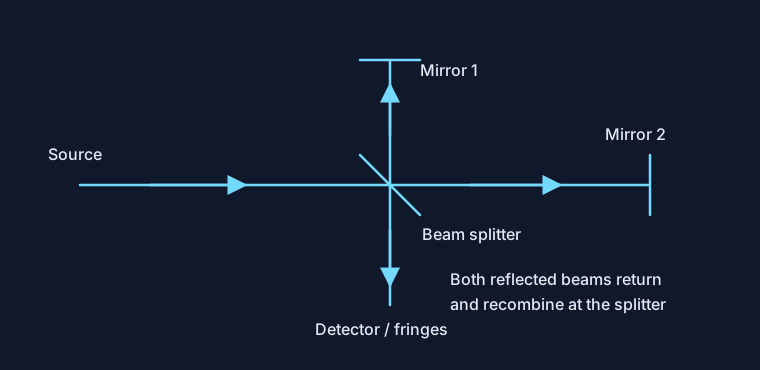
A partially reflecting plate splits a beam into perpendicular arms. Mirrors return the two beams to the splitter, where they recombine and interfere. A compensating plate can equalise glass paths. A change in relative travel time changes phase difference and shifts fringes.
In an ether-wind model, Earth’s motion was expected to affect light travel times differently along parallel and perpendicular arms. Rotating the apparatus should change that difference and move the fringes. It is the change on rotation that matters, not a requirement that the apparatus have zero path difference initially.
2
Interpreting the null result
No expected rotation-dependent shift was found within the sensitivity of the experiment. This undermined the simple stationary-ether account. A null result means the predicted measurable effect was absent within uncertainty, rather than that the instrument recorded no light or no fringes.
The result is consistent with the same vacuum light speed in all inertial frames. It did not by itself prove every consequence of relativity; it forms part of a wider body of experimental evidence. Explain the predicted signal before explaining the failure to observe it.
3
Einstein’s two postulates
An inertial frame is one in which a free body moves at constant velocity: the frame is not accelerating or rotating. Physical laws have the same form in all inertial frames, and the speed of light in vacuum has the same value for all inertial observers, irrespective of the motion of source or observer.
These postulates require changes to classical ideas of space and time rather than adding source speed to c. Relative velocities between ordinary objects still exist; what is rejected is a preferred inertial frame identifiable through different vacuum light speeds.
4
Work through the reasoning
Try each problem before opening the worked solution. State the physical model, show substitutions with consistent units, and explain what your answer means.
Example 1A change in optical path difference of 300 nm occurs with 600 nm light. Find the change in phase and the fringe displacement.
1Path change is wavelength.
2Phase change is rad.
3The fringe pattern shifts by half a fringe spacing.
Answerπ rad; half a fringe.
Example 2A source moves towards an inertial observer at 0.20c and emits a vacuum light pulse. What speed does the observer measure for the pulse?
1Apply the invariant-light-speed postulate.
2Do not add the source speed to c.
3The observed frequency may change, but the vacuum propagation speed does not.
Answerc, not 1.20c.
Common mistakes to avoid
Describing the experiment as having no interference pattern.
The null result concerned the expected fringe change on rotation.
Adding the source speed to vacuum light speed.
The measured light speed remains c in an inertial frame.
Key takeaways
- Interferometry measures relative optical-path changes.
- The expected ether-related fringe shift was absent.
- Relativity treats physical laws and vacuum c as invariant across inertial frames.
Test yourself
Answer a few questions, then review anything you missed.
Next step
Browse practice topicsKeep practising
Start with the quiz above to check the key ideas. You can also choose another topic from the practice library.