Loading...
75–81Waves and the Particle Nature of LightCore
Thin Lenses and Image Formation
A lens changes the directions of rays; an image is located where those rays meet or appear to originate. Use ray geometry to decide image type before applying a signed lens equation.
What you'll be able to do
- Construct converging and diverging lens ray diagrams
- Use the real-is-positive convention consistently
- Calculate magnification and powers of thin lenses in contact
1
Principal rays and focal length
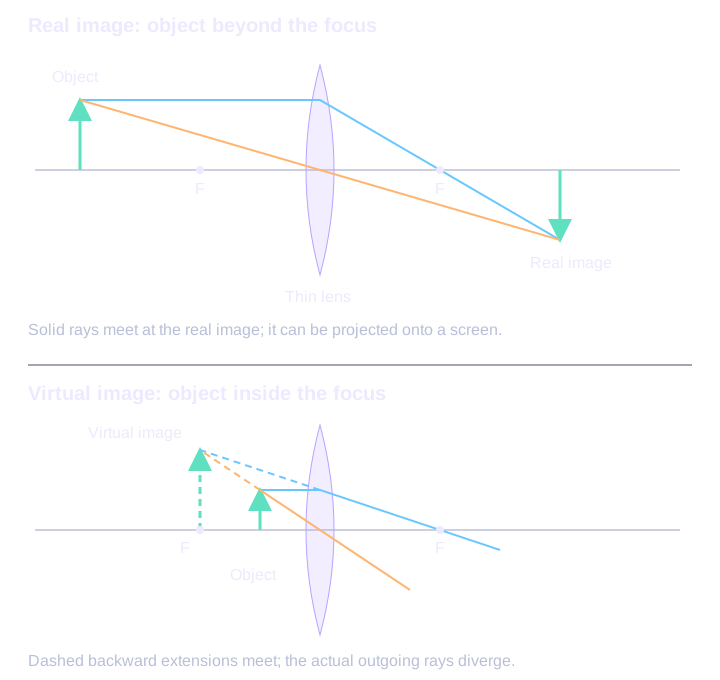
A converging lens brings rays parallel to its principal axis to the far principal focus. A ray through the optical centre of a thin lens continues approximately straight. A ray through the near focus emerges parallel to the axis. Use any two of these rays from the top of an object to locate its image.
A diverging lens makes an incident parallel ray diverge as though it originated at the near focus. Draw the actual outgoing rays as solid lines and their backward extensions as dashed lines. The focal length is the distance from the lens to a principal focus; the two thin-lens focal points are equally distant in the same surrounding medium.
2
Real and virtual images
A real image forms where actual rays converge and can be projected onto a screen placed there. A virtual image is where backward extensions meet; a screen at that apparent position cannot collect converging rays into the image. Both image types can be seen by an eye receiving the outgoing light.
For a real object beyond a converging lens’s focal point, the image is real and inverted. Between lens and focus, the image is virtual, upright and magnified. A diverging lens with a real object produces a virtual, upright and diminished image. An object at the focus of an ideal converging lens gives parallel emerging rays, with no finite image distance.
3
Use the specified sign convention
Edexcel uses the real-is-positive convention: a real object distance u is positive, a real image distance v is positive, and a virtual image distance v is negative. A converging focal length f is positive and a diverging focal length is negative. Measure object and image distances from the thin lens, not from each other.
Substitute signs before solving. The magnitude of image size divided by object size is |v/u|. With this convention, v/u is the signed ratio in the formula listing; use the ray diagram to state orientation explicitly. Do not interpret a positive real-image distance as proof that the image is upright.
4
Lens power and combinations
Lens power is reciprocal focal length in metres, measured in dioptres (m⁻¹). A stronger converging lens has a shorter positive focal length and a greater positive power. A diverging lens has negative power. Converting centimetres to metres before taking the reciprocal avoids a factor-of-100 error.
For thin lenses sufficiently close together, add their signed powers. A converging and diverging lens can partly cancel. The reciprocal of their total power gives the effective focal length; do not add focal lengths. For substantially separated lenses the simple in-contact rule is insufficient.
5
Work through the reasoning
Try each problem before opening the worked solution. State the physical model, show substitutions with consistent units, and explain what your answer means.
Example 1A real object is 30 cm from a converging lens of focal length 10 cm. Find image position and size ratio.
1 in cm⁻¹.
2 cm and .
AnswerA real inverted image 15 cm beyond the lens, half the object height.
Example 2The same lens has a real object 6.0 cm away. Locate the image.
1.
2 cm and .
AnswerA virtual upright image 15 cm from the lens on the object side, magnified 2.5 times.
Example 3A diverging lens has f=−20 cm and a real object at u=30 cm. Find v.
1.
2 cm; .
AnswerVirtual, upright and diminished, 12 cm on the object side.
Example 4Thin lenses of +5.0 D and −2.0 D are in contact. Find their effective focal length.
1 D.
2 m.
AnswerAbout +0.33 m: the combination is converging.
Equation recap
Equation recap
Equation recap
Common mistakes to avoid
Mixing a negative diverging focal length with unsigned image distances.
Apply one complete sign convention.
Adding focal lengths for lenses in contact.
Add signed powers, then invert.
Calling a virtual image invisible.
An eye can receive the diverging rays and see an apparent image.
Key takeaways
- Ray diagrams identify real and virtual images.
- Use signed distances consistently in the thin-lens equation.
- Add powers for thin lenses in contact.
Test yourself
Answer a few questions, then review anything you missed.
Next step
Browse practice topicsKeep practising
Start with the quiz above to check the key ideas. You can also choose another topic from the practice library.