Loading...
1BI0 · CP8.11Core practical investigationsCore
CP8.11: Temperature and Respiration
Aerobically respiring organisms consume oxygen and can produce carbon dioxide. In the specified respirometer model, a suitable carbon dioxide absorbent is kept separate from the organisms. With that gas accounted for, a decrease in the system’s gas amount can support an oxygen-uptake measurement under the stated apparatus conditions.
Before you start
- Use your teacher’s tier checklist: this overview can include Higher-only material, and is not a tier-specific revision list.
- Pearson Edexcel GCSE Biology 1BI0 core-practical preparation. Use the actual specification reference rather than another board’s practical number.
- Recall aerobic respiration and calculate a change per unit time.
- Use the centre’s approved practical method, supervision and safety arrangements. Written preparation and quiz results do not replace carrying out and recording the required practical work.
Watch, pause, try
Video by Michael Ralph. The demonstration explains the shared respirometer model. For this GCSE core practical, apply the specified temperature comparison, water bath, organism controls and ethical requirements.
Viewing focus: Explain the gas balance in an oxygen-use respirometer
After watching, attempt these questions before opening the answers. You can also use the written lesson below.
After watching 1: Why account for produced carbon dioxide?
Show answer and reasoning
It can offset the gas decrease caused by oxygen uptake. The gas balance depends on consumption and production.
After watching 2: Why use a matched temperature control?
Show answer and reasoning
Gas changes can occur without respiration. Separate physical changes from the intended biological signal.
What you'll be able to do
- Explain the gas balance in an oxygen-use respirometer
- Compare temperature treatments with suitable controls
- Calculate a calibrated, normalised uptake rate
1
Account for both gases
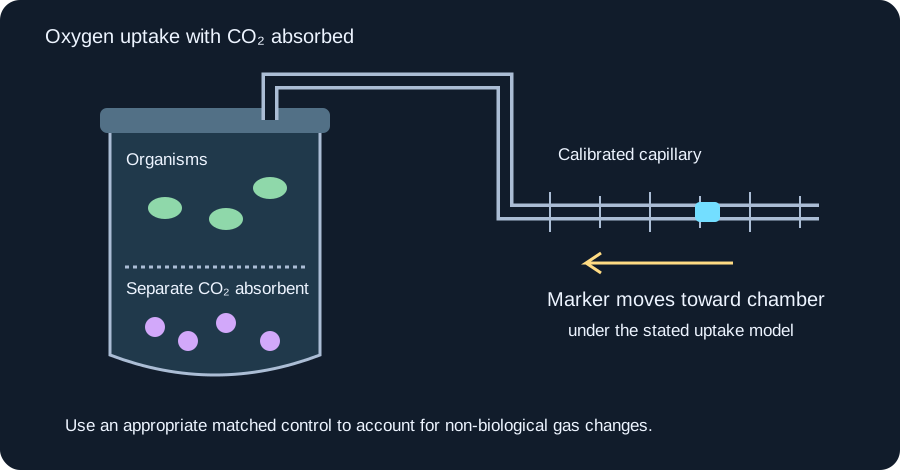
Aerobically respiring organisms consume oxygen and can produce carbon dioxide. In the specified respirometer model, a suitable carbon dioxide absorbent is kept separate from the organisms. With that gas accounted for, a decrease in the system’s gas amount can support an oxygen-uptake measurement under the stated apparatus conditions.
A marker’s movement is not automatically an oxygen volume. Use the instrument’s calibration or the appropriate capillary cross-sectional area to convert displacement where the model allows it. Check the direction of movement and what it means for the actual apparatus rather than memorising a left or right direction.
2
Use temperature comparisons without physical confounding
Use the approved small organisms, water-bath temperatures and ethical handling. Keep organism amount, condition and observation interval comparable. Allow apparatus and organisms to equilibrate appropriately and record actual temperature. A temperature change can alter gas pressure or volume without metabolism.
Check seals and use an appropriate matched control to account for physical effects. Record raw experimental and control readings with their signs and apply the specified correction. The centre controls absorbent handling and organism welfare; this is preparation for supervised work rather than a home apparatus-building task.
3
Calculate and interpret a rate
Divide corrected calibrated oxygen uptake by elapsed time. If organism amounts differ, use a justified mass or organism-number normalisation. State the measured units and avoid comparing a millimetre-per-minute displacement directly with a cubic-centimetre-per-minute volume rate.
Use independent repeats and describe variation. A higher rate at one temperature supports a local response under the tested conditions, not a universal unlimited temperature effect. Substrate, oxygen availability, activity, organism state and the measurement model can influence the result.
4
Worked applications
Attempt these problems on paper before opening the worked reasoning. Explain your steps as well as giving a final answer.
Example 1A stated calibration converts corrected marker movement into 0.30 cm³ oxygen uptake over five minutes. Find the mean rate.
1Rate = 0.30/5.0.
2Retain oxygen-volume and time units.
Answer0.060 cm³ min⁻¹ under the stated gas-balance model.
Example 2The same uptake comes from 0.50 g of organisms. Find the mass-normalised rate.
1Use the measured rate 0.060 cm³ min⁻¹.
20.060/0.50 = 0.12.
Answer0.12 cm³ min⁻¹ g⁻¹.
Common mistakes to avoid
Calling any marker movement oxygen consumption.
Check controls, calibration and the gas-balance assumptions.
Ignoring unequal organism amounts.
Standardise or justify a normalisation.
Key takeaways
- You can explain the gas balance in an oxygen-use respirometer.
- You can compare temperature treatments with suitable controls.
- You can calculate a calibrated, normalised uptake rate.
Apply it in an exam
Question 1: The same uptake comes from 0.50 g of organisms. Find the mass-normalised rate.
Show answer and reasoning
0.12 cm³ min⁻¹ g⁻¹.
- Use the measured rate 0.060 cm³ min⁻¹.
- 0.060/0.50 = 0.12.
Explore further
- Edexcel 1BI0 official specification (opens in a new tab)
Check the assessed scope and practical or mathematical requirements.
- Read or explore this topic (opens in a new tab)
An external explanation or interactive activity to use alongside the lesson. It may include extension material.
Return to this tomorrow
Close the notes and answer from memory. Revisit any explanation you cannot yet reconstruct.
- Why use a matched temperature control?
- What is required before calling marker displacement a gas volume?
Test yourself
Answer a few questions, then review anything you missed.
Next step
Browse practice topicsKeep practising
Start with the quiz above to check the key ideas. You can also choose another topic from the practice library.