CP3.31: Inert and Copper Electrodes
In an electrolytic cell, an external supply drives a chemical change. The cathode is negative and the anode positive in this arrangement. Cations move toward the cathode and anions toward the anode, while electrons move through the external conducting circuit. Do not describe electrons as crossing the bulk solution in place of ions.
Before you start
- Use your teacher’s tier checklist: this overview can include Higher-only material, and is not a tier-specific revision list.
- Pearson Edexcel separate GCSE Chemistry 1CH0. Preserve the specification’s core-practical reference and any explicitly required subparts.
- Distinguish ions from electrons and recall oxidation and reduction.
- Use the centre’s approved supervised method, apparatus, heating and disposal arrangements. Written preparation does not replace performing and recording the practical activities.
Watch, pause, try
Video by Science School. The main video focuses on copper electrodes. The written guide also covers the required inert-electrode products, and compares current with electrode mass change over a fixed time.
Viewing focus: Explain electrode polarity and charge movement
After watching, attempt these questions before opening the answers. You can also use the written lesson below.
After watching 1: Why can a copper anode lose mass while the cathode gains mass?
Show answer and reasoning
Copper atoms can lose electrons to form ions at the anode while copper ions gain electrons to form metal at the cathode.
After watching 2: Why must deposition time be controlled when comparing current?
Show answer and reasoning
Charge transfer depends on both current and time. Changing both would weaken an inference about current and the measured mass change.
What you'll be able to do
- Explain electrode polarity and charge movement
- Use observations and appropriate tests to identify products
- Distinguish inert electrodes from reacting copper electrodes
Follow the two types of charge carrier
In an electrolytic cell, an external supply drives a chemical change. The cathode is negative and the anode positive in this arrangement. Cations move toward the cathode and anions toward the anode, while electrons move through the external conducting circuit. Do not describe electrons as crossing the bulk solution in place of ions.
At the cathode, reduction involves gain of electrons. At the anode, oxidation involves loss of electrons. In aqueous solutions, water-derived species can also be involved, so the dissolved salt’s name alone does not identify every product. Use the stated electrolyte, concentration and electrode material.
Use observations and tests rather than guesses
Record bubbles, colour changes or deposits at identified electrodes. Where gases are collected or tested, use the centre’s approved small-scale method and the appropriate evidence: a hydrogen pop test, oxygen relighting a glowing splint, or chlorine bleaching damp indicator paper are distinct observations. Avoid treating bubbles alone as a unique gas identification.
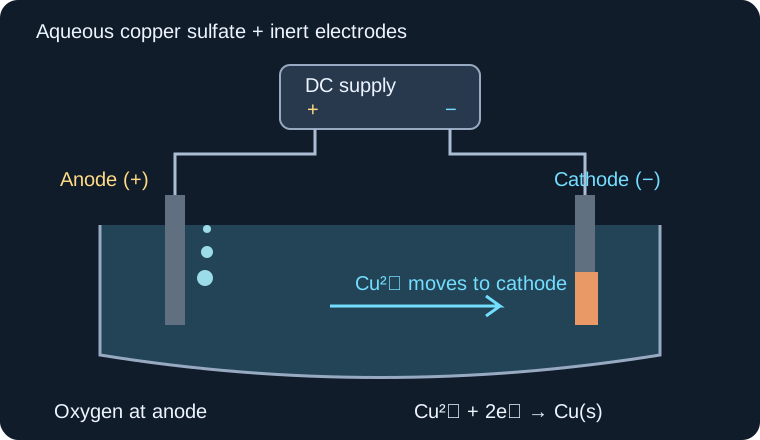
With aqueous copper(II) sulfate and suitable inert electrodes, copper can deposit at the cathode while oxygen forms at the anode. The half-equation Cu²⁺ + 2e⁻ → Cu explains copper formation. For a different electrolyte or electrode, check the product rules and evidence again rather than copying the same labels.
Recognise when the electrode is a reactant
Copper electrodes in copper(II) sulfate provide a different anode process from inert graphite. Copper atoms can form copper ions at the anode while copper ions are reduced at the cathode. Compare the electrode masses using consistent washing and drying; retained solution can distort an apparent mass gain.
When comparing current, control the measurement interval, electrolyte and relevant geometry. Quantitative changes require actual initial and final masses, not a claim that blue colour alone measures deposited copper. In a suitable ideal model, charge is current × time, but interpret the measurements with electrode reactions and possible experimental losses.
| Current / A | Time / s | Illustrative cathode mass gain / g |
|---|---|---|
| 0.20 | 300 | 0.020 |
| 0.40 | 300 | 0.039 |
| 0.60 | 300 | 0.060 |
Worked applications
Attempt these problems on paper before opening the worked reasoning. Explain your steps as well as giving a final answer.
Example 1An electrode changes from 5.320 g to 5.456 g. Calculate its mass change.
Example 2Two runs use the same current, with times 120 s and 240 s. Under a stated ideal deposition model, compare the transferred charges.
Common mistakes to avoid
Key takeaways
- You can explain electrode polarity and charge movement.
- You can use observations and appropriate tests to identify products.
- You can distinguish inert electrodes from reacting copper electrodes.
Apply it in an exam
Question 1: Two runs use the same current, with times 120 s and 240 s. Under a stated ideal deposition model, compare the transferred charges.
Show answer and reasoning
The second run transfers twice the charge under the stated conditions; use measurements to evaluate actual deposition.
- Q = It.
- At fixed current, doubling time doubles charge.
Explore further
- Edexcel 1CH0 official specification (opens in a new tab)
Check the assessed scope and practical or mathematical requirements.
- Read or explore this topic (opens in a new tab)
An external explanation or interactive activity to use alongside the lesson. It may include extension material.
- Inert-electrode demonstration (opens in a new tab)
Malmesbury Education: compare the products and observations when the electrodes do not supply copper.
Return to this tomorrow
Close the notes and answer from memory. Revisit any explanation you cannot yet reconstruct.
- What carries charge through the bulk electrolyte?
- Why does changing graphite to copper matter?
Test yourself
Answer a few questions, then review anything you missed.
Keep practising
Start with the quiz above to check the key ideas. You can also choose another topic from the practice library.
Related lessons
All 8 lessons- Same chapterCP2.11: Ink Chromatography and DistillationExplain both required ink-separation methods
- Same chapterCP3.6: Solid Base Addition and pHControl solid-base additions to a fixed acid sample
- Same chapterCP3.17: Hydrated Copper Sulfate CrystalsExplain excess insoluble reactant, filtration and crystallisation