PAG4: Simple Distillation
In an appropriate mixture such as aqueous ink, simple distillation can recover a volatile solvent while non-volatile components remain in the heated vessel. Heating produces vapour, a cooled region condenses it, and the receiver collects the distillate. Filtration instead removes suitable insoluble particles and does not perform that vapour–liquid separation.
Before you start
- Use your teacher’s tier checklist: this overview can include Higher-only material, and is not a tier-specific revision list.
- OCR Gateway A separate GCSE Chemistry J248. This is a suitable practical-group example; centres can choose other activities covering the required apparatus and techniques.
- Recall boiling, condensation and the difference between volatile and non-volatile components.
- Use the centre’s approved supervised method, apparatus, heating and disposal arrangements. Written preparation does not replace performing and recording the practical activities.
Watch, pause, try
Video by Pearson UK & International Schools. The Pearson demonstration includes ink chromatography as well as distillation. This guide focuses on the vapour–liquid method; the separate chromatography guide develops spot measurements.
Viewing focus: Explain heating, condensation and separate collection
After watching, attempt these questions before opening the answers. You can also use the written lesson below.
After watching 1: What forms the distillate in a suitable setup?
Show answer and reasoning
Condensed vapour. Track the heated component through the vapour path.
After watching 2: Why distinguish coolant from distillate?
Show answer and reasoning
They travel through different parts and have different functions. The jacket removes energy without supplying the intended collected substance.
What you'll be able to do
- Explain heating, condensation and separate collection
- Orient a supplied apparatus diagram and measurement point
- Evaluate recovery and the limits of simple distillation
Follow the component being separated
In an appropriate mixture such as aqueous ink, simple distillation can recover a volatile solvent while non-volatile components remain in the heated vessel. Heating produces vapour, a cooled region condenses it, and the receiver collects the distillate. Filtration instead removes suitable insoluble particles and does not perform that vapour–liquid separation.
Use the centre’s approved apparatus, heating and boiling-control arrangements. The apparatus is not a sealed pressure vessel. Identify the connected vapour route and receiver before interpreting a supplied diagram; an apparently similar tube carrying cooling water has a different function from the tube carrying the substance being distilled.
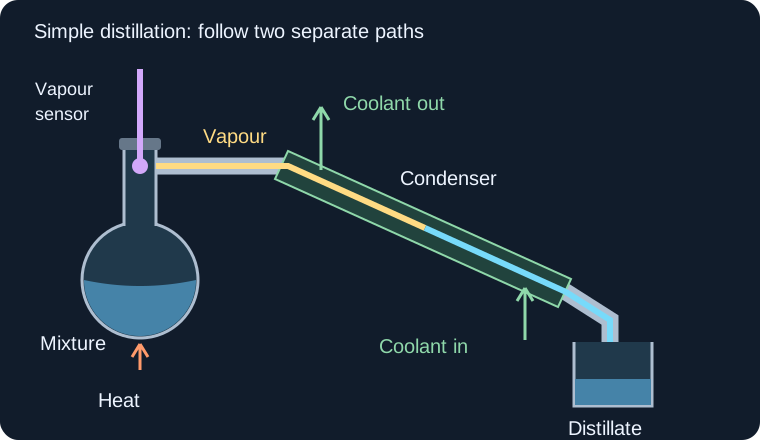
Interpret the condenser and temperature reading
A water-cooled condenser removes energy from vapour. In the usual arrangement, coolant enters the lower connection and leaves the upper connection so the jacket remains filled effectively. Cooling water flows in its separate jacket rather than becoming the collected distillate.
A thermometer intended to record the exiting vapour temperature must be positioned appropriately near that vapour path. A bulb immersed in the boiling mixture measures a different location. Record pressure or other relevant conditions when comparing a boiling temperature, and do not turn one approximate reading into a complete composition analysis.
Separate volume recovery from a purity claim
Measure the initial and collected liquid volumes if a recovery is required. Losses may arise from liquid remaining in the apparatus or other transfer and collection limitations. A larger recovered volume does not by itself establish a purer sample.
Simple distillation is useful when the volatility differences and mixture make it suitable. Other volatile components can also pass into the receiver, and similar-boiling components may need another separation method. A clear distillate is not proof that all possible contaminants have been removed. State the component and evidence actually assessed.
Worked applications
Attempt these problems on paper before opening the worked reasoning. Explain your steps as well as giving a final answer.
Example 1A suitable ink sample begins with 20.0 cm³ liquid and gives 12.5 cm³ collected distillate. Calculate volume recovery.
Example 2A supplied apparatus has the thermometer bulb in the liquid instead of near the exiting vapour. What reading should be questioned?
Common mistakes to avoid
Key takeaways
- You can explain heating, condensation and separate collection.
- You can orient a supplied apparatus diagram and measurement point.
- You can evaluate recovery and the limits of simple distillation.
Apply it in an exam
Question 1: A supplied apparatus has the thermometer bulb in the liquid instead of near the exiting vapour. What reading should be questioned?
Show answer and reasoning
Question any claim that it directly measures the exiting vapour temperature.
- The bulb is sampling the boiling mixture’s temperature.
- It may not represent the vapour entering the condenser.
Explore further
- OCR J248 official specification (opens in a new tab)
Check the assessed scope and practical or mathematical requirements.
- Read or explore this topic (opens in a new tab)
An external explanation or interactive activity to use alongside the lesson. It may include extension material.
Return to this tomorrow
Close the notes and answer from memory. Revisit any explanation you cannot yet reconstruct.
- Why distinguish coolant from distillate?
- Does a clear distillate prove complete purity?
Test yourself
Answer a few questions, then review anything you missed.
Keep practising
Start with the quiz above to check the key ideas. You can also choose another topic from the practice library.
Related lessons
All 8 lessons- Same chapterPAG1: Reactivity Trends and Halogen DisplacementUse controlled comparisons to infer a halogen reactivity order
- Same chapterPAG2: Electrolysis and Product TestsExplain electrode polarity and charge movement
- Same chapterPAG3: Separation and ChromatographyExplain the baseline, solvent front and separation mechanism