Loading...
3.5.1Energy TransfersCore
Photosynthesis: Light-Dependent Reactions
Light energy drives electron transfer, proton-gradient formation and production of ATP and reduced NADP. Follow where electrons and protons move through the chloroplast.
What you'll be able to do
- Explain photoionisation and photolysis
- Describe chloroplast chemiosmosis
- Distinguish ATP, reduced NADP and oxygen production
1
Absorb light and replace lost electrons
Chlorophyll pigments associated with thylakoid membranes absorb light. Energy can excite electrons that leave chlorophyll, a process described as photoionisation. In the light-dependent pathway, these electrons enter electron-transfer systems rather than becoming part of a sugar molecule directly.
Photolysis splits water and provides electrons to replace those lost from the initial light-activated chlorophyll system. It also produces protons and oxygen. The oxygen released during photosynthesis therefore comes from water, not from splitting carbon dioxide. Accessory pigments broaden the range of wavelengths that can contribute to light absorption.
2
Build a gradient and synthesise ATP
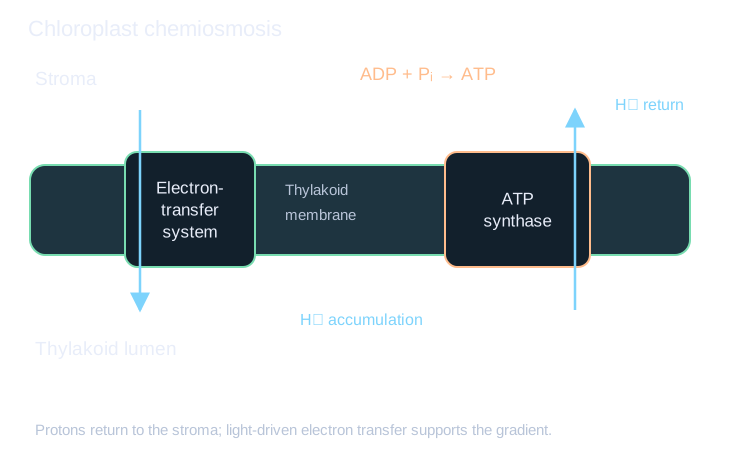
As electrons pass through membrane-associated carriers, some transferred energy supports proton movement from the stroma into the thylakoid lumen. Photolysis also contributes protons within the lumen. The thylakoid membrane restricts free proton movement, helping maintain an electrochemical gradient.
Protons return towards the stroma through ATP synthase, coupling their movement down the gradient to ATP synthesis from ADP and inorganic phosphate. This is chemiosmosis and the light-driven ATP formation is photophosphorylation. ATP is formed on the stromal side for use in reactions such as the Calvin cycle, not by electrons flowing through a DNA molecule.
3
Produce reducing power and connect the stages
Further light excitation enables electrons to contribute to reduction of NADP, producing reduced NADP, often written NADPH. It carries reducing power needed to reduce carbon compounds in the light-independent reactions. ATP and reduced NADP have different roles and should not be treated as interchangeable products.
The membrane system requires suitable light, electron supply and available acceptors. A redox dye in RP8 can report electron-transfer activity under controlled conditions, but a dye’s colour change is not a direct measurement of total sugar production. Distinguish the specific process measured from the whole photosynthetic pathway.
4
Apply the biology
Try each question before opening the worked response. Use precise biological terms, connect each cause to its effect, and check units and assumptions when interpreting data.
Example 1An inhibitor prevents proton flow through chloroplast ATP synthase. Predict a direct effect and a downstream effect.
1Directly, ATP production through that synthase decreases.
2Downstream, Calvin-cycle reactions requiring ATP are limited, even if some light absorption continues.
3The exact effects on electron flow depend on the rest of the system and the time considered.
AnswerFollow the affected mechanism rather than assuming every chloroplast component instantly disappears.
Example 2A plant supplied with isotopically labelled water releases labelled oxygen. What does this support?
1The label in water appears in the released oxygen.
2This supports water as the source of oxygen in photosynthesis.
3It does not by itself identify every intermediate step of the pathway.
AnswerUse the tracer to support a specific source–product relationship.
Common mistakes to avoid
Saying electrons themselves flow through ATP synthase to make ATP.
Proton flow drives the synthase; electron transfer helps establish the gradient.
Assigning released oxygen to carbon dioxide.
Identify photolysis of water as its source.
Key takeaways
- Light drives electron transfer and water photolysis.
- A membrane proton gradient supports ATP synthesis.
- ATP and reduced NADP connect light capture with carbon reduction.
Test yourself
Answer a few questions, then review anything you missed.
Next step
Browse practice topicsKeep practising
Start with the quiz above to check the key ideas. You can also choose another topic from the practice library.