Loading...
3.5.2Energy TransfersCore
Respiration and Oxidative Phosphorylation
Respiration transfers energy from substrates into ATP through linked stages. Distinguish carbon loss, electron transfer and proton movement to explain both aerobic and anaerobic pathways.
What you'll be able to do
- Follow glycolysis, link reaction and Krebs cycle
- Explain oxidative phosphorylation and oxygen’s role
- Explain NAD regeneration during anaerobic metabolism
1
Begin with glycolysis in the cytoplasm
Glycolysis occurs in the cytoplasm and does not directly require oxygen. Glucose is phosphorylated using ATP and converted into triose-phosphate intermediates. Oxidation produces two pyruvate molecules per glucose, reduces NAD and produces ATP by substrate-level phosphorylation, giving a net gain of two ATP in the standard pathway.
ATP is both invested and produced, so distinguish gross production from net gain. Reduced NAD carries electrons and associated reducing power to later reactions. Glycolysis does not release all of glucose’s available energy and is not confined to cells undergoing anaerobic respiration.
2
Oxidise pyruvate and recycle a carbon acceptor
In aerobic metabolism, pyruvate enters the mitochondrial matrix. The link reaction removes carbon dioxide and oxidises the remaining two-carbon unit, reducing NAD; acetate combines with coenzyme A to form acetylcoenzyme A. Coenzyme A carries the acetyl group into the next stage.
In the Krebs cycle, the two-carbon acetyl group combines with a four-carbon acceptor to form a six-carbon compound. A sequence of decarboxylation and oxidation reactions releases carbon dioxide, forms reduced NAD and reduced FAD, produces a small amount of ATP by substrate-level phosphorylation and regenerates the four-carbon acceptor. One glucose supplies two acetyl groups, so per-glucose totals differ from per-cycle totals.
3
Use electrons to create a proton gradient
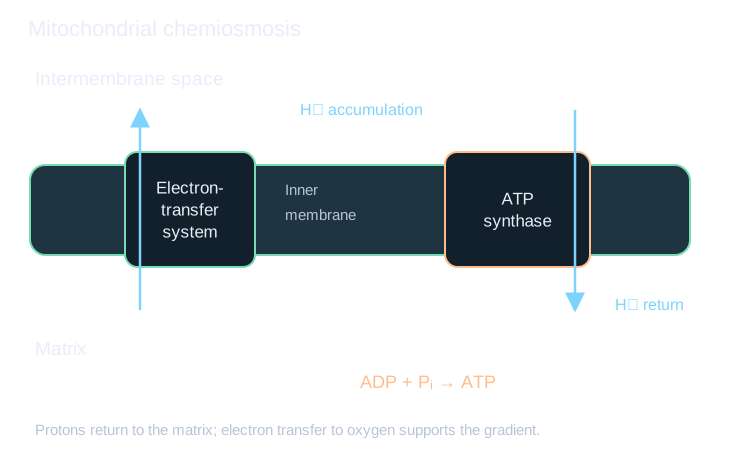
Reduced coenzymes donate electrons to an electron-transfer chain associated with the inner mitochondrial membrane. Electron-transfer energy supports pumping protons from the matrix into the intermembrane space. The membrane limits free proton return, maintaining an electrochemical gradient.
Protons flow back into the matrix through ATP synthase, driving ATP formation from ADP and phosphate: oxidative phosphorylation. Oxygen is the final electron acceptor and combines with electrons and protons to form water. It is not converted into carbon dioxide as its main role in this chain. If oxygen is unavailable, electron transfer and coenzyme reoxidation become limited.
4
Regenerate NAD and compare substrates
Under anaerobic conditions, reduced NAD can reduce pyruvate to lactate, regenerating oxidised NAD so glycolysis can continue. In yeast, pyruvate is converted through an ethanal intermediate to ethanol, with carbon dioxide released and NAD regenerated. Fermentation itself does not add the large ATP yield of oxidative phosphorylation.
Lipids and amino-acid breakdown products can enter respiratory pathways at suitable stages. A universal fixed ATP total per glucose is a poor assumption unless the question supplies a model, because yield depends on coupling and cellular conditions. RP9 investigates respiration in single-celled organisms; define whether the measurement reflects oxygen use, carbon dioxide production or a proxy.
5
Apply the biology
Try each question before opening the worked response. Use precise biological terms, connect each cause to its effect, and check units and assumptions when interpreting data.
Example 1A model states that glycolysis invests 2 ATP and forms 4 ATP per glucose. Calculate its net ATP production for 50 glucose molecules.
1Net per glucose =4−2=2 ATP.
2For 50 glucose molecules, net production =100 ATP.
Answer100 net ATP molecules in the stated glycolysis model.
Example 2Why can lack of oxygen eventually reduce Krebs-cycle activity even though oxygen is not a direct reactant in each cycle step?
1Without the final electron acceptor, electron transfer cannot continue normally.
2Reduced coenzymes are not reoxidised efficiently.
3A shortage of oxidised NAD and FAD then restricts upstream oxidation reactions.
AnswerExplain the indirect link through coenzyme recycling.
Common mistakes to avoid
Saying oxygen directly enters every reaction of glycolysis and Krebs.
Explain its final-acceptor role and indirect effects.
Moving protons in the wrong direction through mitochondrial ATP synthase.
They return from intermembrane space to matrix.
Using one memorised ATP total regardless of the question’s model.
Use supplied assumptions and distinguish net from gross yield.
Key takeaways
- Stages link carbon oxidation to reduced-coenzyme production.
- Electron transfer establishes the gradient driving ATP synthesis.
- Anaerobic pathways regenerate NAD so glycolysis can continue.
Test yourself
Answer a few questions, then review anything you missed.
Next step
Browse practice topicsKeep practising
Start with the quiz above to check the key ideas. You can also choose another topic from the practice library.