Loading...
9BN0 · CP16; Topic 7Core practical investigationsCore
CP16: Measuring Respiration Rates
Use the centre’s approved single-celled organism culture, such as a suitable yeast preparation, and vary one factor such as temperature or substrate concentration. A method may measure carbon dioxide production, oxygen uptake in an appropriate respirometer, or a validated indicator response.
Before you start
- Distinguish respiration and fermentation and calculate a gas-volume change per unit time.
- This guide uses Pearson Edexcel Biology A (Salters–Nuffield), 9BN0, core-practical numbering. Use the approved laboratory method and record independent supervised evidence as directed.
- Prepare for teacher-approved laboratory work. Follow the laboratory risk assessment, handling, heating and disposal instructions. Written study and quiz results do not certify supervised Practical Endorsement evidence.
Watch, pause, try
Video by Michael Ralph. The video explains respirometers. The written lesson distinguishes oxygen uptake from other respiration proxies, including gas production by yeast.
Viewing focus: Design a controlled culture comparison
After watching, attempt these questions before opening the answers. You can also use the written lesson below.
After watching 1: Why is carbon dioxide removed in the stated oxygen-uptake model?
Show answer and reasoning
Respiring organisms consume oxygen and can produce carbon dioxide. Removing the produced carbon dioxide prevents it offsetting the gas decrease being used to infer oxygen uptake.
After watching 2: Why does a matched control matter even when a capillary marker moves?
Show answer and reasoning
Temperature, pressure or leaks can change a gas reading without metabolism. Compare the appropriate control and check the calibrated gas-balance assumptions before calculating an oxygen-use rate.
What you'll be able to do
- Design a controlled culture comparison
- Calculate and normalise a respiration proxy
- Distinguish metabolic effects from apparatus effects
1
Define the organism, variable and measurement
Use the centre’s approved single-celled organism culture, such as a suitable yeast preparation, and vary one factor such as temperature or substrate concentration. A method may measure carbon dioxide production, oxygen uptake in an appropriate respirometer, or a validated indicator response.
Choose the measurement to match the biological question. Yeast can produce carbon dioxide through more than one metabolic condition, so carbon dioxide alone does not prove a particular oxygen-use pathway. Standardise the quantity and physiological state of the culture, substrate supply, pH and total volume as relevant.
2
Control timing and physical effects
Allow treatment components and apparatus to equilibrate where appropriate before starting measurements. Use the same sampling intervals and suitable independent replicates, and include a background or inactive-organism control when it helps distinguish metabolism from apparatus changes.
A sealed gas method needs leak checks and an interpretation of pressure or temperature effects. In a respirometer intended to measure oxygen uptake, carbon dioxide handling must be accounted for in the stated method. Warming trapped gas can change its volume without a corresponding change in respiration, so a control apparatus can be essential.
3
Process rates and evaluate biological variation
Calculate change per unit time over a defined interval and normalise to culture mass, cell number or another justified measure when comparing different amounts of organism. A fixed population-size label may still hide differences in viability or metabolic state.
A temperature rise can increase enzyme-controlled activity over a suitable range but eventually reduce it through stress or loss of function. Substrate limitation, oxygen availability and product accumulation can alter later readings. Use initial or otherwise justified comparable intervals rather than assuming the entire progress curve is linear.
4
Explain oxygen-uptake respirometry
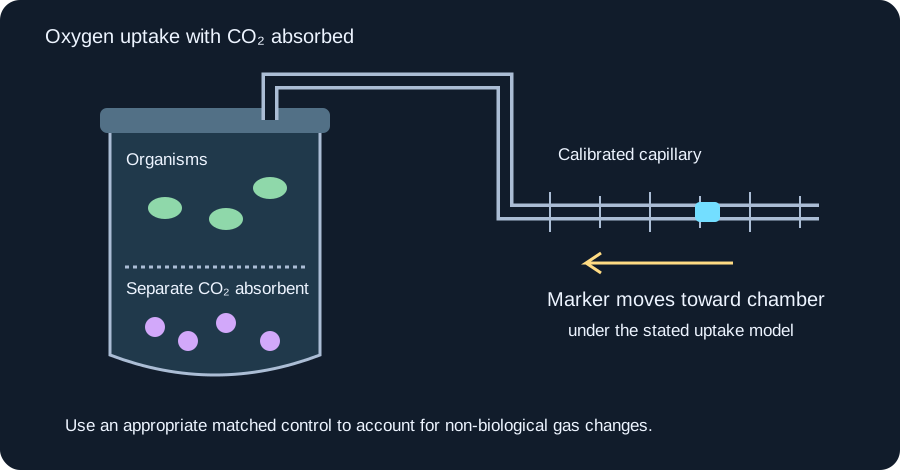
In a suitable closed-system respirometer, a carbon dioxide absorber removes exhaled CO₂ so a corrected gas change can represent oxygen uptake. Keep the absorber separated from living material using the approved arrangement and follow the handling instructions for the chemical used. A matched control can help reveal temperature- or pressure-driven changes unrelated to respiration.
A calibrated capillary displacement can be converted to volume using its cross-sectional area when the instrument model permits it. Calculate change per time and normalise to an appropriate organism amount when comparing samples. Check leaks, equilibration and the stated gas conditions. Oxygen uptake and yeast CO₂ production are different measurement contexts and must not be relabelled as identical signals.
5
Apply the biology
Try each question before opening the worked response. Use precise biological terms, connect each cause to its effect, and check units and assumptions when interpreting data.
Example 1A yeast preparation produces 6.0 cm³ of gas in 5 min and contains 0.40 g of the defined culture material. Calculate the mass-normalised rate.
1Volume rate=6.0/5=1.2 cm³ min⁻¹.
2Normalised rate=1.2/0.40=3.0 cm³ min⁻¹ g⁻¹.
Answer3.0 cm³ min⁻¹ g⁻¹ as the specified gas-production proxy.
Example 2A respirometer control with no respiring organisms shows a volume change when temperature rises. Why is this important?
1Gas expansion or another physical effect can change the apparatus reading.
2The experimental reading is therefore not solely biological.
3Equilibration and an appropriate control correction are needed before interpreting respiration.
AnswerUse the control to distinguish metabolism from physical behaviour.
Example 3A corrected calibrated capillary movement represents 7.85 mm³ oxygen uptake in 5.00 min by 0.500 g of organisms. Find the mass-normalised rate.
1Volume rate = 7.85/5.00 = 1.57 mm³ min⁻¹.
2Normalise: 1.57/0.500.
Answer3.14 mm³ min⁻¹ g⁻¹ under the stated oxygen-uptake model.
Common mistakes to avoid
Treating every gas change as metabolic without a control.
Evaluate temperature, pressure and leaks.
Comparing raw rates from unequal culture quantities without explanation.
Standardise or normalise appropriately.
Key takeaways
- You can design a controlled culture comparison.
- You can calculate and normalise a respiration proxy.
- You can distinguish metabolic effects from apparatus effects.
Apply it in an exam
Question 1: A respirometer control with no respiring organisms shows a volume change when temperature rises. Why is this important?
Show answer and reasoning
Use the control to distinguish metabolism from physical behaviour.
- Gas expansion or another physical effect can change the apparatus reading.
- The experimental reading is therefore not solely biological.
- Equilibration and an appropriate control correction are needed before interpreting respiration.
Explore further
- Edexcel 9BN0 official specification (opens in a new tab)
Check the assessed scope and practical or mathematical requirements.
- Read or explore this topic (opens in a new tab)
An external explanation or interactive activity to use alongside the lesson. It may include extension material.
Return to this tomorrow
Close the notes and answer from memory. Revisit any explanation you cannot yet reconstruct.
- A gas-volume temperature control helps detect:
- Comparing a linear early interval can help reduce effects of:
Test yourself
Answer a few questions, then review anything you missed.
Next step
Browse practice topicsKeep practising
Start with the quiz above to check the key ideas. You can also choose another topic from the practice library.
Related lessons
All 18 lessons- Same chapterCP1: Caffeine and Daphnia Heart RateDesign a controlled invertebrate heart-rate comparison
- Same chapterCP2: Vitamin C and DCPIP ComparisonsStandardise a fixed DCPIP endpoint using a vitamin C reference
- Same chapterCP3: Membrane Permeability InvestigationsDesign a named-variable permeability investigation