Loading...
7405 · RP8Required practical investigationsCore
RP8: Measuring Cell EMF
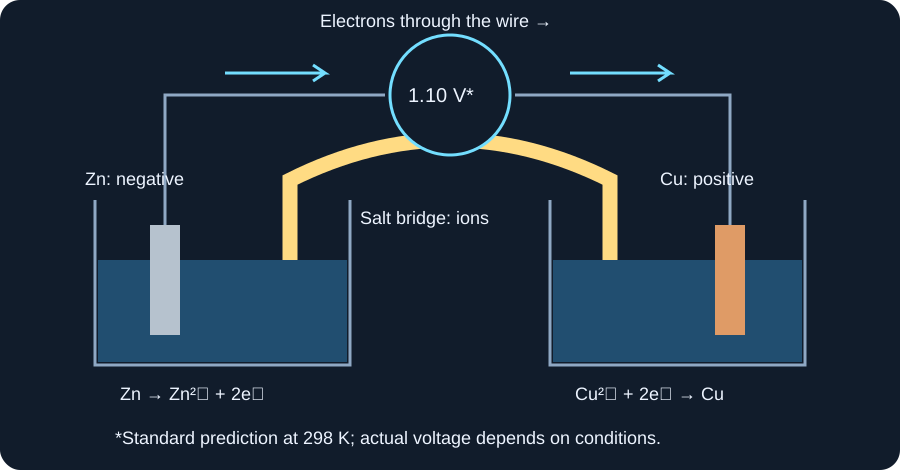
A simple metal/metal-ion cell uses clean metal strips in their corresponding salt solutions. Leads connect the metals to a high-resistance voltmeter. A salt bridge connects the solutions so ions can migrate and limit charge build-up; electrons travel through the external metal circuit, not through the salt bridge. Choose bridge ions that do not react appreciably with the half-cell species.
Before you start
- Write redox half-equations and compare standard electrode potentials.
- Use these notes to prepare for teacher-approved laboratory work. Follow the laboratory risk assessment, eye protection, handling and disposal instructions; a reading or quiz does not record Practical Endorsement evidence.
Watch, pause, try
Video by Royal Society of Chemistry. Use the demonstration alongside this lesson’s specification reference and written explanations.
Viewing focus: Assemble and explain a two-half-cell measurement
After watching, attempt these questions before opening the answers. You can also use the written lesson below.
After watching 1: What carries charge through a salt bridge?
Show answer and reasoning
Ions. Ion movement maintains approximate electrical neutrality in the half-cells.
After watching 2: Why use a high-resistance voltmeter?
Show answer and reasoning
To minimise current drawn from the cell. A small current reduces loading and better approximates open-circuit EMF.
What you'll be able to do
- Assemble and explain a two-half-cell measurement
- Calculate and interpret cell EMF and polarity
- Distinguish standard predictions from laboratory measurements
1
Provide two different paths for charge
A simple metal/metal-ion cell uses clean metal strips in their corresponding salt solutions. Leads connect the metals to a high-resistance voltmeter. A salt bridge connects the solutions so ions can migrate and limit charge build-up; electrons travel through the external metal circuit, not through the salt bridge. Choose bridge ions that do not react appreciably with the half-cell species.
Use separate clean apparatus and suitable metal surfaces to limit contamination and insulating oxide layers. Record the electrode materials, solution concentrations, temperature and lead orientation with each reading. The high-resistance meter draws very little current, giving a closer approximation to open-circuit EMF than a heavily loaded circuit. Follow the approved handling and collection of metal-containing waste.
2
Predict the reaction and the sign
For a spontaneous galvanic cell, oxidation occurs at the negative electrode and reduction at the positive electrode. Using standard reduction potentials, E°cell = E°(positive half-cell) − E°(negative half-cell). Do not multiply an electrode potential by a balancing coefficient: potential is an energy-per-charge quantity.
Connect the positive meter lead to the predicted positive electrode. Reversing the leads reverses the displayed sign, without changing the cell chemistry. If a measured sign disagrees with a prediction, check the lead labels and actual concentrations before concluding that the redox series is wrong. An inert electrode is needed where the redox couple has no suitable conducting solid of its own.
3
Evaluate a real voltage
A standard comparison requires the stated standard conditions, including concentrations of 1 mol dm⁻³ and appropriate gas pressures; quoted data are usually at 298 K. A school cell with different concentrations measures a non-standard potential. Changing concentration can shift the equilibrium and voltage, so a small difference from E° is not automatically an experimental mistake.
Investigate concentration by changing one half-cell systematically while controlling the other half-cell, temperature and electrode preparation. Repeat readings after a consistent settling time. Surface contamination, junction effects and finite meter current can affect results. A positive thermodynamic prediction does not establish a rapid reaction or unlimited useful current.
4
Worked applications
Attempt these problems on paper before opening the worked reasoning. Explain your steps as well as giving a final answer.
Example 1Cu²⁺/Cu has E° = +0.34 V and Zn²⁺/Zn has E° = −0.76 V. Predict E°cell and electron direction.
1Copper is the reduction half-cell; zinc is oxidised.
2E°cell = 0.34 − (−0.76) = 1.10 V.
Answer1.10 V; electrons flow externally from zinc to copper.
Example 2The same cell reads −1.06 V with the red lead on zinc. Is this evidence that electrons flow through the bridge?
1The red lead is on the negative electrode, so the displayed sign is expected.
2Swap meter leads to obtain approximately +1.06 V; bridge charge is carried by ions.
AnswerNo. Lead orientation explains the sign; the small magnitude difference can reflect non-standard conditions and measurement effects.
Common mistakes to avoid
Subtracting a negative electrode potential as if it were positive.
Use brackets: +0.34 − (−0.76).
Calling every school measurement a standard EMF.
Record and compare actual conditions.
Key takeaways
- You can assemble and explain a two-half-cell measurement.
- You can calculate and interpret cell EMF and polarity.
- You can distinguish standard predictions from laboratory measurements.
Apply it in an exam
Question 1: The same cell reads −1.06 V with the red lead on zinc. Is this evidence that electrons flow through the bridge?
Show answer and reasoning
No. Lead orientation explains the sign; the small magnitude difference can reflect non-standard conditions and measurement effects.
- The red lead is on the negative electrode, so the displayed sign is expected.
- Swap meter leads to obtain approximately +1.06 V; bridge charge is carried by ions.
Explore further
- AQA 7405 official specification (opens in a new tab)
Check the assessed scope and practical or mathematical requirements.
- Read or explore this topic (opens in a new tab)
An external explanation or interactive activity to use alongside the lesson. It may include extension material.
Return to this tomorrow
Close the notes and answer from memory. Revisit any explanation you cannot yet reconstruct.
- Why use a high-resistance voltmeter?
- If a half-equation is doubled, what happens to its electrode potential?
Test yourself
Answer a few questions, then review anything you missed.
Next step
Browse practice topicsKeep practising
Start with the quiz above to check the key ideas. You can also choose another topic from the practice library.