Loading...
7405 · RP9Required practical investigationsCore
RP9: Weak–Strong Acid–Base pH Curves
Required coverage includes a weak acid reacting with a strong base and a strong acid reacting with a weak base. Choose a measured starting volume and record pH against cumulative titrant volume. The controlled quantities include starting amounts, temperature and the selected chemical pair. pH is the dependent measurement; an indicator end point is not a substitute for the curve.
Before you start
- Calculate reacting amounts and explain conjugate acid–base pairs.
- Use these notes to prepare for teacher-approved laboratory work. Follow the laboratory risk assessment, eye protection, handling and disposal instructions; a reading or quiz does not record Practical Endorsement evidence.
Watch, pause, try
Video by Eliot Rintoul. Use this buffer explanation to prepare for the pH-curve analysis. The written practical covers probe technique and both required acid–base combinations.
Viewing focus: Measure pH curves with a calibrated probe
After watching, attempt these questions before opening the answers. You can also use the written lesson below.
After watching 1: Where are smaller titrant additions most useful?
Show answer and reasoning
Around the steep equivalence region. They resolve the volume associated with the rapid pH change.
After watching 2: What does half-equivalence pH estimate for a weak monoprotic acid titrated with strong base?
Show answer and reasoning
pKa. The acid and conjugate-base ratio is approximately one.
What you'll be able to do
- Measure pH curves with a calibrated probe
- Compare weak acid–strong base and strong acid–weak base titrations
- Use equivalence and half-equivalence evidence appropriately
1
Measure the curve rather than chase a colour change
Required coverage includes a weak acid reacting with a strong base and a strong acid reacting with a weak base. Choose a measured starting volume and record pH against cumulative titrant volume. The controlled quantities include starting amounts, temperature and the selected chemical pair. pH is the dependent measurement; an indicator end point is not a substitute for the curve.
Calibrate the probe with suitable known-pH buffers following its instructions. Rinse between solutions, remove excess rinse water as instructed, immerse the sensing part properly and stir gently. Wait for a stable reading after each addition. Keep a consistent temperature because both electrode response and chemical equilibria depend on it.
2
Resolve the steep region
Use an initial trial or stoichiometric estimate to locate equivalence, then use smaller additions near the rapid pH change. Record the actual cumulative burette volume, not just a sequence number. Keep the probe clear of the stirrer and do not scrape the bulb against glass. Dense sampling near equivalence improves volume estimation more effectively than collecting many extra points on a flat part.
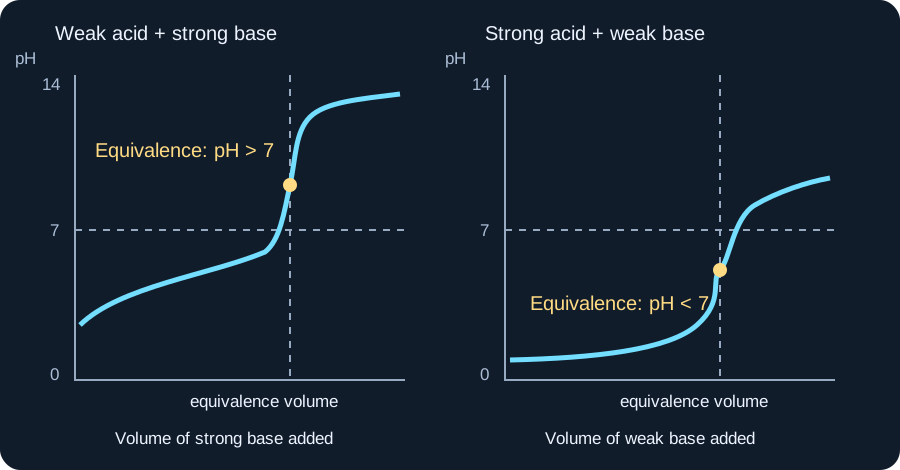
For weak acid plus strong base, a buffer region precedes equivalence and the equivalence solution is alkaline because the conjugate base hydrolyses. For strong acid plus weak base, equivalence is acidic because the conjugate acid of the weak base releases H⁺. At 298 K, neither equivalence is automatically pH 7. The direction of the plotted pH change also depends on which reagent is added.
3
Interpret the information and its limits
At half-neutralisation of a weak monoprotic acid by strong base, the remaining acid and formed conjugate base have equal amounts, so pH ≈ pKa under the buffer assumptions. Read this point using half the equivalence volume, not half the final recorded volume. For a weak base titrated by strong acid, the corresponding half-equivalence pH concerns its conjugate acid’s pKa.
Choose an indicator range lying inside the steep portion for that specific acid–base pair. A weak–weak combination has no similarly sharp ordinary indicator transition and is not a replacement for either required pairing. Evaluate probe calibration, response delay, addition size and mixing separately: repeated volume readings do not remove a systematic pH calibration offset.
4
Worked applications
Attempt these problems on paper before opening the worked reasoning. Explain your steps as well as giving a final answer.
Example 125.0 cm³ of 0.100 mol dm⁻³ monoprotic weak acid is titrated with 0.100 mol dm⁻³ NaOH. Find equivalence and half-equivalence volumes.
1Initial acid amount = 0.100 × 0.0250 = 0.00250 mol.
2The 1:1 reaction needs 0.00250/0.100 = 0.0250 dm³ of base.
AnswerEquivalence at 25.0 cm³; half-equivalence at 12.5 cm³.
Example 2For that acid, pH at 12.5 cm³ is 4.80. Estimate Ka and explain why pH at 25.0 cm³ need not equal 7.
1At half-equivalence pKa ≈ 4.80, so Ka = 10⁻⁴·⁸⁰.
2At equivalence the conjugate base reacts with water to form OH⁻.
AnswerKa ≈ 1.58 × 10⁻⁵ mol dm⁻³ under the concentration convention used; equivalence is alkaline at 298 K.
Common mistakes to avoid
Using half the final burette volume as half-equivalence.
First establish the equivalence volume.
Omitting strong acid–weak base because a weak acid curve was measured.
The specification requires both pairings.
Key takeaways
- You can measure pH curves with a calibrated probe.
- You can compare weak acid–strong base and strong acid–weak base titrations.
- You can use equivalence and half-equivalence evidence appropriately.
Apply it in an exam
Question 1: For that acid, pH at 12.5 cm³ is 4.80. Estimate Ka and explain why pH at 25.0 cm³ need not equal 7.
Show answer and reasoning
Ka ≈ 1.58 × 10⁻⁵ mol dm⁻³ under the concentration convention used; equivalence is alkaline at 298 K.
- At half-equivalence pKa ≈ 4.80, so Ka = 10⁻⁴·⁸⁰.
- At equivalence the conjugate base reacts with water to form OH⁻.
Explore further
- AQA 7405 official specification (opens in a new tab)
Check the assessed scope and practical or mathematical requirements.
- Read or explore this topic (opens in a new tab)
An external explanation or interactive activity to use alongside the lesson. It may include extension material.
Return to this tomorrow
Close the notes and answer from memory. Revisit any explanation you cannot yet reconstruct.
- What does half-equivalence pH estimate for a weak monoprotic acid titrated with strong base?
- Why is strong acid–weak base equivalence acidic at 298 K?
Test yourself
Answer a few questions, then review anything you missed.
Next step
Browse practice topicsKeep practising
Start with the quiz above to check the key ideas. You can also choose another topic from the practice library.