IoT Devices, Platforms and Applications
Trace a measurement from physical hardware to an application decision. Include the software, connection and platform services that make the data interpretable and usable.
Before you start
- Distinguish a sensor measurement from its encoded telemetry record.
- Calculate record volume over an explicitly bounded sampling interval.
Watch, pause, try
Video by LearnFree. The general LearnFree introduction connects everyday devices to applications; the IBM companion develops processing near data sources. Pearson’s written IoT stack adds the explicit hardware, software, connectivity, platform/API and cloud-application roles. Treat product examples as illustrations, not current purchasing advice or a complete reliability/security design.
Viewing focus: Complete a layered IoT system diagram
After watching, attempt these questions before opening the answers. You can also use the written lesson below.
After watching 1: Seventy-five devices each produce a 32-byte payload at times 0,2,4,…,298 seconds during outage interval [0,300). Calculate the total readings and raw buffer bytes required to retain all of them. What remains to be included before selecting actual storage capacity?
Show answer and reasoning
Each device produces 150 readings, so there are 75×150=11,250 readings and 360,000 payload bytes. Time 300 is outside the stated interval. Actual capacity also needs identifiers/timestamps/units where not already counted, storage-format overhead, the chosen retention policy and suitable allowance for the specified outage/workload. Payload arithmetic alone does not establish a complete buffer or recovery design.
After watching 2: An IoT platform receives an encrypted and authenticated value 42 from an authorised device, but the record omits its unit, sample time and calibration context. Explain why the channel protection does not establish a sound control input, and identify a local outage behaviour that must be specified independently.
Show answer and reasoning
Channel protection can establish properties of the communication and peer under its assumptions; it does not calibrate the sensor or define whether 42 is current, correctly scaled or relevant. The application needs meaning, provenance and freshness appropriate to its task. Define whether local control continues under a bounded fallback, pauses or uses another justified policy when remote connectivity fails; do not assume the cloud always supplies an immediate valid decision.
What you'll be able to do
- Complete a layered IoT system diagram
- Explain hardware, software, connectivity and cloud-platform roles
- Evaluate telemetry meaning, offline operation and device management
Start with the device and its software
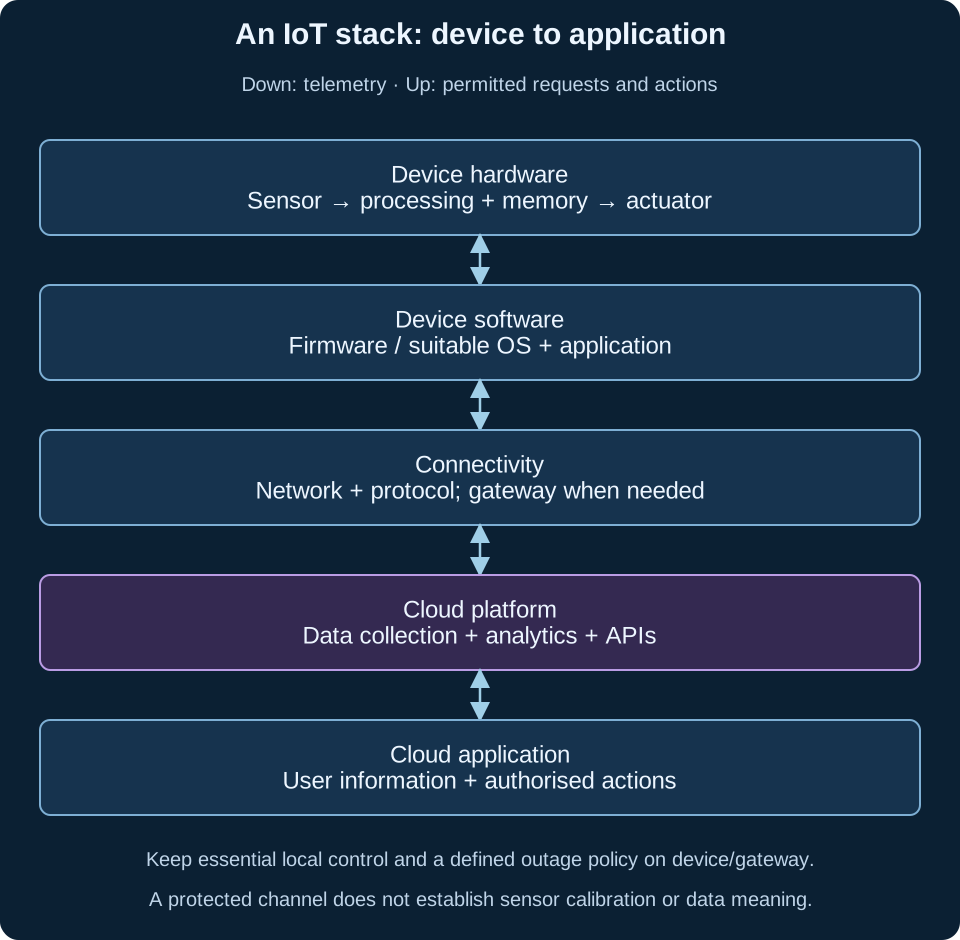
An Internet of Things system connects physical devices that collect information or act on their environment. A device may contain sensors, processing, memory, a power supply, interfaces and actuators. An analogue signal may need conversion before digital processing. The presence of a sensor alone does not make a complete networked system.
Firmware and application software determine sampling, local processing and communication. An operating system may manage resources on a suitable platform; a small MCU can also run a focused control loop without a general-purpose OS. Device software needs an update/configuration process. A battery-powered design must account for measurement, processing and radio energy, not only an advertised processor speed.
Connect the stack’s services
Connectivity supplies suitable network access and protocols. A gateway can connect local devices to a wider network and may also buffer or process their data. A cloud platform can accept device data, store it, run analytics and expose an application programming interface (API). A cloud application then presents information or performs permitted actions for its users.
Keep platform services and the user-facing application distinct in a diagram, even when one provider supplies both. Telemetry needs identifiers, timestamps, units and a defined value meaning. A number 21.5 without its unit and origin can be misinterpreted. A protected connection authenticates/protects communication under its rules; it does not prove that a faulty sensor’s physical measurement is accurate.
Design for gaps and scale
Suppose 100 devices each send one 20-byte reading per second. Their raw payload is 2000 bytes/s, or 16,000 bits/s, before protocol overhead and retries. Retaining an hour of that payload requires 7,200,000 bytes. Capacity needs also include metadata, storage layout and any period of interrupted connectivity. Define whether old samples are queued, dropped or summarised when buffers fill.
Essential local behaviour needs an outage policy rather than assuming the cloud always responds. Security requires device identity, controlled permissions, protected credentials and suitable updates, while users need an appropriate data-access policy. A complete evaluation connects these requirements to the actual workload: what must happen locally, what can wait, what evidence remains after an outage and who can issue commands.
| IoT stack role | Example responsibility |
|---|---|
| Device hardware | Measure temperature and drive an output |
| Device software | Sample, validate and manage local state |
| Connectivity | Deliver permitted messages through networks/protocols |
| Cloud platform | Collect/store data, analyse and expose APIs |
| Cloud application | Present authorised information/actions to users |
Work through the problem
Attempt the task before opening its worked response. Record each change of state, explain the rule used, and check the result against the original requirements. Code examples labelled Python 3 use that language’s conventions; pseudocode states its own assumptions.
Example 1Find the raw hourly payload for 100 devices sending 20 bytes each second.
Example 2Why can an encrypted temperature value still be unsuitable for a control decision?
Common mistakes to avoid
Key takeaways
- An IoT system combines physical and software services.
- Telemetry needs context as well as a value.
- Scale, outages and device management shape the design.
Explore further
- Pearson YCP01 official specification (opens in a new tab)
Check the International A-level requirements and relevant numbered points; this course remains in progress.
- Pearson International Computer Science subject guide (opens in a new tab)
Official introduction to the four examined units and their theory/practical purposes.
- Topic reading and reference (opens in a new tab)
Use the relevant board requirement or primary technical reference alongside the written examples.
- What is the Internet of Things? — LearnFree (opens in a new tab)
Original publisher or creator source for the embedded explanation; apply the stated viewing scope.
- What is edge computing? — IBM Technology (opens in a new tab)
Companion explanation: connect its topic to the written Pearson scope and follow-up activities.
- NIST IoT device cybersecurity baseline (opens in a new tab)
Connect device identity, access, updates and state awareness to the scenario; this is technical extension reading, not a Pearson marking checklist.
Return to this tomorrow
Close the notes and answer from memory. Revisit any explanation you cannot yet reconstruct.
- Offline buffer capacity should account for:
- Every IoT device must run a full general-purpose OS:
Test yourself
Answer a few questions, then review anything you missed.
Keep practising
Start with the quiz above to check the key ideas. You can also choose another topic from the practice library.