TCP/IP and a TLS Handshake
Distinguish delivery, reliable transport and authenticated encryption. Draw a version-specific handshake so a historical RSA key-transport explanation is not mistaken for TLS 1.3.
Before you start
- Distinguish reliable transport, key establishment, identity verification and protected application data.
- Read a message sequence and identify which information must remain secret.
Watch, pause, try
Video by F5 DevCentral Community. Use the general F5 handshake explanation with the shared AQA TCP/IP foundation. The 2018 video predates the current July 2026 RFC 9846 update; the written certificate-authenticated example and current primary reference control normative detail. TLS 1.3 has several supported key-establishment paths, and historical RSA key transport must not be inserted into the stated ephemeral example.
Viewing focus: Trace handshake roles and identity checks, then compare the written TLS 1.3 example with the older explanation.
After watching, attempt these questions before opening the answers. You can also use the written lesson below.
After watching 1: For the stated certificate-authenticated ephemeral TLS 1.3 example, organise ClientHello/key share, ServerHello/key share, encrypted server parameters/certificate/proof/Finished, client Finished and application traffic. Where does identity validation matter, and must the client send a premaster secret encrypted with the server’s RSA key?
Show answer and reasoning
The client first offers its parameters/share; ServerHello selects the exchange. Subsequent server handshake messages are protected, including the certificate/proof/Finished in this example. The client validates the intended identity and handshake proofs before completing its side; application data use derived traffic keys. Do not insert historical RSA premaster-secret transport. An RSA signing certificate can authenticate an appropriate exchange without making that older encryption step part of TLS 1.3.
After watching 2: A proposal reuses an ephemeral key_share across connections as a speed shortcut and ignores a certificate-name mismatch because traffic is encrypted. Evaluate both against the current reference and explain whether a correctly authenticated connection proves a downloaded explanation is factually true.
Show answer and reasoning
RFC 9846 explicitly forbids reusing KeyShare values between connections; fresh values matter to the stated exchange. A certificate-name mismatch undermines binding to the intended service and must not be ignored just because a cipher was negotiated. Even a correctly authenticated protected channel does not establish the truth or harmlessness of its application content, or protect decrypted data on an already compromised endpoint.
What you'll be able to do
- Compare the four-layer TCP/IP model with OSI
- Explain a certificate-authenticated TLS 1.3 handshake
- Separate encryption, identity checks and application trust
Choose and name the layered model
In the four-layer TCP/IP model used here, application combines many functions associated with OSI’s upper layers; transport supplies protocols such as TCP; internet supplies IP addressing/routing; and link covers local delivery and the underlying network access. A five-layer teaching model may separate physical from link. Declare which model a diagram uses rather than marking every different layer count as inherently wrong.
TCP provides an ordered reliable byte stream between endpoints under its protocol, using sequence and acknowledgement mechanisms. IP supplies routed packet delivery, while the link protocol handles a hop. TLS adds authenticated encryption for an appropriate connection above its underlying transport. TLS does not replace every role of TCP/IP, and a TLS record is not necessarily identical to one packet.
Trace a stated modern handshake
Consider a simplified certificate-authenticated TLS 1.3 connection. ClientHello offers supported parameters and a key share; ServerHello selects parameters and supplies a corresponding share. An ephemeral key agreement lets both sides derive shared secret material without sending the secret itself as plaintext. The server then supplies encrypted handshake information including its certificate, a proof using its signing key and a Finished message.
The client checks the server’s certificate/identity and the relevant handshake proofs, then sends its Finished. Application traffic uses derived symmetric authenticated-encryption keys. This summary omits optional/resumption paths. The current October 2026 primary reference is RFC 9846, published in July 2026, which supersedes RFC 8446 while retaining TLS 1.3. Its requirements include not reusing KeyShare values across connections. A certificate can contain an RSA signing key without TLS 1.3 using RSA to encrypt a premaster secret; that older key-transport story must be labelled as a different protocol/version model.
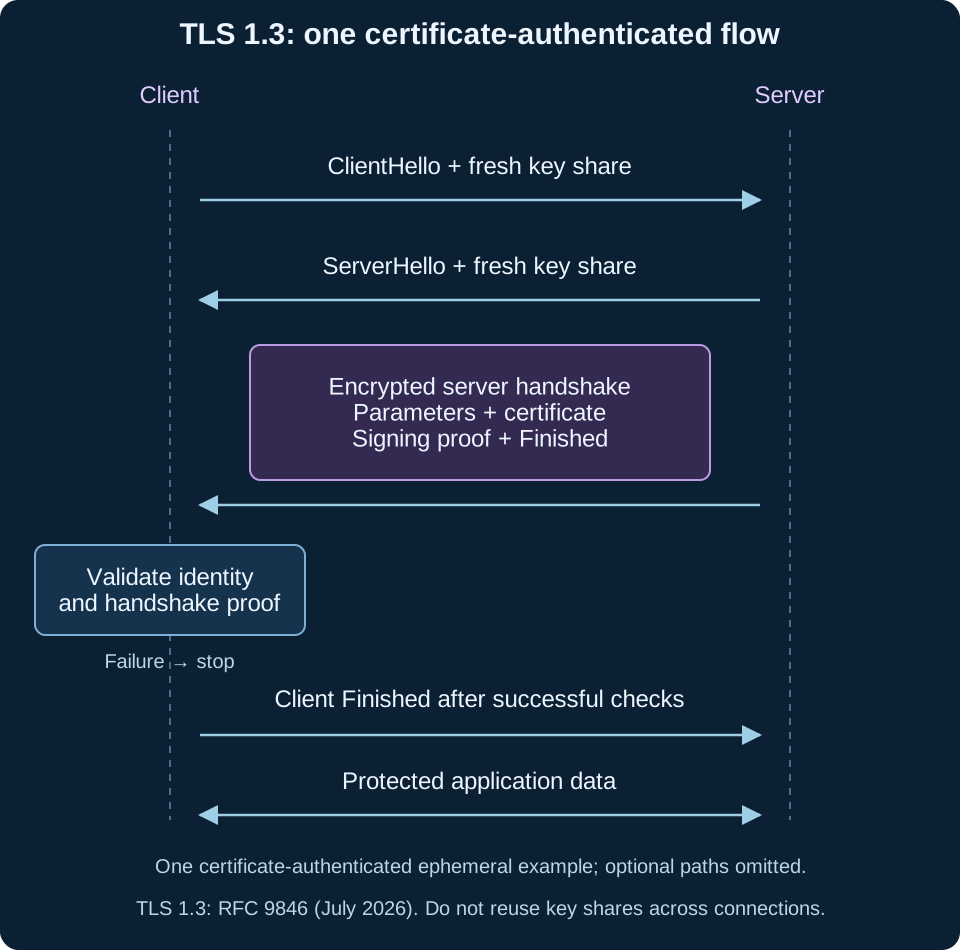
Explain the trust boundary through a failure case
Suppose the requested name is lab.example but the connection presents a certificate valid only for another name. Encryption alone does not justify accepting that identity. The client needs a suitable chain of trust and identity/name checks; merely receiving a public key from an unknown peer does not prove it belongs to the intended service. In a diagram, show validation as a decision rather than an automatic success.
A correctly authenticated encrypted connection protects the channel under its assumptions. It does not prove that an endpoint’s statements are true, that downloaded code is harmless or that a compromised endpoint will protect decrypted data. SSL is historical terminology; identify the actual TLS model being taught. An exam explanation should connect the mechanism to confidentiality/integrity/authentication without claiming it solves every application security problem.
| Stage in this simplified TLS 1.3 flow | Purpose |
|---|---|
| ClientHello / ServerHello | Negotiate supported parameters and key shares |
| Ephemeral key agreement | Derive secret material from the exchange |
| Certificate and signing proof | Support verification of server identity/possession |
| Finished messages | Confirm handshake/key-related agreement |
| Protected application traffic | Use derived authenticated-encryption keys |
Work through the problem
Attempt the task before opening its worked response. Record each change of state, explain the rule used, and check the result against the original requirements. Code examples labelled Python 3 use that language’s conventions; pseudocode states its own assumptions.
Example 1A server encrypts traffic but presents a certificate for a different name. Why is accepting it unsafe?
Example 2A diagram labels TLS 1.3 but says the client encrypts a premaster secret with the server’s RSA encryption key. Correct the model.
Common mistakes to avoid
Key takeaways
- Name the TCP/IP model and each protocol’s job.
- Use a consistent version-specific TLS flow.
- Encryption and identity checks support a channel with a defined trust boundary.
Explore further
- Pearson YCP01 official specification (opens in a new tab)
Check the International A-level requirements and relevant numbered points; this course remains in progress.
- Pearson International Computer Science subject guide (opens in a new tab)
Official introduction to the four examined units and their theory/practical purposes.
- Topic reading and reference (opens in a new tab)
Use the relevant board requirement or primary technical reference alongside the written examples.
- TLS 1.3 Handshake — F5 DevCentral Community (opens in a new tab)
Original publisher or creator source for the embedded explanation; apply the stated viewing scope.
- 147. AQA A Level (7517) SLR22 - 4.9.4 The TCP-IP stack and MAC addresses — Craig'n'Dave (opens in a new tab)
Companion explanation: connect its topic to the written Pearson scope and follow-up activities.
- TLS 1.3 current specification status (opens in a new tab)
RFC 9846, July 2026, supersedes RFC 8446 while retaining TLS 1.3; use the stated handshake mode and current requirements.
Return to this tomorrow
Close the notes and answer from memory. Revisit any explanation you cannot yet reconstruct.
- The stated TLS 1.3 flow derives secret material using:
- A certificate/key received from a peer should be:
Test yourself
Answer a few questions, then review anything you missed.
Keep practising
Start with the quiz above to check the key ideas. You can also choose another topic from the practice library.
Related lessons
All 4 lessons- Same chapterOSI Layers and EncapsulationIdentify the seven OSI layers and their roles
- Same chapterPacket Switching and Next-hop RoutingExplain packet components and store-and-forward decisions
- Same chapterDNS Hierarchy, Resolvers and CachingDistinguish client, recursive resolver and authoritative servers