RP6: Paper Chromatography and Rf
Use the approved paper, solvent and sample preparation. Place small sample spots on a pencil baseline above the initial solvent level. If a spot is submerged, the sample can dissolve directly into the reservoir rather than starting a controlled chromatographic separation. Pencil avoids introducing soluble ink from the baseline itself.
Before you start
- Use your teacher’s tier checklist: this overview can include Higher-only material, and is not a tier-specific revision list.
- AQA separate GCSE Chemistry 8462. Use this guide’s required-practical reference and the centre’s approved activity.
- Distinguish a solute, a solvent, a mixture and a pure substance.
- Use the centre’s approved supervised method, apparatus, heating and disposal arrangements. Written preparation does not replace performing and recording the practical activities.
Watch, pause, try
Video by Malmesbury Education. Use the demonstration alongside this lesson’s specification reference and written explanations.
Viewing focus: Explain the baseline, solvent front and separation mechanism
After watching, attempt these questions before opening the answers. You can also use the written lesson below.
After watching 1: Why keep the baseline above the solvent reservoir?
Show answer and reasoning
To prevent the sample dissolving directly into the reservoir. The sample needs a defined starting position on the stationary material.
After watching 2: Which distances define Rf?
Show answer and reasoning
Component and solvent distances from the same baseline. A common origin is essential.
What you'll be able to do
- Explain the baseline, solvent front and separation mechanism
- Calculate Rf using distances from a common origin
- Evaluate matching spots and limits on purity claims
Keep the sample above the initial solvent
Use the approved paper, solvent and sample preparation. Place small sample spots on a pencil baseline above the initial solvent level. If a spot is submerged, the sample can dissolve directly into the reservoir rather than starting a controlled chromatographic separation. Pencil avoids introducing soluble ink from the baseline itself.
The solvent moves through the paper, and components have different interactions with the moving solvent and stationary material. Different migration distances can separate a mixture. Use comparable conditions when placing reference samples alongside an unknown, and avoid overloading a spot so bands become difficult to distinguish.
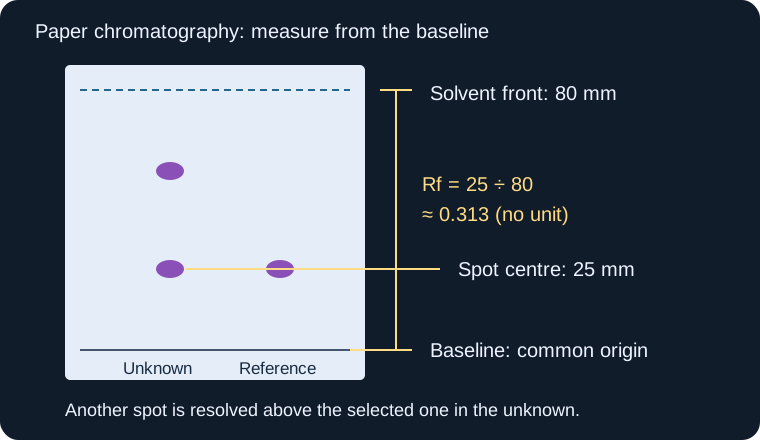
Measure from one origin
Mark the solvent front at the appropriate time before it becomes difficult to identify. Measure the component distance from the baseline to a justified spot centre and the solvent distance from that same baseline to the front. Distances from the bottom edge or from different origins cannot be combined into a valid Rf.
Rf = component distance ÷ solvent-front distance. Use the same units for both lengths; the ratio has no unit. A broad or streaked spot introduces positional uncertainty. Record the actual observations and measurement convention rather than selecting whichever edge produces an expected reference value.
Compare evidence under comparable conditions
An unknown component matching a reference spot under the same run conditions supports a possible identity. It does not uniquely prove identity because different substances can have similar migration. Rf depends on the chromatographic conditions, so comparisons across different solvents or papers need caution.
Several resolved spots support a mixture. One visible spot does not prove complete purity: components may overlap, fail to move or escape the detection method. Explain what was detected and propose a suitable further separation or detection comparison rather than treating one chromatogram as a universal chemical fingerprint.
Worked applications
Attempt these problems on paper before opening the worked reasoning. Explain your steps as well as giving a final answer.
Example 1A spot centre is 25 mm above the baseline and the solvent front 80 mm above it. Find Rf.
Example 2Two samples give one spot at the same height on one run. Is identical composition established?
Common mistakes to avoid
Key takeaways
- You can explain the baseline, solvent front and separation mechanism.
- You can calculate Rf using distances from a common origin.
- You can evaluate matching spots and limits on purity claims.
Apply it in an exam
Question 1: Two samples give one spot at the same height on one run. Is identical composition established?
Show answer and reasoning
No; the match supports a comparison but does not uniquely establish composition.
- The spots show similar migration under those conditions.
- Different components can co-migrate or remain undetected.
Explore further
- AQA 8462 official specification (opens in a new tab)
Check the assessed scope and practical or mathematical requirements.
- Read or explore this topic (opens in a new tab)
An external explanation or interactive activity to use alongside the lesson. It may include extension material.
Return to this tomorrow
Close the notes and answer from memory. Revisit any explanation you cannot yet reconstruct.
- Which distances define Rf?
- Does a single visible spot prove complete purity?
Test yourself
Answer a few questions, then review anything you missed.
Keep practising
Start with the quiz above to check the key ideas. You can also choose another topic from the practice library.
Related lessons
All 8 lessons- Same chapterRP1: Pure, Dry Soluble-Salt CrystalsExplain excess insoluble reactant, filtration and crystallisation
- Same chapterRP2: Strong Acid–Alkali TitrationExplain measured delivery and endpoint technique
- Same chapterRP3: Aqueous Electrolysis with Inert ElectrodesExplain electrode polarity and charge movement