RP8: Water Analysis and Purification
Compare defined sample volumes using the specified pH, residue or other approved tests. Keep the preparation and measurement conditions comparable and record raw observations. An evaporated residue indicates material that remains under that method; a clear-looking sample can still contain dissolved substances.
Before you start
- Use your teacher’s tier checklist: this overview can include Higher-only material, and is not a tier-specific revision list.
- AQA separate GCSE Chemistry 8462. Use this guide’s required-practical reference and the centre’s approved activity.
- Distinguish dissolved solutes, suspended solids and the meaning of potable water.
- Use the centre’s approved supervised method, apparatus, heating and disposal arrangements. Written preparation does not replace performing and recording the practical activities.
Watch, pause, try
Video by Malmesbury Education. Use the demonstration alongside this lesson’s specification reference and written explanations.
Viewing focus: Compare measurements of different water samples
After watching, attempt these questions before opening the answers. You can also use the written lesson below.
After watching 1: What can ordinary filtration remove most directly?
Show answer and reasoning
Suitable suspended insoluble particles. A dissolved substance is not generally trapped like an insoluble particle.
After watching 2: What is collected in a suitable simple distillation?
Show answer and reasoning
Condensed vapour from the heated mixture. Track vaporisation and condensation.
What you'll be able to do
- Compare measurements of different water samples
- Explain filtration, evaporation and simple distillation
- Distinguish evidence of chemical purity from suitability for drinking
Make sample comparisons fair
Compare defined sample volumes using the specified pH, residue or other approved tests. Keep the preparation and measurement conditions comparable and record raw observations. An evaporated residue indicates material that remains under that method; a clear-looking sample can still contain dissolved substances.
pH describes an acid–base property, not the identity or concentration of every dissolved material. A neutral pH does not establish that a sample is safe to drink. Use the particular observation to answer the question it can address rather than turning one measurement into a complete water-quality judgement.
AQA RP8 includes pH, dissolved-solids analysis and distillation of water from different sources. Compare those required observations rather than replacing the activity with a visual clarity check alone.
Explain what each separation removes
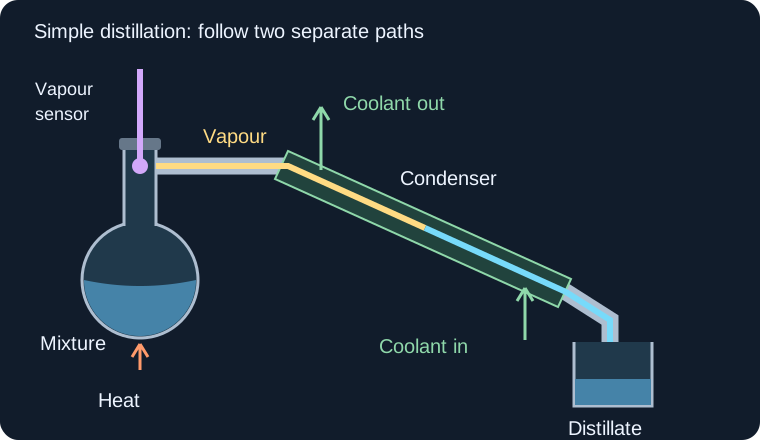
Filtration can remove appropriate insoluble particles but does not normally remove dissolved salts. Evaporation can leave a non-volatile solute behind while losing the solvent. Simple distillation instead vaporises a volatile component and condenses it into a separate receiver, allowing suitable solvent recovery.
Use the centre’s approved apparatus and heating arrangement. Follow the vapour path, cooling and collection rather than assuming that the receiving liquid is produced by filtration. Distillation can reduce non-volatile dissolved contamination, but other volatile substances may also pass over. An apparatus must be used according to its actual separation limits.
Distinguish potable from chemically pure
Potable water is suitable for drinking under the relevant treatment and assessment system; it need not contain only water molecules. Chemical purity describes composition. A classroom pH reading, absence of visible residue or one successful distillation does not by itself certify a drinking-water sample.
Use approved supplied samples and do not taste laboratory water as a test. Evaluate volume recovery, residue and the observations required by the practical without assuming every possible contaminant has been checked. Explain a specific limitation and identify the kind of additional evidence needed for a broader claim.
Worked applications
Attempt these problems on paper before opening the worked reasoning. Explain your steps as well as giving a final answer.
Example 1Evaporating 50.0 cm³ of a sample leaves 0.020 g residue. Estimate residue per dm³ for a representative sample under the method.
Example 2A distillation recovers 18 cm³ from an initial 25 cm³ liquid sample. Find percentage volume recovery.
Common mistakes to avoid
Key takeaways
- You can compare measurements of different water samples.
- You can explain filtration, evaporation and simple distillation.
- You can distinguish evidence of chemical purity from suitability for drinking.
Apply it in an exam
Question 1: A distillation recovers 18 cm³ from an initial 25 cm³ liquid sample. Find percentage volume recovery.
Show answer and reasoning
72% volume recovery.
- Recovery = 18/25 × 100.
- This is a recovery measure, not a chemical-purity percentage.
Explore further
- AQA 8462 official specification (opens in a new tab)
Check the assessed scope and practical or mathematical requirements.
- Read or explore this topic (opens in a new tab)
An external explanation or interactive activity to use alongside the lesson. It may include extension material.
Return to this tomorrow
Close the notes and answer from memory. Revisit any explanation you cannot yet reconstruct.
- What is collected in a suitable simple distillation?
- Does neutral pH prove a sample is potable?
Test yourself
Answer a few questions, then review anything you missed.
Keep practising
Start with the quiz above to check the key ideas. You can also choose another topic from the practice library.
Related lessons
All 8 lessons- Same chapterRP1: Pure, Dry Soluble-Salt CrystalsExplain excess insoluble reactant, filtration and crystallisation
- Same chapterRP2: Strong Acid–Alkali TitrationExplain measured delivery and endpoint technique
- Same chapterRP3: Aqueous Electrolysis with Inert ElectrodesExplain electrode polarity and charge movement