Loading...
11.1.4Advanced Systems and RepresentationCore
MIMD, SIMD and Parallel Speedup
Identify what can run independently and what must still happen in order. Match multiple instruction streams or repeated data operations to suitable processing resources.
What you'll be able to do
- Distinguish MIMD and the syllabus SIMD GPU model
- Explain multicore and GPU workload suitability
- Calculate a speedup limit from serial work and overhead
1
Distinguish work streams
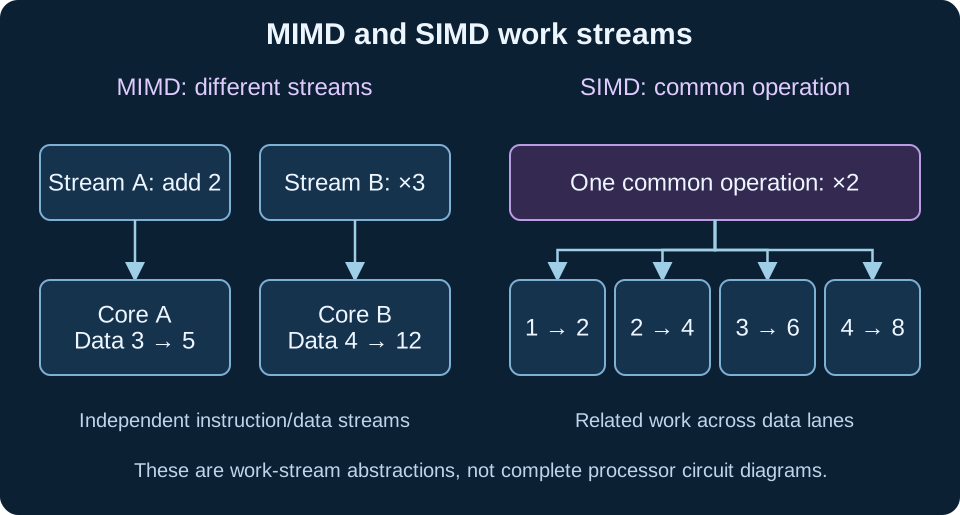
MIMD means multiple instruction streams operating on multiple data streams. Multicore CPU resources can run different threads or tasks, for example one handling requests while another processes an independent calculation. Software, scheduling and data dependencies determine whether the available cores can perform useful work simultaneously. Several ready tasks on one core may be interleaved concurrently without executing at the same physical instant.
SIMD means a common instruction operation applied to multiple data elements. The syllabus uses this model to explain GPU-style data parallelism: many pixels, vertices or numerical values can undergo related operations. Actual GPU execution models include further scheduling and control-flow detail; a simple SIMD diagram is a useful abstraction rather than a complete description of every device.
2
Match the hardware to the data flow
A large image filter can apply similar calculations across many pixels, offering substantial parallel work. A short decision chain in which each step depends on the previous result may offer little independent work. Irregular branches, unequal task sizes and limited memory bandwidth can leave processing resources waiting. A larger core count does not eliminate a program’s dependencies.
Moving data between host and accelerator, starting work and returning results can cost time. If a GPU calculation takes 2 ms but preparation/transfers take 8 ms, its total is 10 ms. Compare that with the complete CPU route, not just the 2 ms arithmetic kernel. Keeping reusable data near the processing resource can improve an appropriate workload, but capacity and access patterns still constrain it.
3
Account for the serial part
Suppose 30% of original execution time is inherently serial and 70% can be divided perfectly over four processors with no overhead. Normalised time becomes 0.30+0.70/4=0.475, giving speedup 1/0.475≈2.11. Four processors do not give four times the speed. Even infinitely many ideal processors cannot reduce the serial 0.30 part, giving a model limit of approximately 3.33.
Real communication, synchronisation and imbalance add further costs. Shared state may require coordination to prevent races, and measuring throughput is different from measuring one request’s latency. A useful recommendation identifies the independent units, their data movement, the serial section and the resource overhead. Support it with the question’s evidence rather than claiming a GPU is best simply because it has many processing resources.
| Model feature | MIMD multicore example | SIMD-style data example |
|---|---|---|
| Instruction streams | Different tasks/threads can differ | One common operation across lanes |
| Data | Separate task data, possibly shared state | Many related data elements |
| Useful workload | Independent varied tasks | Large repeated numerical/image operations |
| Potential limits | Serial dependencies and synchronisation | Data movement, divergence and memory bandwidth |
4
Work through the problem
Attempt the task before opening its worked response. Record each change of state, explain the rule used, and check the result against the original requirements. Code examples labelled Python 3 use that language’s conventions; pseudocode states its own assumptions.
Example 1Estimate four-processor speedup with a 30% serial fraction and ideal division of the rest.
1Retain 0.30 serial time.
2Divide 0.70 by four, giving 0.175.
3Add to get 0.475 and invert.
AnswerApproximately 2.11 times, before real coordination and transfer overhead.
Example 2A CPU completes a whole task in 6 ms. A GPU calculation takes 2 ms plus 8 ms preparation/transfers. Which is faster for this invocation?
1Count the GPU route’s complete 10 ms.
2Compare it with the CPU route’s complete 6 ms.
3Do not compare only the accelerator’s arithmetic time.
AnswerThe CPU route is faster here; a different workload or data-reuse pattern could change the result.
Common mistakes to avoid
Equating concurrent scheduling on one core with simultaneous execution on many cores.
Distinguish interleaving from physical parallel work.
Ignoring transfers when comparing CPU and accelerator time.
Include the complete path and identify any reusable resident data.
Key takeaways
- MIMD and SIMD describe different work-stream organisations.
- Dependencies and data movement constrain parallel benefit.
- Serial work limits speedup even in an ideal model.
Test yourself
Answer a few questions, then review anything you missed.
Next step
Browse practice topicsKeep practising
Start with the quiz above to check the key ideas. You can also choose another topic from the practice library.