Loading...
11.1.5Advanced Systems and RepresentationCore
Embedded System Design and Control
Design the whole sensing-to-action path. Explain why each component is needed, what the control software must do and how the system behaves when an input or connection fails.
What you'll be able to do
- Connect sensors, processing, memory, interfaces and actuators
- Compare a microprocessor with a microcontroller
- Justify firmware, operating-system and power choices
1
Follow the physical information
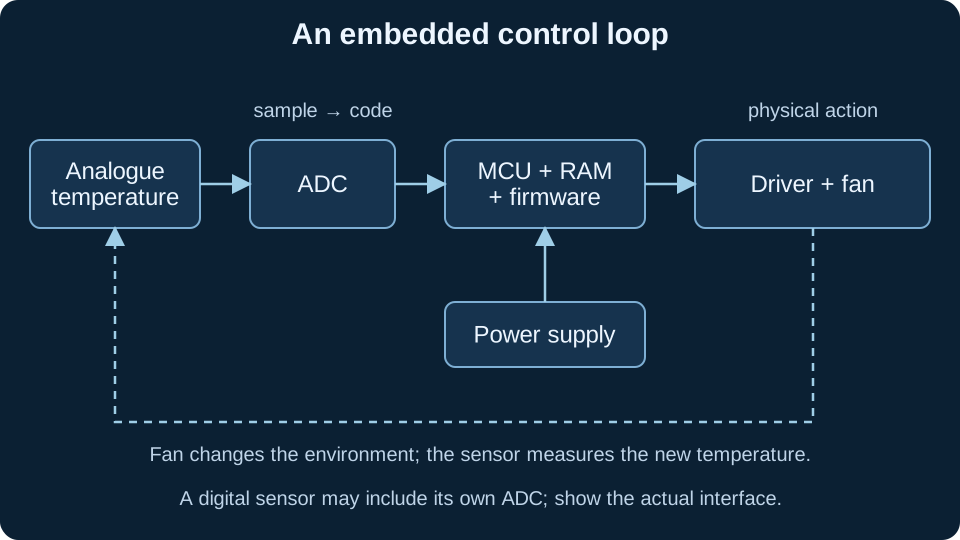
An embedded computer performs a role within a larger device. A greenhouse ventilation controller receives temperature readings, compares them with a control rule and drives a fan or motor. Label the input, processing and output in a diagram: a sensor measures a physical quantity; an actuator changes the physical environment. A display or network message reports information but does not replace the motor that opens a vent.
Match the sensor to the measurement: an accelerometer can measure acceleration and orientation-related changes, a vibration sensor can monitor a machine, and sound and temperature sensors suit different signals. Some sensors supply analogue voltages requiring an ADC; others contain conversion circuitry and communicate digitally. An actuator can require a power driver rather than direct connection to a low-current processor pin.
2
Choose an appropriate processing platform
A microcontroller unit (MCU) typically integrates a processor core, memory and peripheral interfaces on one chip. This can reduce component count, board area and power for a focused control task. A microprocessor commonly relies on more external memory and peripheral support and may suit more demanding processing. Actual devices vary, so justify the chosen resources instead of claiming that every MCU is slower than every microprocessor.
Identify non-volatile storage for program firmware, RAM for current readings and state, I/O ports for sensors and outputs, and a suitable power supply. A battery design needs an energy budget: average power depends on active work, sleep periods and communication. Networking introduces credentials, update and outage requirements. A controller that must ventilate locally should retain its essential control loop when a cloud service cannot be reached.
3
Turn requirements into a control rule
Suppose the fan turns on at 30°C and stays on until temperature falls to 27°C. This hysteresis avoids repeated on/off switching when a noisy reading sits near a single threshold. The algorithm needs to retain the previous fan state, read a validated measurement, apply the appropriate threshold and set the output. A missing or implausible reading needs a specified fault response rather than silently becoming a valid zero.
Firmware supplies persistent device software. A simple loop may run without a general-purpose OS; a more complex design may use a real-time OS to manage several tasks and deadlines. C/C++ can offer hardware control and predictable resource use, while Python variants can support suitable higher-level devices. The language alone does not prove that deadlines will be met: consider execution time, I/O delays and the platform.
| Component | Greenhouse role | Design question |
|---|---|---|
| Temperature sensor | Measures input | Accuracy, range and sampling interval? |
| ADC or digital interface | Transfers readings to processing | Analogue or already digital? |
| MCU and memory | Runs control and retains state | Required RAM, firmware and deadlines? |
| Driver and fan | Acts on the environment | Electrical load and safe fault state? |
| Power supply | Maintains operation | Peak demand and battery life? |
4
Work through the problem
Attempt the task before opening its worked response. Record each change of state, explain the rule used, and check the result against the original requirements. Code examples labelled Python 3 use that language’s conventions; pseudocode states its own assumptions.
Example 1The fan is off. Readings are 29, 30, 29, 28, 27°C. Trace the stated hysteresis rule.
1At 29 it remains off; at 30 it turns on.
2While on, 29 and 28 do not cross the lower turn-off threshold.
3At 27 it turns off.
AnswerOff, on, on, on, off.
Example 2A proposal puts the entire ventilation decision in a remote cloud function. Identify a missing requirement and improve it.
1Network loss may prevent a timely control decision.
2Specify a local control/fault policy, with remote monitoring or set-point updates as additional services.
AnswerEssential control must meet its local availability and timing requirements even during the defined outage cases.
Common mistakes to avoid
Treating a sensor and actuator as interchangeable.
Trace measurement into the controller and physical action out.
Naming components without explaining their connections.
Follow the signal, power and control paths for the actual scenario.
Key takeaways
- Embedded design connects physical inputs to controlled outputs.
- Choose processing, memory, power and interfaces together.
- Define state, timing and fault behaviour in the control software.
Test yourself
Answer a few questions, then review anything you missed.
Next step
Browse practice topicsKeep practising
Start with the quiz above to check the key ideas. You can also choose another topic from the practice library.