Loading...
11.3.1Advanced Systems and RepresentationCore
IEEE Binary16: Fields and Decoding
Read a half-precision floating-point value by separating its sign, biased exponent and stored fraction. Establish the format before doing any arithmetic.
What you'll be able to do
- Identify the three fields of IEEE 754 binary16
- Decode positive and negative normal values
- Distinguish a biased exponent from a signed exponent
1
Start with the actual format
Pearson’s International A-level uses IEEE 754 half precision, also called binary16. Its sixteen bits comprise one sign bit, five exponent bits and ten stored fraction bits. Group a bit string as s | EEEEE | FFFFFFFFFF before reading its value. The exponent field is an unsigned integer with bias 15; it is not a five-bit two’s-complement number.
For a normal finite value, exponent codes 1 through 30 represent powers −14 through 15. Subtract 15 from the stored exponent E to find the actual exponent. The sign bit selects a positive or negative value; a negative value is not obtained by complementing all sixteen bits. These rules belong to this format and must not be replaced by another board’s signed-mantissa model.
2
Restore the leading one
For a normal value, the significand is 1.f in binary. Only the fraction after the point is stored, because the leading 1 is implied. If the ten-bit fraction field has unsigned integer value F, that fraction is F/1024. There are therefore eleven significant binary digits of precision for a normal number, although only ten fraction bits appear in the stored field.
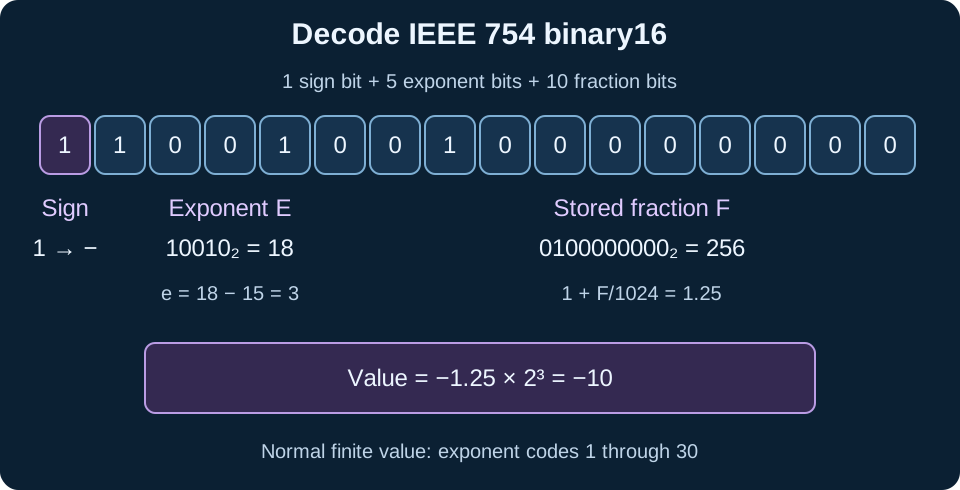
Use the place values 1/2, 1/4, 1/8 and so on to read the fraction directly. With stored fraction 0100000000, the restored significand is 1.01₂, equal to 1.25. With exponent field 10010₂=18, its scale is 2³. A sign bit of 1 gives −1.25×8=−10. Check the magnitude before applying the sign.
Normal finite binary16 values only: 1 ≤ E ≤ 30.
3
Classify before substituting
Exponent codes 00000 and 11111 have special meanings. Do not feed either into the normal-value formula with an implied leading 1. The next lesson on limits explains zeros, subnormals, infinities and NaNs. A reliable conversion begins with field boundaries and exponent classification, continues with the significand and scale, and ends with a sign and reasonableness check.
A useful check is that a normal significand lies from 1 inclusive to 2 exclusive. With actual exponent 3, its positive magnitude must lie from 8 inclusive to 16 exclusive. A claimed result of 0.625 for those fields is inconsistent. Practise both reading a supplied sixteen-bit string and assembling the fields from a labelled table.
| Field | Stored bits | Meaning |
|---|---|---|
| Sign | 1 | Negative |
| Exponent | 10010 | 18 − 15 = 3 |
| Fraction | 0100000000 | 1/4; restored significand 1.25 |
| Value | 1 | 10010 | 0100000000 | −10 |
4
Work through the problem
Attempt the task before opening its worked response. Record each change of state, explain the rule used, and check the result against the original requirements. Code examples labelled Python 3 use that language’s conventions; pseudocode states its own assumptions.
Example 1Decode 0 | 10000 | 1010000000.
1The exponent is 16−15=1.
2The restored significand is 1.101₂=1+1/2+1/8=1.625.
3Apply the positive sign and multiply by 2¹.
Answer3.25.
Example 2A learner interprets 10010 as −14 using two’s complement. Explain and correct the error for 1 | 10010 | 0100000000.
1Binary16 stores the exponent as an unsigned biased code.
210010₂ is 18; subtract the bias 15 to obtain 3.
3The fraction restores 1.01₂=1.25 and the sign is negative.
AnswerThe value is −10; the exponent is +3, not −14.
Equation recap
Normal finite binary16 values only: 1 ≤ E ≤ 30.
Common mistakes to avoid
Using two’s complement for the stored IEEE exponent.
Read an unsigned exponent code and subtract bias 15.
Forgetting the implicit leading 1.
Restore 1.f only for a normal finite exponent code.
Key takeaways
- Split the word into 1, 5 and 10 bits.
- Normal exponent codes use a bias of 15.
- Restore the leading 1, apply the scale, then the sign.
Test yourself
Answer a few questions, then review anything you missed.
Next step
Browse practice topicsKeep practising
Start with the quiz above to check the key ideas. You can also choose another topic from the practice library.